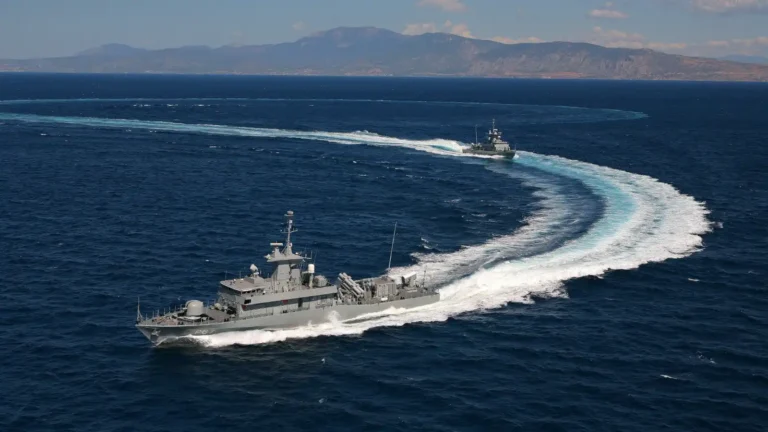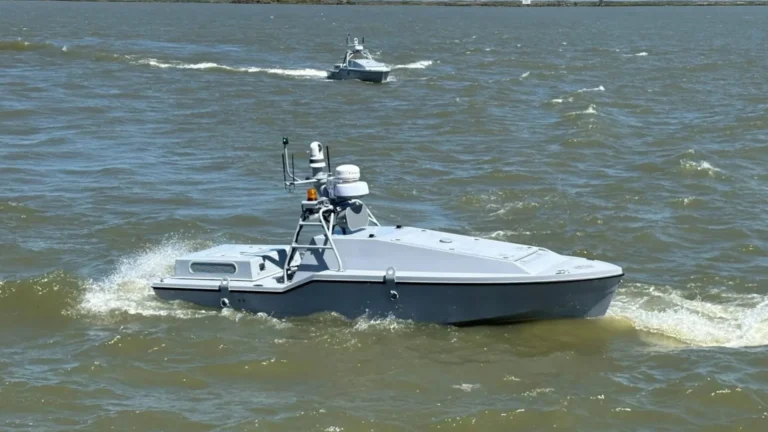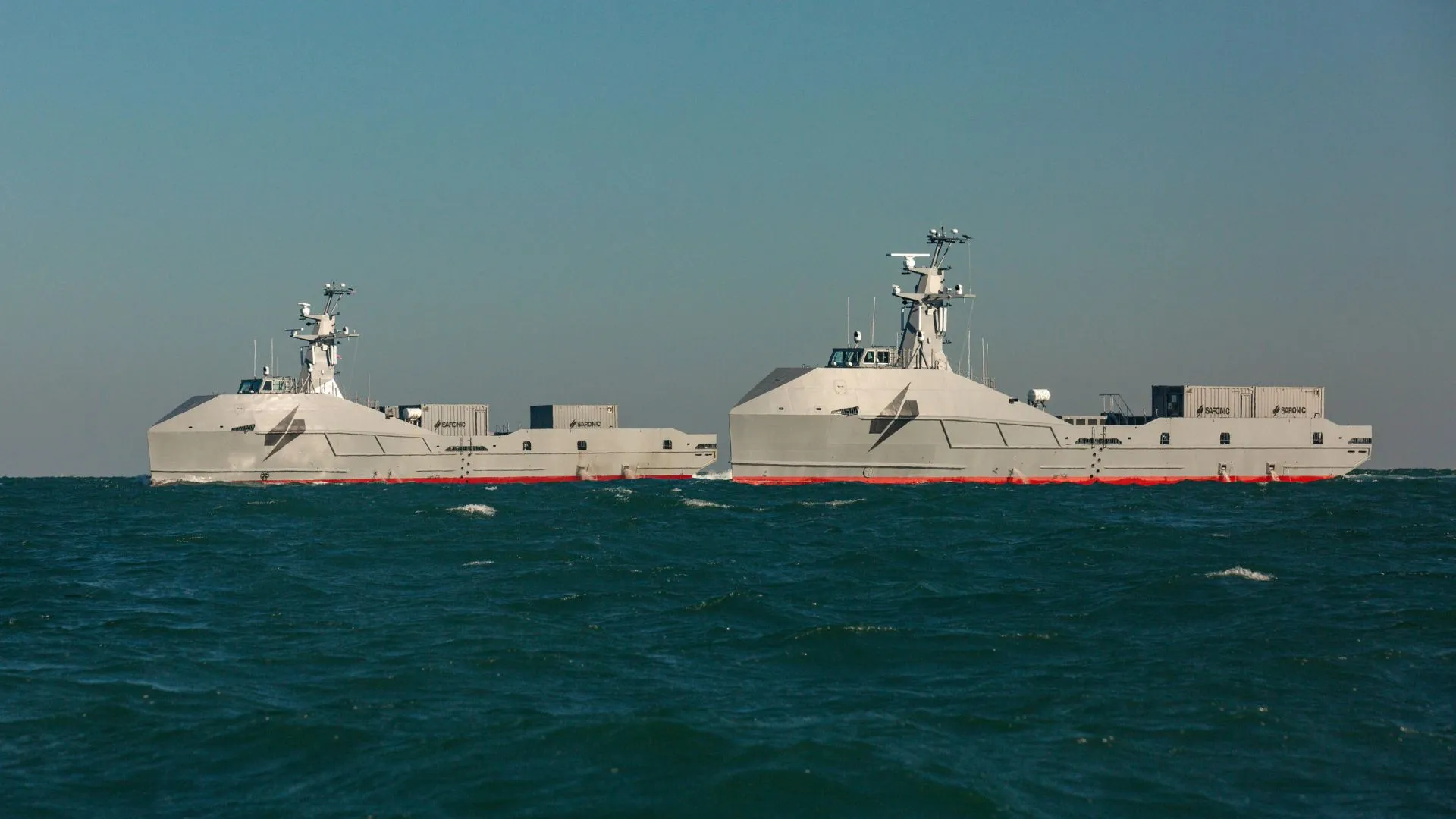
Saronic Technologies released an image on X on November 19, 2026, showing two of its Marauder medium unmanned surface vessels (MUSV) underway together in the Gulf. The caption read: “Look who brought a friend to the Gulf today.” The photo shows both hulls running in company, each carrying ISO containers on its aft mission deck. The production Marauder ordered by the Navy is a 180-foot design that Saronic rates at more than 25 knots, with up to 150 metric tons of containerized payload.
The two-ship sortie comes 16 days after the Austin, Texas-based company announced the launch of its second Marauder at its Franklin, Louisiana shipyard, and seven weeks after the US Navy awarded Saronic a production Other Transaction agreement for 10 Marauders under the MUSV Marketplace. The September 29, 2026 awards covered 30 hulls split evenly among Saronic, Huntington Ingalls Industries (HII), and Galliano Marine Services. The Navy cited an average procurement cost of about $40 million per vessel, implying roughly $1.2 billion across the buy, but individual award values were not disclosed.
Saronic Marauder Specifications: Payload, Range, and Autonomy
Saronic lists Marauder at 180 feet (54.9 meters) overall, with an aluminum hull designed from the keel up to operate without a crew, either fully autonomously or under remote human supervision from ashore. Saronic unveiled Marauder as a 150-foot design in April 2025 and enlarged it to 180 feet by December 2025, when it said its first two hulls under construction followed the 150-foot design and that the third would introduce the longer configuration. Top speed exceeds 25 knots. At a 12-knot cruise, Saronic quotes a range of up to 5,400 nautical miles with a 25-metric-ton load, falling to about 4,100 nautical miles at the maximum payload of 150 metric tons.
That payload sits on an open mission deck sized for four 40-foot or eight 20-foot ISO containers. The containerized approach lets operators swap mission modules, from logistics and intelligence, surveillance, and reconnaissance (ISR) to communications relay and decoys, without redesigning the hull. Saronic and Castelion plan a containerized launch of Castelion’s Blackbeard hypersonic missile from a Marauder in 2027, which would turn the vessel into a distributed strike node rather than a pure logistics carrier.
Chief executive Dino Mavrookas said in September 2025 that Saronic’s ships, including the then 150-foot Marauder, are built around seven or eight major components: water jets, engines, fuel tank, bow thrusters, sensors, a large computer, and the payload. Stripping out crew systems is central to the production logic. Saronic has not disclosed installed power, engine make, or the composition of its sensor suite beyond radar and passive perception.
During the Navy’s Phase I at-sea evaluation, Marauder completed more than 140 test scenarios over eight days of continuous operations without failure, according to the company. Trials covered autonomous tracking and maneuvering around other vessels and passive-perception runs in which the ship had to detect, track, and follow traffic without active radar, a requirement with direct relevance to emissions-controlled operations in contested waters.
Franklin Shipyard Scales Toward 20 Marauder Hulls a Year
Saronic acquired the Gulf Craft yard in Franklin in April 2025, pledging more than $250 million to modernize it, and announced a $300 million expansion of the site in December 2025. The first Marauder hull was flipped in December 2025 and launched in May 2026, less than a year after initial design. The second hull, flipped in March 2026, required 8% fewer labor hours to build than the first, according to Mavrookas. A third hull had been flipped by late September, with further hulls on the line. At full rate, the company expects Franklin to deliver 20 Marauders per year.
The yard is one piece of a wider industrial push. Saronic already holds a Navy production agreement for its 24-foot Corsair autonomous surface vessel, and in September 2026 it was one of three builders selected for Landing Craft Utility (LCU) 1700 prototype agreements, which carry a combined initial obligation of about $280.5 million. Those landing craft are slated for Port Alpha, a shipyard of more than $3 billion that Saronic is developing in Brownsville, Texas, with operations expected to begin in 2028.
Saronic did not say whether the November 19 sortie involved coordinated autonomous maneuvering between the two ships, whether either carried a safety crew, or where in the Gulf the pair was operating.
Analysis: For the Navy’s MUSV strategy, a second hull at sea matters more than any single specification. The Marketplace model shifts development and production risk onto industry and rewards builders that can show repeatable output, and a falling labor-hour curve between hull one and hull two is the earliest hard evidence of that repeatability. Two ships operating together also open the door to the multi-vessel work, including teaming, relay, and distributed sensing, that the Navy’s hybrid manned and unmanned fleet concept depends on. The open question is whether payload integration keeps pace with hull production: a 150-ton container deck delivers value only once the Navy fields the mission modules to fill it.
The next milestones are the first production deliveries under the MUSV award, expected before the end of fiscal year 2027, and the Blackbeard launch demonstration planned for the same year. The Navy has also opened MUSV Phase II, issuing a new call for solutions on September 23, 2026, which will bring additional competitors into the Marketplace. Contract values, delivery schedules for the 10 Saronic hulls, and the mission packages the Navy intends to field remain undisclosed.