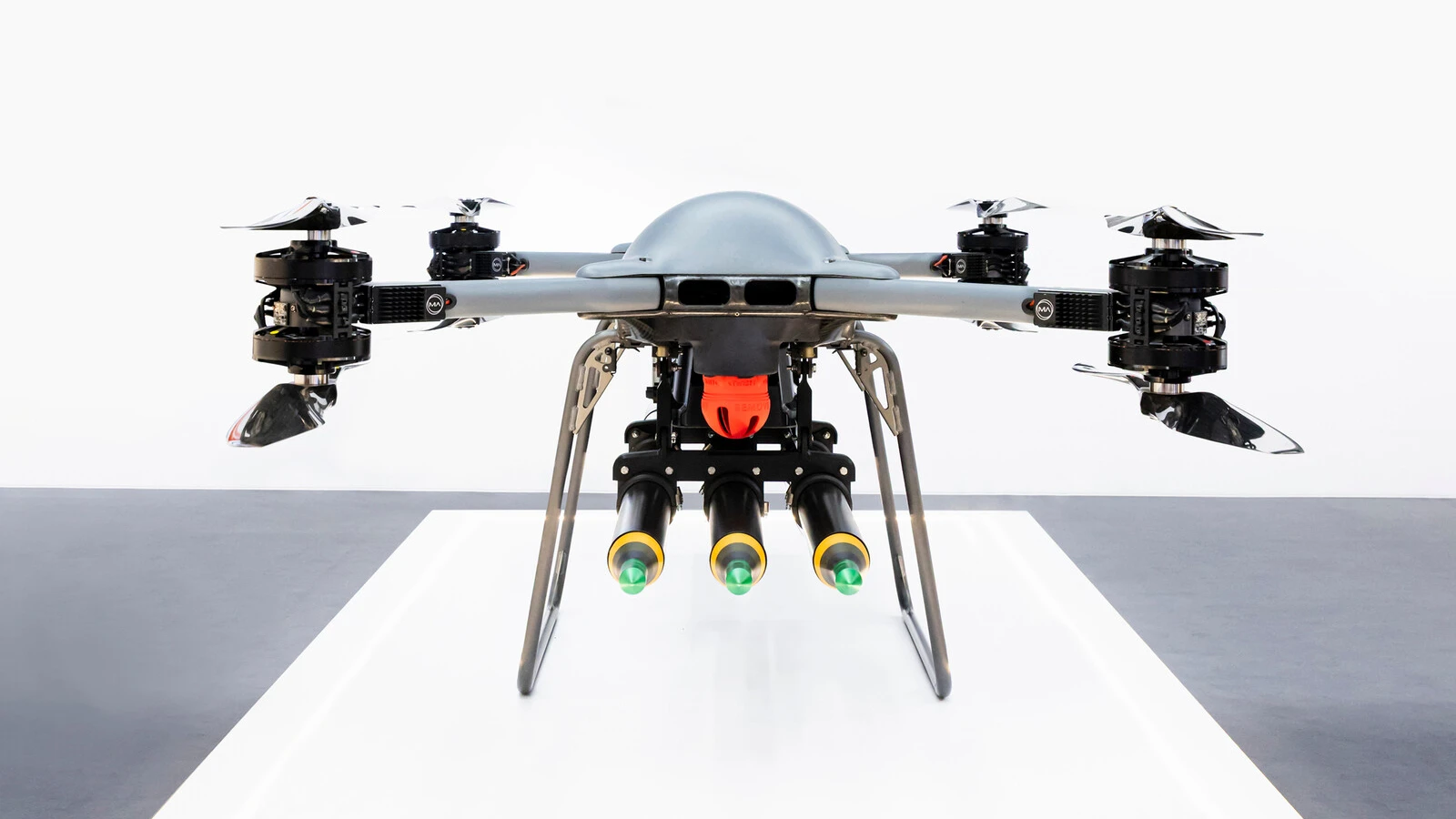
A weaponized variant of the BAE Systems Malloy Aeronautics T-150 heavy-lift drone, designated TRV-150, intercepted multiple one-way attack drones with laser-guided Advanced Precision Kill Weapon System (APKWS) rockets at Eglin Air Force Base, Florida, in late September 2026, BAE Systems announced on October 21, 2026. Carrying a production-ready three-pod launcher, the uncrewed air system (UAS) engaged several targets in succession without landing or reloading.
The live-fire event formed part of the Mission Capabilities Joint Readiness Experimentation exercise run by the Office of the Under Secretary of War for Research and Engineering (OUSW R&E). It is the latest step in a test campaign that began with a single-shot APKWS launch from the drone at Dugway Proving Ground in May 2025, and it arrives as US and allied forces search for interceptors priced closer to the drones they are meant to kill.
How the TRV-150 Drone Engaged Multiple Targets in One Sortie
BAE Systems said the TRV-150 fired its rockets against air targets in succession during a single mission. The company has not disclosed how many drones were engaged, the engagement ranges achieved, or whether the rockets carried the proximity fuze BAE developed for counter-UAS work. Nor has it said whether targets were lased from the drone or by an off-board designator.
The integration is a two-company effort. SURVICE Engineering, the Maryland-based firm that builds and markets Malloy drones in the United States, adapted the T-150 to US Army requirements, while the BAE Systems FalconWorks division developed and integrated the APKWS modification kit. “Our customers are facing drone threats right now,” said Thomas Lancashire, head of UAS business development at FalconWorks, adding that the partners had moved at pace to a system able to engage multiple targets per mission.
Eglin caps a test sequence that has run for more than a year. In May 2025, at US Army Dugway Proving Ground in Utah, a TRV-150 achieved the first air-to-air engagement of an APKWS round from a UAS, hitting air and ground targets with no misses, results BAE Systems announced in July 2025. On May 20, 2026, the US Army flight-tested the three-pack launcher at Fort Rucker, Alabama, live-firing a rocket. The Army then slated the system for tier-two experimentation events at White Sands Missile Range, New Mexico, in June and at Eglin in September.
T-150 Airframe and APKWS Guidance: Payload, Range, and Launch Envelope
The T-150 is an all-electric octocopter with four arms carrying two coaxial rotors each. Publicly available specifications list a length of 2.64 meters, a width of 2.03 meters, a maximum payload of 68 kilograms, a top speed of 30 meters per second (about 108 km/h) and endurance of up to roughly 36 minutes depending on load. Malloy quotes a range of 13 to 37.5 kilometers, falling toward the lower figure at full payload. Hot-swappable batteries allow rapid turnaround.
APKWS converts unguided 70 mm (2.75-inch) Hydra 70 rockets into precision munitions by inserting the WGU-59/B mid-body guidance section, whose semi-active laser seeker optics deploy about half a second after launch. Because the seeker acquires the laser spot in flight, the round does not need to lock on before firing, which shortens reaction time against fast-closing drones. A complete round weighs roughly 15 kilograms by open-source estimates, so three rockets consume about two-thirds of the T-150 lift capacity before the launcher is counted. That load will cut range and loiter time.
Fired from helicopters, APKWS has a published range of 1.1 to 5 kilometers; fixed-wing launches at speed extend that to about 11 kilometers. A hovering multirotor imparts little launch energy, so the TRV-150 envelope is likely closer to the rotary-wing figures, although BAE has published no data from Eglin. Cost drives the case: the guidance section is estimated at around $15,000, against just under $420,000 for an AIM-9X Block II Sidewinder per Pentagon budget documents.
From TRUAS Logistics Drone to Battalion-Level Counter-UAS Asset
The TRV-150 starts from a fielded logistics airframe rather than a clean-sheet interceptor. The US Marine Corps ordered 21 TRV-150C systems for its Tactical Resupply Unmanned Aircraft System (TRUAS) requirement in April 2023 and declared initial operational capability that November. The US Army describes the TRV-150 as a program of record with both services. In the United Kingdom, the Royal Navy declared the T-150 ready for front-line operations in September 2025, and the drone carried supplies between ships throughout the Carrier Strike Group’s eight-month Indo-Pacific deployment that year.
That installed base shortens the path from experiment to fielding. Units already trained to operate and maintain the airframe could receive a strike or counter-UAS kit rather than a new aircraft. Clark Dutterer, vice president of business development at SURVICE, said in a US Army release that APKWS is currently deployed from the AH-64 Apache and other exquisite assets at corps level and above, and that the TRV-150 brings the effect down to battalion level. SURVICE President Gregory Thompson described APKWS on the TRV-150 as “a proven, precise, and cost-effective capability.”
Analysis: The TRV-150 is not a substitute for layered air defense; it is a magazine-depth and cost-exchange tool. Three rounds per sortie, a laser designation requirement and endurance measured in tens of minutes make it a point-defense asset for forward bases, convoys or ships rather than an area shield. Its value lies in pairing munitions already in inventory with an airframe already in service, letting a maneuver commander kill a cheap drone without spending a high-end interceptor. The open question is the kill chain. Whether the target is lased from the drone, from a second UAS or by a ground team will determine how fast existing counter-UAS radars can cue the system and how many simultaneous threats it can handle.
BAE Systems said the partners will now extend the concept to the maritime environment to protect customers from similar threats at sea. No procurement decision, contract value or fielding timeline for an armed TRV-150 has been announced by the US Army, the Marine Corps or the UK Ministry of Defence. The next markers are whether the Eglin results feed a formal counter-UAS requirement, whether the three-pod launcher is offered as a kit for existing TRV-150C fleets, and whether the Royal Navy tests the configuration at sea.