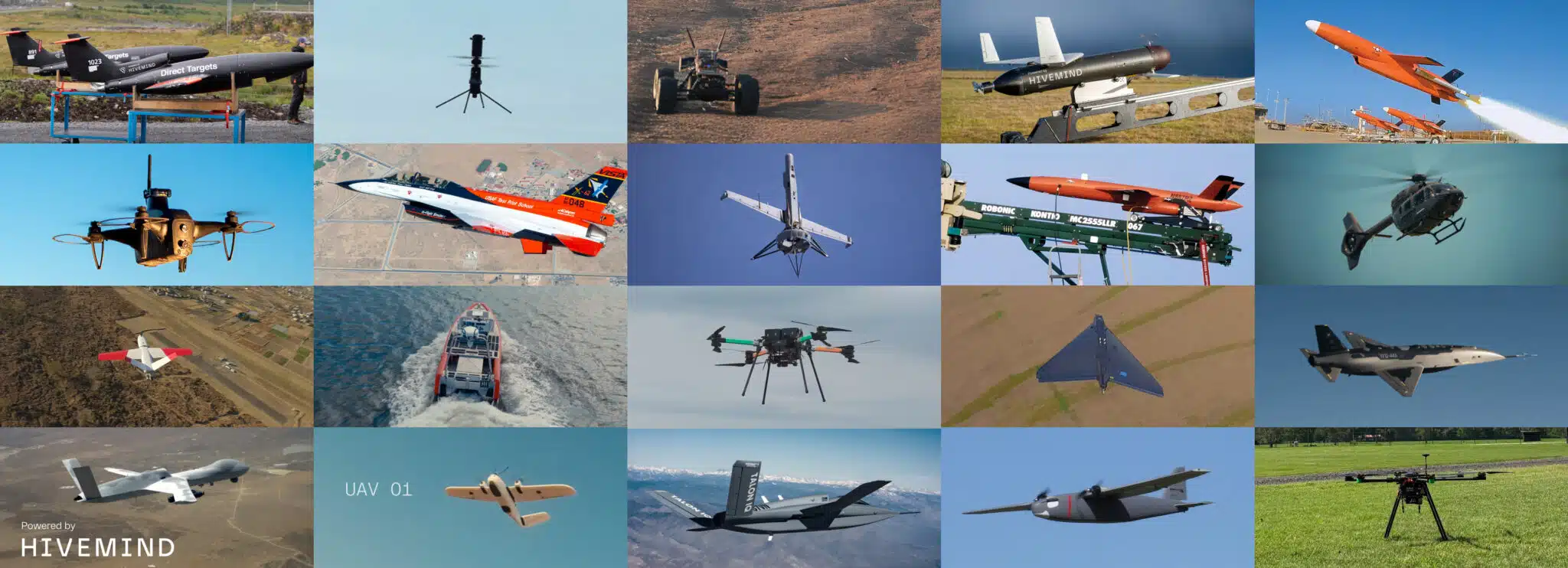
Shield AI on October 22, 2026, detailed how its Hivemind mission autonomy software is designed to earn operator trust when an unmanned aircraft loses its datalink mid-mission. The company described three mechanisms: assurance layers validated at simulation scale before deployment, an independent onboard run-time assurance (RTA) monitor during flight, and a governed retraining loop after landing. Engineering Fellow Chris Barngrover wrote the post.
The timing matters. On June 17, 2026, the US Air Force awarded Collaborative Combat Aircraft (CCA) Increment 1 production contracts for the General Atomics FQ-42A and the Anduril FQ-44A, and placed six firms, including Lockheed Martin and Northrop Grumman, on a six-year mission autonomy contract vehicle. Only Anduril, RTX Collins Aerospace and Shield AI received production options funding the first of two six-month competitive phases, with a single primary autonomy provider for Increment 1 due by summer 2027. Hivemind has flown aboard Anduril’s YFQ-44A Fury since February 2026 under the government-owned Autonomy Government Reference Architecture (A-GRA), which separates mission software from the airframe.
How Shield AI Hivemind Splits Autonomy Into Assurance Layers
Barngrover anchors the argument in a single intelligence, surveillance and reconnaissance (ISR) scenario. An aircraft tracking a ground vehicle loses it under a tree line, then loses its communications link while searching. With the operator unable to intervene, the autonomous pilot must choose its next action from mission objectives and incomplete data. Shield AI argues operators need not predict each decision, only see evidence that decisions stay inside defined safety and operational boundaries.
To produce that evidence, Shield AI conceptually divides the autonomous pilot into assurance layers mapped to its perceive, reason, decide and act functions. Assurance gates check each stage’s output, and an independent safety layer enforces critical limits regardless of what upstream functions propose. Testing layers separately lets engineers localize weaknesses. In simulation, they test whether a reasoning gate blocks a route through a designated keep-out zone and whether the safety layer prevents flight dangerously close to terrain.
The tree-line search is then rerun thousands of times while engineers vary visibility, terrain, sensor performance, target behavior and link availability. Gates assess whether each new search pattern is likely to reacquire the target and whether the airframe can physically fly it, catching faults such as a turn beyond the performance envelope or a route into rising terrain before the software reaches the field. The output is a map of where performance holds and where it degrades. That logic tracks Department of Defense Directive (DoDD) 3000.09, which since January 25, 2023, has required autonomous and semi-autonomous weapon systems to undergo rigorous verification and validation and realistic test and evaluation. Shield AI disclosed no run counts, coverage metrics or pass thresholds.
Run-Time Assurance and the ASTM F3269 Safety Monitor Model
Testing cannot cover conditions nobody simulated. In flight, Hivemind relies on RTA, which resides in the independent safety layer onboard the aircraft. It evaluates each command the AI pilot proposes before that command reaches the flight controller, checks it against safety constraints and blocks anything outside them. If the planner concludes that a sharp descent offers the best chance of reacquiring the vehicle but the maneuver would breach terrain clearance, RTA rejects it and steers the aircraft toward an approved alternative or a safe state.
The principle is established in aviation assurance. ASTM F3269, first issued in 2017 and revised in 2021, defines an RTA architecture in which a trusted monitor bounds complex functions, including machine learning components, that conventional software assurance processes such as RTCA DO-178C cannot practically certify. Certification effort then concentrates on a comparatively simple monitor rather than on the adaptive planner it supervises. Shield AI’s post does not cite the standard, and the company has not said whether its implementation conforms to it.
The relevance to contested airspace is direct. When electronic warfare (EW) cuts the datalink, the operator’s veto disappears and the onboard monitor becomes the sole enforcement layer. Shield AI’s August post states that after a lost link the platform executes predefined mission logic and approved contingency behaviors without establishing a new objective. Both published RTA examples, however, are flight-safety constraints. Shield AI has not described how the monitor would handle engagement-related constraints on armed platforms such as CCA, where scrutiny under DoDD 3000.09 will concentrate.
Autonomy Factories and Keeping the Assurance Case Intact After Updates
After landing, the loop turns to learning. In Barngrover’s scenario, mission data shows the perception model tracked the vehicle reliably on open road but degraded once the target was partially obscured by trees. That data returns to what Shield AI calls a field-deployed autonomy factory, which an August 13 post by Hivemind Enterprise Vice President Tom Schaefer described as a governed pipeline for evaluating, assuring and releasing new capabilities. The model does not retrain itself mid-mission.
Shield AI says it is building tools that would let operators use that data to improve recognition of partially hidden vehicles, rerun the tree-line scenario against the updated model and confirm through regression testing that other perception functions are unaffected. Because layers are assured separately, the company argues, a perception update leaves safety-layer evidence intact and the assurance case grows rather than restarting. Shield AI’s shorthand for the cycle is “Fly. Learn. Improve. Test. Validate. Fly again.” The capability remains in development and has not been fielded.
Simulation fidelity governs that loop. On March 26, 2026, Shield AI announced the acquisition of Aechelon Technology, a specialist in high-fidelity visual simulation and physics-based sensor modeling, alongside a $1.5 billion Series G round and $500 million in preferred equity at a $12.7 billion post-money valuation. The deal closed in June 2026. Aechelon’s tools support the Pentagon’s Joint Simulation Environment (JSE), which Chief Executive Gary Steele highlighted in announcing the deal. The October post illustrates a four-agent Hivemind wide-area search demonstration built on NVIDIA Cosmos 2 and Aechelon simulation.
What Hivemind’s Assurance Case Means for the CCA Autonomy Competition
Analysis: The post reads as an assurance case aimed at the CCA autonomy down-select. The Air Force’s award fee structure ties payment for mission autonomy to operator feedback and combat performance, and A-GRA lets software move between airframes. Under those terms, the differentiator shifts from one-off flight demonstrations to how quickly a vendor can regenerate credible evidence after each software change. Layered architectures, run-time monitors and large-scale simulation are established practice rather than proprietary advantages; owning Aechelon gives Shield AI tighter control over the evidence pipeline itself. The harder test is regulatory. For autonomous weapon systems subject to senior review, DoDD 3000.09 requires a new review when a modified version’s algorithms, mission set or operating environment substantially differ from the approved baseline, and frequent operator-driven updates will probe that threshold. Scale cuts both ways: Shield AI says Hivemind has been integrated on more than 30 platforms, so an undetected regression could spread as fast as an improvement.
The first funded competitive phase, which began June 17, runs to roughly mid-December 2026. The Air Force then plans to assess vendor progress and down-select to one or two vendors for a second six-month phase before naming the Increment 1 primary provider by summer 2027, with a large-scale mission autonomy fly-off planned at roughly the three-year point. Shield AI has published no quantitative assurance data; whether that changes before the down-select is the next marker to watch.