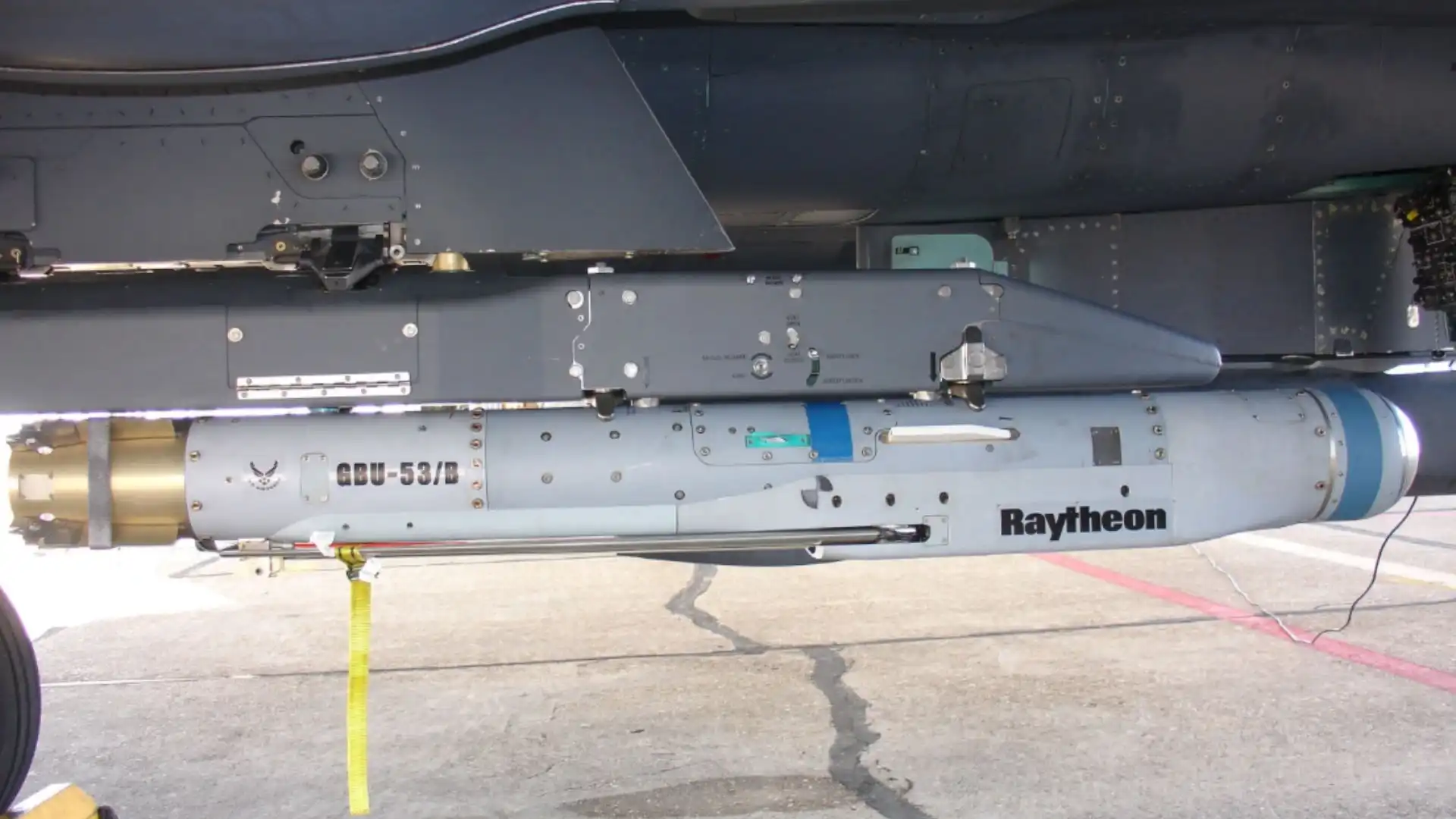
The U.S. Air Force has raised the ceiling of Raytheon’s StormBreaker life cycle support contract by $350 million, lifting the cumulative face value of the vehicle from $600 million to $950 million. The modification (P00014) to contract FA8672-19-D-0001, announced by the Pentagon on October 22, 2026, covers life cycle support for the GBU-53/B Small Diameter Bomb II (SDB II). Work will be performed in Tucson, Arizona, and is expected to be completed by December 31, 2030. No funds were obligated at the time of award. The Air Force Life Cycle Management Center (AFLCMC) at Eglin Air Force Base, Florida, is the contracting activity.
The action extends a contract that has outgrown its original scope several times. AFLCMC awarded the sole-source indefinite-delivery/indefinite-quantity (IDIQ) contract, designated Small Diameter Bomb II Life Cycle Support Contract III, in September 2019 with a $200 million ceiling and a September 30, 2024, completion date. A $75 million increase followed in May 2022, and modification P00010 added $325 million in July 2024. The latest increase lands as the weapon’s user base widens: the U.S. Navy cleared StormBreaker for operational use on the F/A-18E/F Super Hornet in February 2026, and in April 2026 Raytheon received a not-to-exceed $708.9 million undefinitized contract action for Production Lot 12, including deliveries to eight partner nations.
Inside the $950 Million StormBreaker Life Cycle Support Contract
Life cycle support is distinct from munitions production. Under the scope defined at the original award, the contract covers weapon integration, production support, sustainment, testing, obsolescence analysis and management, logistics, training, upgrades, and software updates. It also funds studies on future performance growth, modeling and simulation, test hardware, aircraft integration activities, and repair of non-warranted assets.
A ceiling increase with no obligated funds is contractual headroom, not new spending. It allows AFLCMC to issue task orders against the vehicle through December 31, 2030, with actual expenditures depending on future orders and appropriations. The announcement does not specify how the additional $350 million will be distributed across integration, sustainment, and software work; that breakdown remains unknown.
The extension also overlaps with planning for a successor vehicle. The SDB II Program Office at Eglin has published a sources-sought notice (FA8672-26-R-B001) for a seven-year, sole-source IDIQ covering SDB II and its variants, referred to as IDIQ 4. The Air Force has not publicly stated how work will transition between the two contracts or when the follow-on award is expected.
Tri-Mode Seeker, Datalink, and the F-35 Integration Roadmap
Much of the support burden stems from the weapon’s architecture. Publicly available specifications indicate the GBU-53/B weighs about 208 pounds (94 kilograms), measures 69 inches (175 centimeters) in length, and has a maximum diameter of roughly 7 inches. Pop-out wings give it a glide range exceeding 40 nautical miles against fixed targets, with a shorter envelope against moving targets.
Midcourse guidance combines GPS and inertial navigation with a two-way Link 16 and UHF datalink, allowing aircrews or third-party controllers to update target coordinates or abort after release. In the terminal phase, a tri-mode seeker blends millimeter-wave radar, uncooled imaging infrared, and digital semi-active laser homing, enabling strikes on moving targets through weather, smoke, and dust. Open sources describe a multi-effects warhead of roughly 105 pounds combining blast, fragmentation, and shaped-charge effects. Each seeker algorithm, datalink message set, and aircraft interface requires continuous software maintenance, which is precisely the work this contract funds.
The weapon’s small footprint drives its operational value. Carried on the BRU-61/A four-place rack, it allows an F-15E Strike Eagle to load up to 28 rounds. StormBreaker has been fielded on the F-15E since 2020; the Navy cleared it for operational use on the Super Hornet in February 2026 and declared initial operational capability on the type by mid-2026. Integration across F-35 variants, tied to the Block 4 modernization effort, continues; the UK Ministry of Defence, which approved a Foreign Military Sales buy for its F-35B fleet in May 2026, does not expect that capability before the early 2030s.
Analysis: The contract’s growth from $200 million to $950 million tracks StormBreaker’s shift from a single-platform U.S. weapon to a multinational inventory spread across three fighter families and a growing roster of allied F-35 operators. Sustainment demand scales with every aircraft integration, software baseline, and partner configuration, and the December 2030 horizon covers the window in which internal carriage on the F-35 must mature. For the Air Force, StormBreaker remains one of the few weapons able to engage moving targets in adverse weather from inside a stealth fighter’s weapons bay, a core requirement for contested scenarios in the Indo-Pacific. The program’s reliance on a single engineering and production source in Tucson, however, concentrates industrial risk on one line.
Key markers to watch include task orders issued against the new ceiling, the timing and value of the IDIQ 4 award, definitization of the Lot 12 production action, and F-35 Block 4 integration milestones.