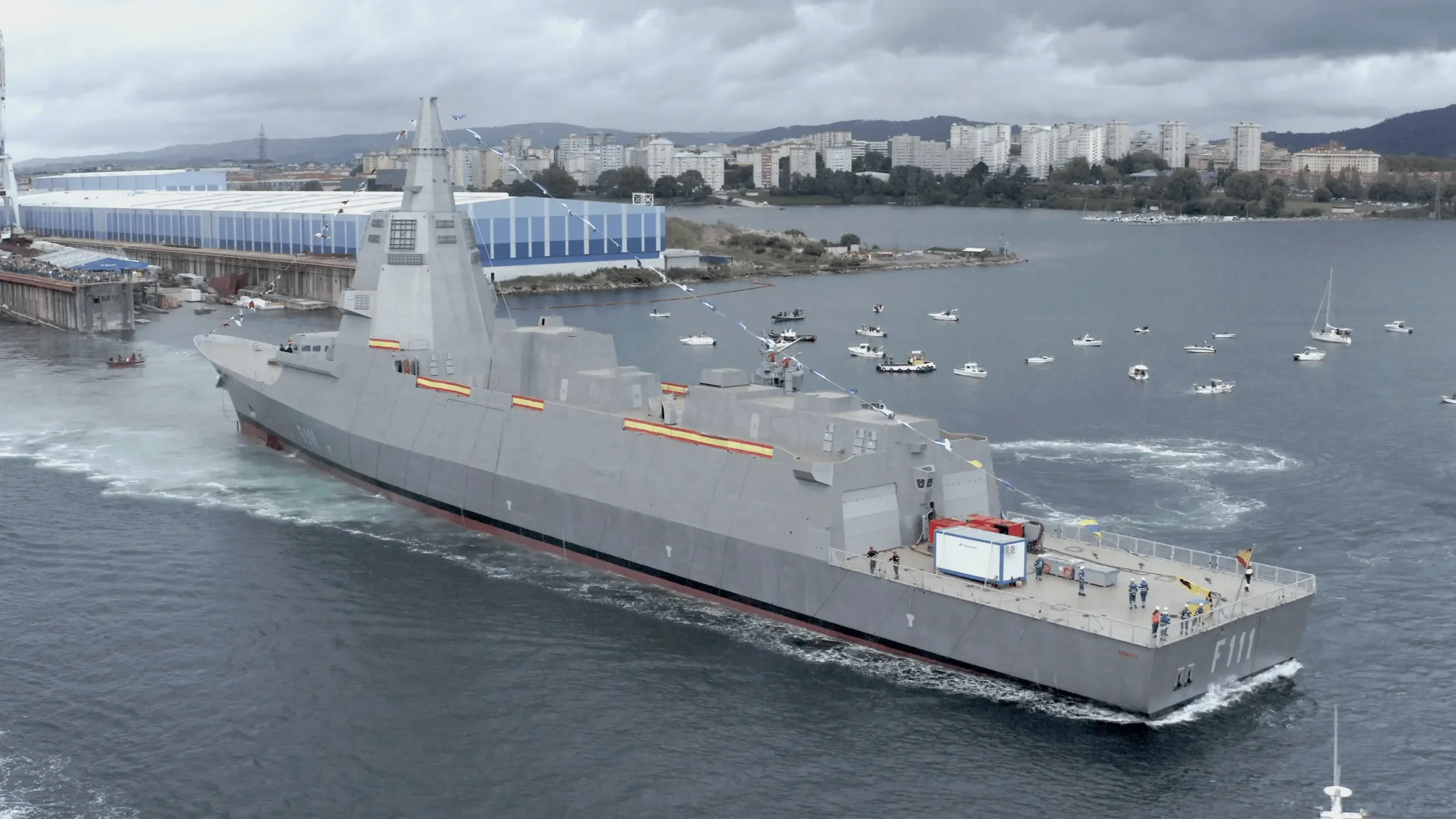
The Spanish Navy and Navantia are jointly defining an integrated air and missile defense (IAMD) variant of the F110 frigate, the state-owned shipbuilder said on October 23, 2026. The proposed ship would extend the Bonifaz class beyond the five hulls under construction at Ferrol and engage aircraft, cruise missiles and ballistic missiles simultaneously, built around expanded vertical launch system (VLS) capacity.
The work follows requirements the Navy set out in its Armada 2050 strategy document, presented in Madrid in December 2024. The five Bonifaz-class frigates, ordered under a €4.317 billion contract signed on April 23, 2019, replace the six Santa María-class frigates that entered service from 1986. Lead ship Bonifaz (F111) was launched on September 11, 2025, more than 70% complete, and is due for delivery in 2028, with one hull following each year through Barceló (F115) in 2032.
F110 IAMD Frigate Requirements: Area Defense and a Deeper Magazine
Navantia assigns the variant three missions: area air defense, escort of high-value assets and coordination of air defense across a naval task group. That last role moves the ship from self-protection to managing a formation’s air picture, a task the Navy now assigns to its five F100 Álvaro de Bazán-class frigates.
Navantia said the expanded VLS would accommodate different missile types, with loadouts adapted to each mission. It did not disclose cell counts, interceptor selections or how many additional ships are under consideration. The Navy, the Ministry of Defense and Navantia will set the final configuration through the requirements and procurement process.
Navantia has, however, marketed an export concept designated F110 Flight II, or IAMD, shown as a scale model at Denmark’s DALO Industry Days earlier this year. That design carries 64 Mk 41 cells, 48 strike-length cells forward of the bridge and 16 tactical-length cells ahead of the helicopter hangar, against 16 cells on the baseline ship. It measures roughly 150 meters, about 5 meters longer than Bonifaz, displaces around 6,700 tonnes at full load against roughly 6,100 tonnes, and has a maximum speed above 29 knots. Strike-length cells are the Mk 41 configuration needed for the largest weapons in the family, including the Standard Missile-3 and Tomahawk.
Whether Spain’s configuration matches those figures is unconfirmed. Specialist press reporting from DALO, citing an industry source, said two Flight II ships would join the Spanish Navy alongside the five Bonifaz-class hulls. The ministry has not confirmed that number, and Navantia’s October 23 statement gave no ship count.
SCOMBA New Generation Moves Fleet Air Defense Into a Combat Cloud
The baseline F110 pairs Navantia’s sovereign SCOMBA (Sistema de Combate de los Buques de la Armada) combat management system with Lockheed Martin’s AN/SPY-7(V)2 radar and International Aegis Fire Control Loop (IAFCL), the latter supplied through a US Foreign Military Sales (FMS) case. Navantia describes this as the foundation of the frigate’s air defense, coordinating tracks, doctrine and engagements in one architecture. The SPY-7(V)2 is an S-band solid-state multifunction radar housed in an integrated mast.
The IAMD variant would move to SCOMBA New Generation, a cloud-hosted system linking sensors, weapons, uncrewed vehicles, onboard systems and data links. Navantia says a shared tactical picture within a naval combat cloud would coordinate air defense across the force, with data exchange across NATO, European Union and joint multi-domain networks. The architecture is built to absorb new sensors, weapons and countermeasures as missile and drone threats evolve.
The radar matters for the ballistic mission. The SPY-7 family, derived from Lockheed Martin’s Long Range Discrimination Radar technology, also equips Japan’s Aegis System Equipped Vessels, built for ballistic missile defense, and Canada’s River-class destroyers. Navantia’s export concept adds an enhanced SPY-7 arrangement and a dedicated counter-drone capability whose sensor remains unnamed.
Bonifaz Class Baseline: Anti-Submarine Suite and Digital Twin Carried Forward
Navantia says the variant keeps the baseline ship’s anti-submarine and anti-surface warfare capabilities, its electronic warfare suite, its protection against asymmetric threats and a multi-mission space for mission modules, a second helicopter and uncrewed vehicles. Publicly available specifications for Bonifaz indicate a Leonardo 127/64 LW Vulcano 127mm gun, two quadruple Kongsberg Naval Strike Missile launchers, two Mk 32 Mod 9 torpedo launchers, and 16 Mk 41 cells holding quad-packed RIM-162 Evolved Sea Sparrow Missile (ESSM) Block 2 rounds, for up to 64 interceptors. Propulsion is a combined diesel-electric or gas (CODLOG) plant built around a single General Electric LM2500 gas turbine, with electric drive for quiet submarine hunting. Navantia said the IAMD ship would gain speed and endurance for extended deployments.
On the baseline ship, the Integrated Services System links sensors, internal communications and services to the Integrated Platform Management System and a Digital Twin that draws on shipboard data to support maintenance, operations and crew training. For the IAMD variant, Navantia ties digital-twin technology and condition-based maintenance to higher availability and through-life efficiency. Development would draw on a domestic network of more than 500 companies, alongside technology centers and universities.
Analysis: The variant addresses the baseline F110’s most visible constraint. Sixteen cells of short-range ESSM make Bonifaz a capable anti-submarine escort with credible self-defense, not an area air defense ship, and the five F100 frigates that fill that role entered service between 2002 and 2012 with 48 Mk 41 cells and the older AN/SPY-1D radar. A stretched F110 with SPY-7 and up to 64 cells would give Spain a route to sea-based ballistic missile defense without a clean-sheet destroyer, while keeping hull, combat system and supply chain commonality across the frigate fleet. The decisive variable is the interceptor: on an Aegis-derived architecture, ballistic engagements point to weapons such as the Standard Missile-6 or Standard Missile-3, and no selection has been made public.
The next decisions sit with the Ministry of Defense: a formal configuration, a ship count, a funding line and, for any US interceptors, FMS approval. None has a published date. On the baseline program, the keel of Menéndez de Avilés (F113) was laid in July 2026, seven months ahead of contract. The timing of an IAMD order will decide whether Ferrol moves straight from F115 to the new variant or faces a gap.