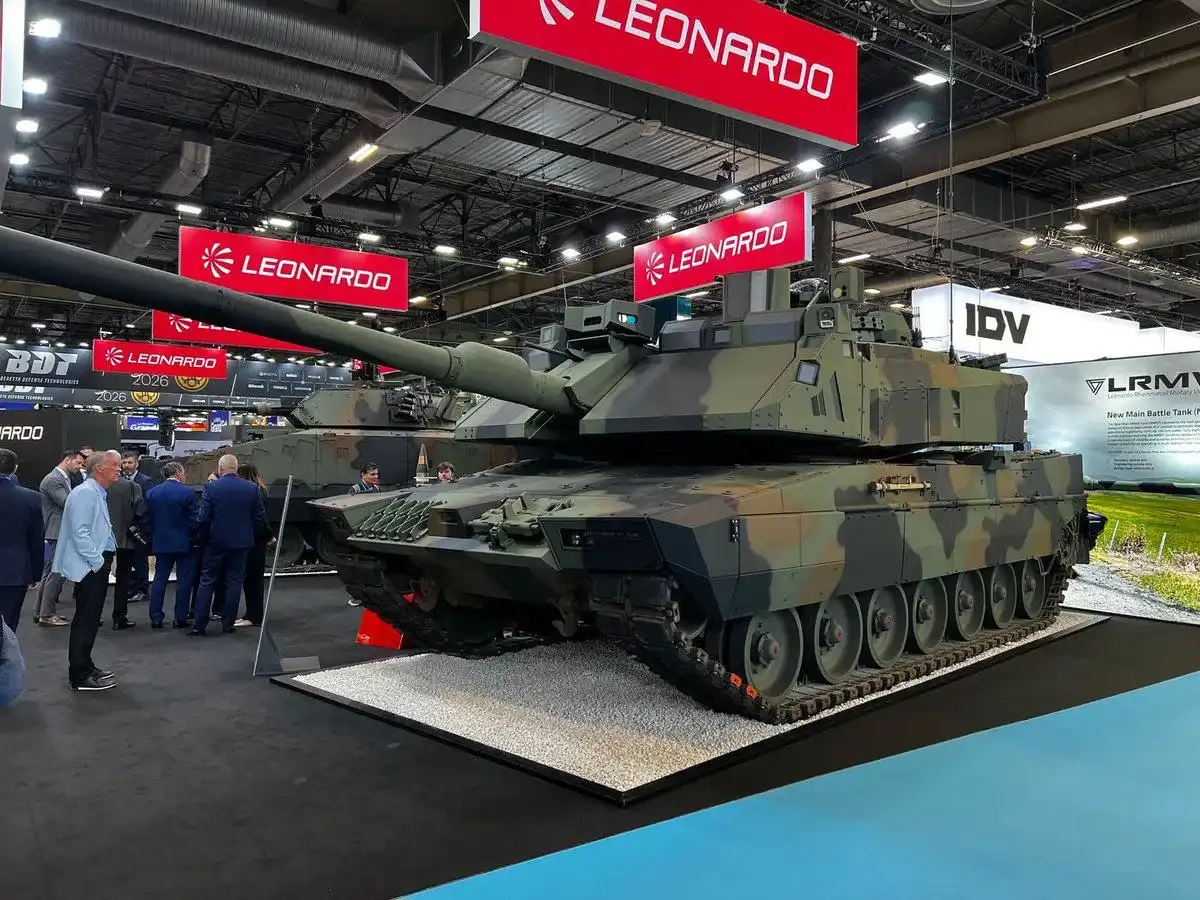
Italy’s Ministry of Defence has reportedly awarded Leonardo Rheinmetall Military Vehicles (LRMV) two contracts worth a combined €3.7 billion ($4.16 billion), covering the first production tranche of the Italian Main Battle Tank (I-MBT) and 30 additional Lynx KF41 infantry fighting vehicles, according to Italian financial daily MF, which first reported the awards on October 21, 2026. Neither company has formally confirmed the signature. Rheinmetall declined to comment, and Leonardo CEO Lorenzo Mariani said he could not confirm it “as any communication on the matter must be coordinated with our clients.”
The orders move Italy’s heavy armor renewal from demonstrators to series production. The broader effort, valued at about €23.2 billion through 2040, calls for 132 I-MBTs, 140 derivative vehicles on the same chassis, and roughly 1,050 Army Armoured Combat System (A2CS) vehicles in 16 variants. Those fleets will replace the C1 Ariete tank, in service since the mid-1990s, along with the VCC-80 Dardo and M113 tracked carriers. The need is concrete: in a January 2025 parliamentary hearing, Army Chief of Staff Gen. Carmine Masiello put average Ariete readiness at around 30 percent.
Inside the Leonardo Rheinmetall Contracts: 48 I-MBT Platforms, 30 Lynx
The larger award is the first I-MBT production contract, valued at €3.4 billion with options worth a further €850 million, according to Italian defense industry reporting. It covers 48 tracked platforms: 26 tanks in the combat configuration and 22 derivative vehicles in recovery, engineering and bridge-laying roles. Italian defense press places the signature in early October, and the ministry has not published the contract. Mariani had signaled the scale on September 5, when he said the first tank contract would be worth around €3.4 billion.
The second award exercises the 30-vehicle option embedded in LRMV’s first A2CS contract of November 5, 2025. That contract covered 21 vehicles: five Lynx KF41 with Rheinmetall’s Lance turret and 16 with Leonardo’s two-person Hitfist 30mm turret. The first four Lance-equipped vehicles reached the Army at the Montelibretti test center near Rome on January 27, 2026. The option lifts the initial fleet to 51 vehicles, enough to equip a full evaluation battalion. No value has been published for the Lynx tranche; the reported totals imply roughly €300 million.
LRMV, a 50-50 joint venture formed in October 2024 with its registered office in Rome and operations in La Spezia, splits each contract equally between Leonardo and Rheinmetall. Rheinmetall passes about 10 percent of total value to its Rheinmetall Italia subsidiary, which brings the share of work performed in Italy to roughly 60 percent.
Italianizing Panther and Lynx: Guns, Turrets and Protection
The I-MBT derives from Rheinmetall’s KF51 Panther, but Rome has diverged on the main armament. Where the baseline Panther carries a 130mm smoothbore gun, the Italian tank retains a 120mm L/55 smoothbore fed by an autoloader holding 20 ready rounds, according to specifications released for the demonstrator, with provision for a later move to 130mm. The choice keeps the I-MBT on NATO-standard 120mm ammunition while preserving an upgrade path. Leonardo supplies the electronics, mission systems and weapons integration.
Protection combines passive armor with an active protection system against anti-tank guided missiles and top-attack threats such as drones. At Eurosatory in June 2026, LRMV showed a concept demonstrator that paired the new turret with a Leopard 2A4 hull; the definitive production hull is still in development. A Leonardo Blaze 30 remote weapon station with a 30x113mm cannon firing programmable ammunition adds a dedicated counter-drone layer. LRMV gives a combat weight of up to 69.5 tonnes, but engine details have not been disclosed.
The A2CS follows the same logic: a Rheinmetall chassis carrying Italian combat systems. Publicly available specifications indicate the Lynx KF41 carries three crew and up to eight dismounts. The Hitfist turret mounts a 30x173mm cannon, matching the caliber of the Lance turret’s MK30-2/ABM, so ammunition commonality survives the switch. The five Lance vehicles are slated for upgrade to the Italian standard.
Analysis: The award commits Italy to a tank that no other army operates, and it fixes the Ariete’s core failure only if exports follow. Italy built just 200 Ariete tanks, too few to sustain a spare-parts base over three decades, and the readiness figures show the cost. The Panther lineage and the Lynx’s growing European user base offer a wider support pool than the Ariete ever had, but Italian-specific turrets, electronics and a 60 percent domestic workshare narrow it again. For NATO, the 120mm choice keeps Italy on alliance ammunition while Paris, Berlin and Rome each pursue separate tank paths.
The next decision points are financial. Defense Minister Guido Crosetto announced on July 6, 2026, an 18 percent cost reduction target for the combined program, and Italian budget analyses show only about €5.5 billion of an estimated €8.2 billion tank requirement earmarked so far. First I-MBT deliveries have already slipped from 2027 to late 2029 or early 2030, while initial deliveries of Italian-standard A2CS vehicles are planned from 2029. Whether Rome revisits its decision not to draw on the EU’s Security Action for Europe (SAFE) loans, for which both vehicles qualify, will shape the pace of follow-on tranches.