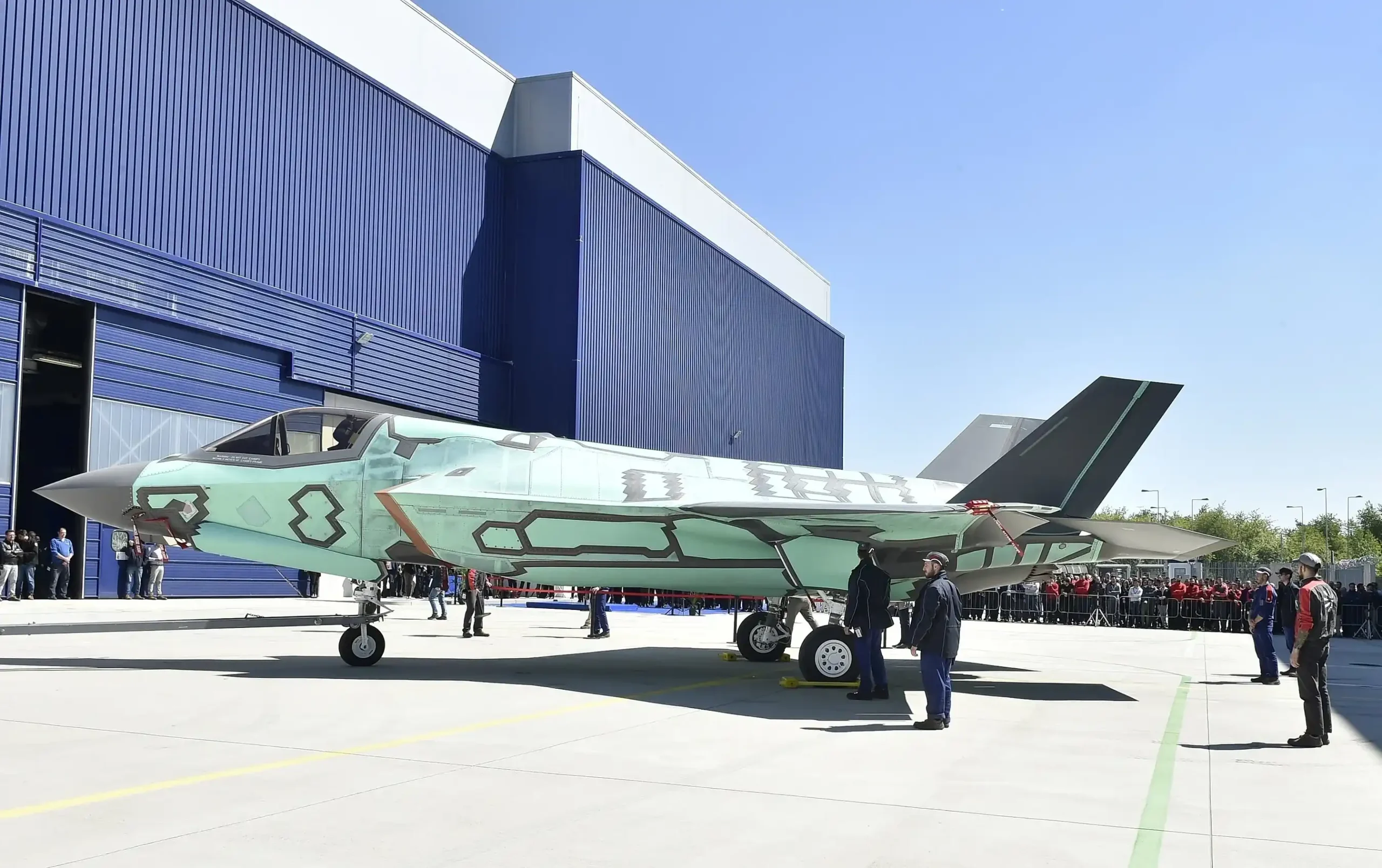
Lockheed Martin Aeronautics Co. will upgrade three electronic mate and assembly stations at the F-35 final assembly and check-out (FACO) facility in Cameri, Italy, under a $9,376,464 firm-fixed-price contract modification announced by the Department of War on October 19, 2026. Naval Air Systems Command (NAVAIR), Patuxent River, Maryland, issued the modification, P00029, against contract N0001923C0003. The work covers assembly stations two, three and four and is scheduled for completion in March 2028.
The award is small by F-35 standards, but it lands on Europe’s only F-35 final assembly line at a moment when the F-35 Cameri line is shifting from a national Italian program into a multinational production node. In addition to Italy’s own fleet, the plant now assembles F-35As for the Netherlands, Poland and Switzerland, and the stations being upgraded sit at the core of how quickly airframes move down the line. The entire $9,376,464 comes from non-U.S. partner funds obligated at the time of award; no U.S. appropriations are involved.
How the F-35 Cameri Line Became Europe’s Production Hub
The Cameri FACO, near Novara in the Piedmont region, is owned by the Italian Ministry of Defence and operated by Leonardo in conjunction with Lockheed Martin. It is one of two F-35 final assembly lines outside the United States, alongside the Nagoya facility in Japan, and the only one outside Fort Worth able to assemble the F-35B short takeoff and vertical landing variant. When the first Italian F-35A, AL-1, rolled out in March 2015, Lockheed Martin described the 101-acre site as comprising 22 buildings and 11 assembly stations.
Italy’s requirement stands at 115 aircraft, split between 75 F-35As and 40 F-35Bs, the latter shared between the Italian Air Force and the Italian Navy, which operates the type from the carrier Cavour. Roughly 40 Italian jets had been delivered by January 2026.
The customer base has since widened. Cameri is building 29 F-35As for the Royal Netherlands Air Force and 16 of Poland’s 32 F-35As. The first Polish jet assembled in Italy, tail number 3517, completed its first functional test flight on July 22, 2026. Switzerland’s procurement agency, armasuisse, confirmed on August 14, 2026, that the first fuselage section and wing for a Swiss F-35A had been joined at Cameri. Most of Switzerland’s order, reduced from 36 to 30 aircraft, is expected to pass through the Italian line, and the first Cameri-built Swiss jet is due to fly to Switzerland in mid-2028.
The F-35 Cameri plant is sized for up to 20 aircraft per year and completed 65 F-35s between 2021 and 2025, including 19 in 2025. Cameri also produces roughly one third of all F-35 wings under a commitment covering 835 complete wing sets, and serves as the designated heavy airframe maintenance, repair, overhaul and upgrade (MRO&U) center for Europe, with expansion planned from 13 to 21 bays by 2029.
Electronic Mate and Assembly Stations: Scope of the Upgrade
Mate stations are the point in F-35 production where the major structural sections come together. Publicly available descriptions of the F-35 line indicate that these computer-controlled fixtures use precision metrology to position the forward, center and aft fuselage sections and the wings before they are permanently joined into a single airframe. Alignment at this stage drives both structural fit and low-observable surface quality, making the stations a throughput constraint as well as a quality gate.
The contract does not specify what the upgrades consist of, whether control software, metrology hardware, tooling or a combination. The workshare split, 93% in Fort Worth, Texas, and 7% in Cameri, suggests that engineering, design and fabrication will be concentrated at Lockheed Martin’s main plant, with installation and validation in Italy. The announcement does not confirm this.
The modification was not competitively procured, consistent with Lockheed Martin’s role as design authority for F-35 production tooling. Per the contract, the upgrades support production for the U.S. Air Force, Marine Corps and Navy, non-U.S. partners and Foreign Military Sales (FMS) customers.
The announcement attributes the funding to non-U.S. partners without naming the paying nation. Of Cameri’s current customers, Italy and the Netherlands are program partners, while Poland and Switzerland buy through FMS. As owner of the facility, Italy is the most plausible funder, though that remains unconfirmed.
Analysis: The dollar figure is minor, but the timing is not. Polish serial production started in mid-2026, Swiss airframes are entering final assembly, and Italy still had roughly 75 aircraft to receive as of January 2026, including F-35Bs that only Cameri and Fort Worth can build. Upgrading three mate stations ahead of that overlap is a hedge against a bottleneck at the line’s most alignment-sensitive step. It also shows that European operators increasingly depend on a single non-U.S. line for both new production and depot-level support, which raises the cost of any disruption at Cameri and strengthens Italy’s industrial position within the F-35 enterprise.
The upgrades are due for completion in March 2028, shortly before the first Cameri-built Swiss F-35A is scheduled to fly to Switzerland. Poland expects its full fleet of 32 jets by 2030, and the additional MRO&U bays are due by 2029. Open questions remain: which partner is funding the work, whether the line’s other assembly stations will receive similar upgrades, and whether the modification is tied to broader configuration changes on the F-35 production line.