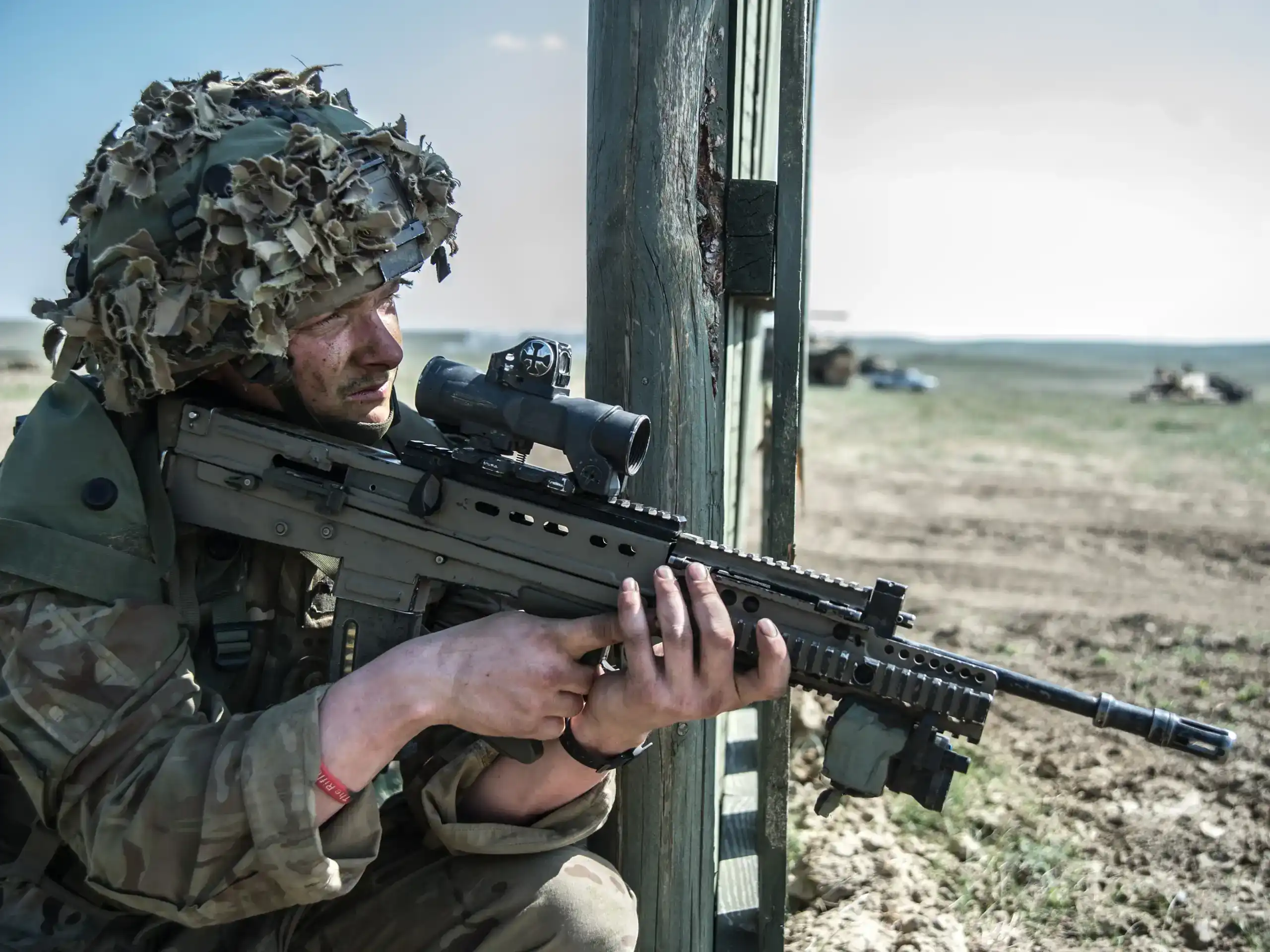
The UK Ministry of Defence (MoD) has put an estimated value of £2 billion, including Value Added Tax (VAT), on Project Grayburn, the SA80 replacement program for the service rifle family used across the British armed forces. The contract is expected to run from July 2029 to the end of March 2045, according to a notice issued on October 23, 2026, by the MoD’s National Armaments Director (NAD) Group announcing an industry day.
It is the first cost figure attached to the program. In April 2025, then Minister of State for Defence Maria Eagle told Parliament that no formal estimate could yet be given; in July 2026 a senior defense official said Grayburn was funded despite having no specific line in the Defence Investment Plan. Excluding VAT, the notice values the work at £1.67 billion. A January 2026 pipeline notice from Defence Equipment and Support (DE&S) gave notional dates of April 2028 to March 2045, so the start has moved back 15 months, and the tender notice is now expected on July 2, 2027.
SA80 Replacement Timeline Slips to a July 2029 Contract Start
The notice states that the MoD “has not selected a preferred procurement route, delivery model, supplier, product or contractual structure,” and that the engagement is neither a call for competition nor an invitation to tender. The hybrid industry day offers each organization a single one-to-one session of no more than 15 minutes, which will not be used to evaluate or down-select suppliers. Registration closes at 5:00 p.m. on October 30 and the engagement deadline is November 27. Approvals will pass through the Combined Operational Effectiveness and Investment Appraisal (COEIA) process.
The later start compresses the handover. Ministers cited 2030 as the L85A3’s out-of-service date through 2025, but by July 2026 officials said the rifle would serve into the early 2030s. Heckler & Koch UK delivered the last batch of 15,600 upgraded rifles on July 30, 2026, completing a program that put more than 40,000 SA80A3s into service. As of February 25, 2025, the MoD held 125,276 L85A2 and 40,144 L85A3 rifles, according to a parliamentary answer. Reported requirements of 150,000 to 180,000 new weapons have not been confirmed by the MoD.
Five Variants on a Common Lower Receiver Replace the L85 Family
The January notice set out five planned variants, most likely built on a common lower receiver: a standard dismounted close combat rifle replacing the L85A3, a short dismounted close combat variant, a Personal Defence Weapon (PDW) replacing the L22 carbine, a generalist rifle replacing the L85A2, and a cadet rifle replacing the L98. Requirements include lethality against current and emerging body armor, day optics as standard with rapid integration of in-line night vision, signature reduction on selected variants, and reliability in all climatic conditions.
The rifle being replaced is a gas-operated, rotating-bolt bullpup chambered in 5.56x45mm NATO. Publicly available specifications indicate a 518 mm barrel, 785 mm overall length, and a cyclic rate of 610 to 775 rounds per minute. The bullpup layout fits a full-length barrel into a compact weapon, and that matters: the Royal United Services Institute (RUSI) puts muzzle energy at about 1,700 joules from the L85 against roughly 1,300 joules from the shorter-barreled L403A1, the Knight’s Armament KS-1 already in specialist British service.
Caliber remains open. A January 2026 ministerial answer said interoperability, including caliber, will be weighed across Grayburn and the Project Troubler light machine gun effort, and the MoD said in September that current work includes options to optimize 5.56x45mm capability. RUSI’s April 2026 paper concluded that British troops need a rifle able to suppress at 400 meters and reliably kill within 150 meters, and that defeating body armor at 400 meters would require a larger caliber at the cost of carried ammunition. The US Army has already adopted the SIG Sauer M7 in 6.8x51mm under its Next Generation Squad Weapon (NGSW) program.
UK Manufacture Requirement Shapes the Project Grayburn Contender Field
In February 2026, Minister of State for Defence Luke Pollard told Parliament the MoD expects the weapon to be manufactured in the UK to strengthen sovereign industry, though no export ambition has been defined. The January notice also floated a long-term strategic supplier relationship covering delivery, support and spiral development.
FN Herstal unveiled the 5.56mm ARKA in June 2026, a short-stroke piston rifle derived from the SCAR with AR-15 pattern controls, shown with 285 mm and 368 mm barrels. Its subsidiary FN UK runs the country’s only assault rifle and machine gun production line, and parent FN Browning Group agreed in May 2026 to acquire sniper rifle maker Accuracy International. Heckler & Koch, which rebuilt the SA80 to A2 and A3 standard, is offering the HK416 and HK433 and has bought machining firm Globe Engineering to make components in the UK. Beretta Defence Technologies has proposed a small arms hub at its Skydock test site in Lincolnshire, and SIG Sauer is promoting its MCX family.
Analysis: The £2 billion figure is a demand signal, not a unit price. Averaged over the contract term, the £1.67 billion ex-VAT value comes to a little over £100 million a year, covering delivery, support and spiral development across five variants, plus a UK production base for a service rifle Britain has not built at scale since SA80 production ended. The 15-month slip fits a pattern RUSI warned about: deferring a capability-retention program to ease in-year budgets until replacement is urgent and financial room is gone. The risk is a caliber and supplier choice driven by cost and schedule rather than by the armor-defeat requirement the MoD has set itself.
The tender notice, expected July 2, 2027, should be the first document to fix caliber, quantities and the procurement route. Until then, the L85A3 has no confirmed out-of-service date beyond the early 2030s, and the program named for Lieutenant John Grayburn, awarded a posthumous Victoria Cross at Arnhem in 1944, still has no selected weapon.