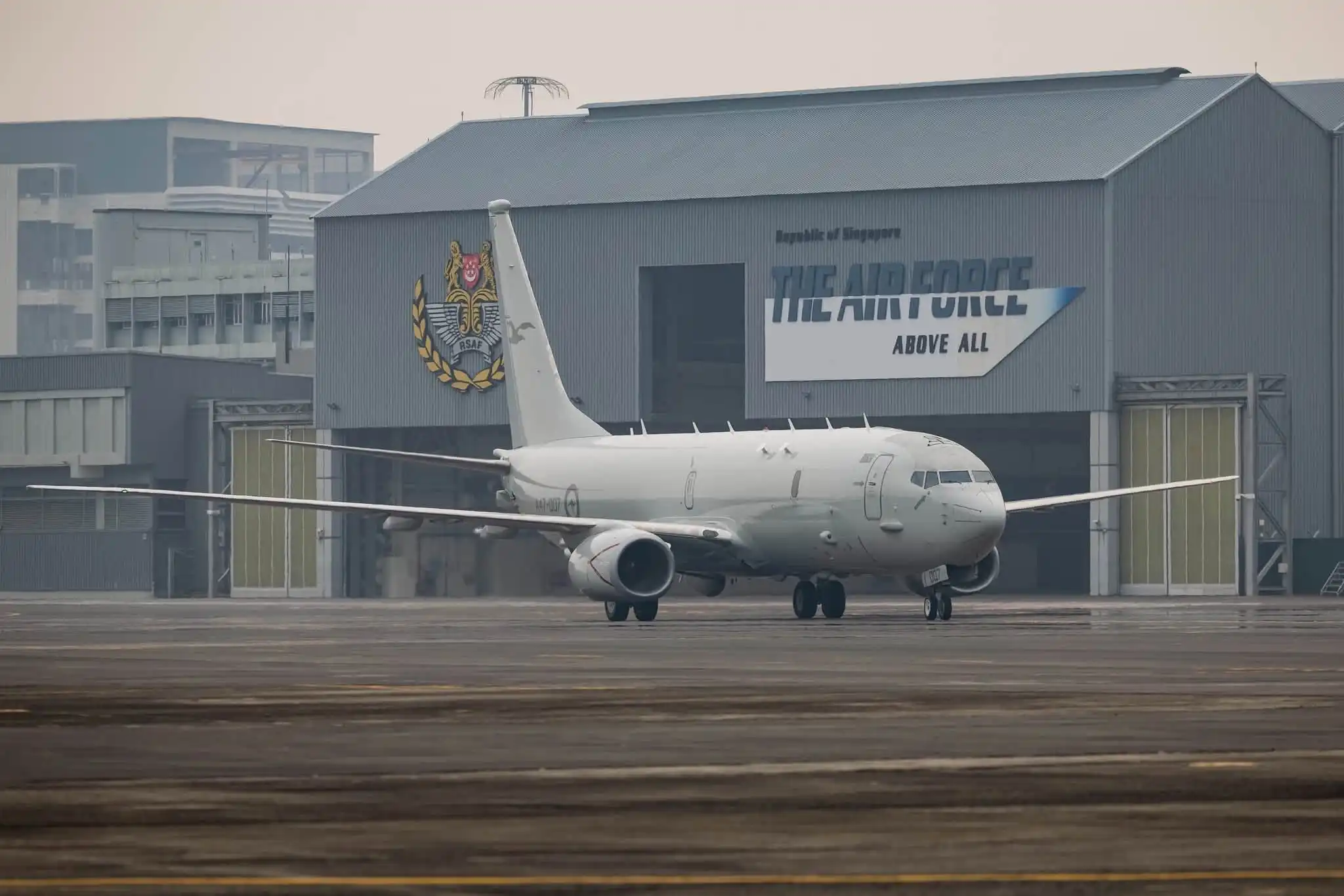
A Royal Australian Air Force (RAAF) P-8A Poseidon maritime patrol aircraft laid sonobuoys to search for a Republic of Singapore Navy (RSN) submarine during an anti-submarine warfare (ASW) serial on Exercise Bersama Lima 2026, operating alongside a Royal New Zealand Air Force (RNZAF) P-8A crew, the Australian Department of Defence reported on October 26, 2026.
The serial formed part of the Five Power Defence Arrangements (FPDA) exercise hosted by Singapore from October 5 to 23, 2026, bringing together Australia, Malaysia, New Zealand, Singapore and the United Kingdom. According to Singapore’s Ministry of Defence, this year’s iteration involved approximately 1,900 personnel, 42 aircraft, seven ships and one submarine, and marked the 55th anniversary of the FPDA, established in 1971. Maritime air surveillance and a submarine hunt featured among the air and naval serials. For the RAAF, the exercise came after its Poseidon fleet reached its full 14-aircraft strength in May 2026.
How the P-8A Poseidon Crews Ran the Submarine Hunt
The Australian aircraft was crewed by personnel from No. 12 Squadron, which the RAAF re-established at RAAF Base Edinburgh, South Australia, in October 2025 as its second operational Poseidon unit alongside No. 11 Squadron. During the serial, the crew dropped sonobuoys to listen beneath the surface, feeding acoustic data to operators who had to separate signals of interest from surrounding noise and pass their findings to the rest of the crew.
Lead acoustics operator Sergeant Aaron Mitchell described his role as using sonobuoys “to detect, classify and track submarines.” He said the job demands strong analytical skills to pick out what differs from the background, and that constant communication among operators is what keeps the crew on a submarine once it is found.
On the flight deck, co-pilot Flying Officer Callum Morgan contended with tropical weather and congested airspace, with Changi Airport next to the operating area. He described the conditions as “tricky, but a good challenge.”
Flying alongside the RNZAF crew allowed the two air forces to compare procedures. Morgan said similarities between Australian, New Zealand and Singaporean procedures let personnel work together cohesively. Mitchell said testing the crew’s skills against partners using different equipment and training was a valuable opportunity.
The Department of Defence did not disclose the duration of the serial, the number of sonobuoys expended, whether the submarine was held in contact, or which RSN boat took part.
Poseidon Sensors Against Singapore’s Invincible-Class Submarine Force
Derived from the Boeing 737-800 airframe, the P-8A carries up to 129 sonobuoys and integrates a multi-role radar, an electro-optical camera, an electronic signal detection system and a high-capacity acoustic system, according to the RAAF. Publicly available specifications indicate the radar is the Raytheon AN/APY-10. With almost 34 tonnes of internal fuel, the aircraft can conduct low-level ASW operations more than 2,000 kilometres from base, operate down to 200 feet, and refuel in flight from the RAAF’s KC-30A Multi-Role Tanker Transport. Weapons are carried in an internal bay and on underwing stations; publicly available data indicates the RAAF fleet employs the Mk 54 lightweight torpedo and the AGM-84 Harpoon. The fleet is also receiving Increment 3 Block 2 upgrades.
The RNZAF operates four P-8As with No. 5 Squadron at RNZAF Base Ohakea, according to publicly available information, giving the two partners a common airframe, mission system and training baseline.
Singapore’s submarine force centres on the Invincible-class (Type 218SG), a 70-metre air-independent propulsion (AIP) design built by ThyssenKrupp Marine Systems, displacing about 2,200 tonnes dived and fitted with eight tubes. Singapore’s Ministry of Defence identified the participating boat as an Invincible-class submarine, and the Royal Navy described it as Singapore’s newest. AIP reduces the need to snorkel, shrinking the windows in which a patrol aircraft can detect a submarine by radar or electronic support measures and pushing the hunt toward acoustics. Shallow tropical water and dense merchant traffic around Singapore further degrade sonobuoy performance, making the area a demanding acoustic environment.
Analysis: The value of the serial lies in the target and the terrain. Australia, New Zealand and the United Kingdom all fly the P-8A, and training against a modern AIP boat in shallow, high-clutter littoral water is the closest proxy the FPDA partners have to the conventional submarine threat their maritime patrol forces would face around Indo-Pacific choke points. For the RAAF, placing a No. 12 Squadron crew in that environment within a year of the unit’s re-establishment indicates the second squadron is moving from standing up to sustaining multinational operational tasks.
Defence has not released assessment results from the serial. The next indicators to watch are the pace of Increment 3 Block 2 modifications across the 14-aircraft fleet, the scale of Poseidon participation in subsequent FPDA activities, and whether the RSN expands submarine availability for allied ASW training as its Invincible-class boats mature in service.