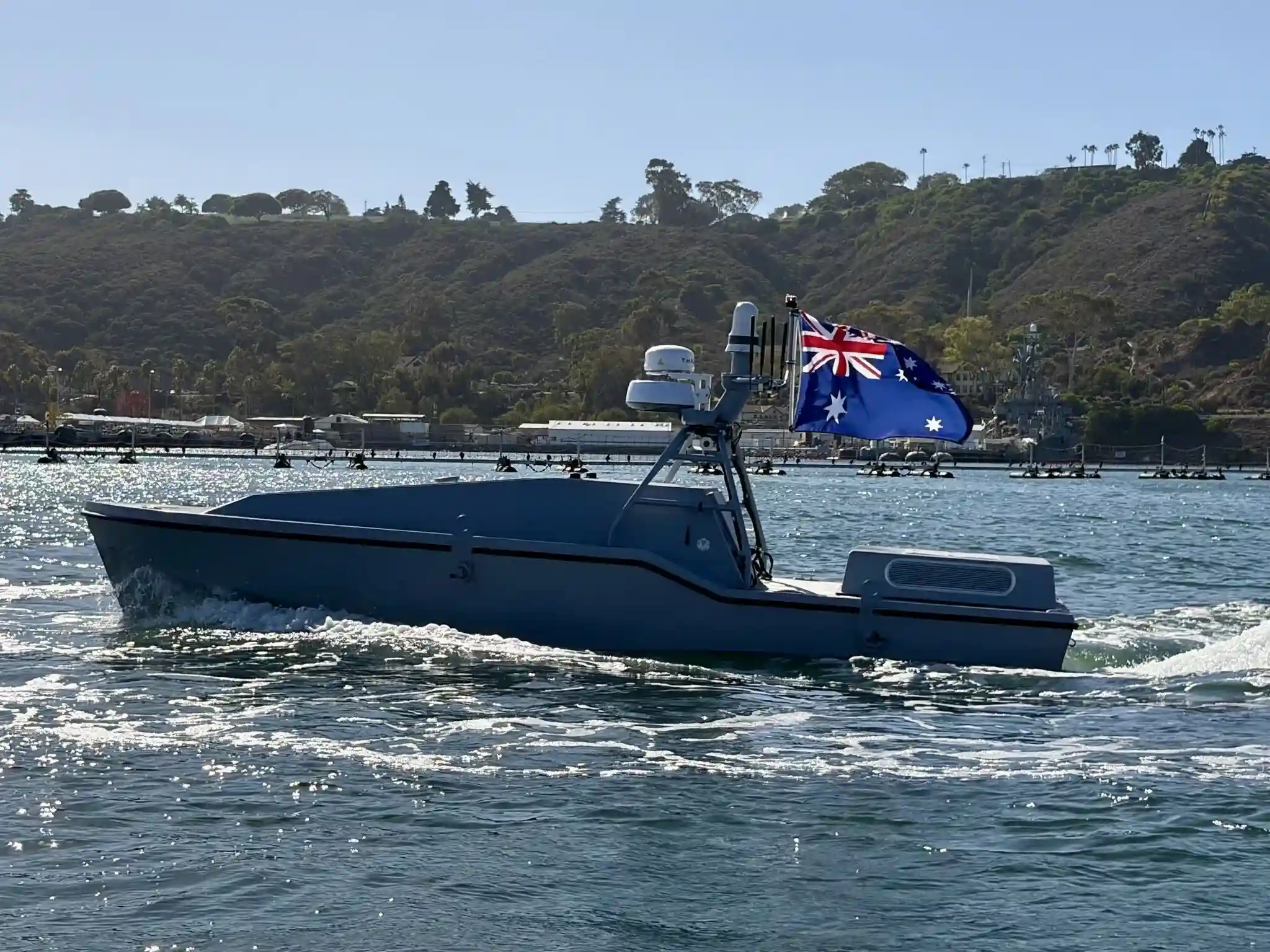
Saronic Technologies fielded three Corsair autonomous surface vessels alongside U.S., British and Australian forces during Maritime Big Play Pacific, the AUKUS partners’ largest demonstration of uncrewed and autonomous technology, held off Southern California from October 5 to 25, 2026. The Texas company said the boats ran pier resupply partly under denied communications and a trilateral sense, decide, effect mission inside a mixed fleet of uncrewed surface vessels and aircraft.
The demonstration comes three months after the Corsair’s combat debut. On July 12, 2026, U.S. Central Command (CENTCOM) used three Corsairs to strike a submarine and ship-maintenance facility at Iran’s Bandar Abbas Naval Base, which the command described as the first American combat employment of sea drones. San Diego tested a different question: whether a hull proven in a U.S.-only kill chain can plug into coalition command and control under AUKUS Pillar 2, the partnership’s advanced-capabilities track.
How the Saronic Corsair Fit Into AUKUS Resupply and Strike Serials
Maritime Big Play Pacific was hosted by Naval Information Warfare Center Pacific, U.S. Pacific Fleet and the U.S. Marine Corps. It brought more than 40 government and industry technologies from the three nations into scenarios built around anti-submarine warfare, integrated lethality, contested resupply, and subsea and seabed warfare. The Royal Navy led the anti-submarine strand with its own uncrewed surface vessels, underwater gliders, drones and subsea vehicles.
The Corsair’s pier resupply serial addresses contested logistics, where jamming can sever the datalinks remote operators depend on. Running those segments without a link requires onboard autonomy for navigation and task execution. The sense, decide, effect serial placed the boats in a heterogeneous network of uncrewed surface vessels and uncrewed aircraft, a trilateral version of the distributed targeting chain the U.S. Navy is building.
Saronic said it controlled the boats through its Echelon software, integrated into the Common Control System (CCS). CCS is a U.S. Navy command-and-control and mission-planning system that the service has sought to extend across its uncrewed systems in every domain. That shared control layer is the precondition for multi-vendor, multinational fleets. The company credited the Royal Navy with giving it the opportunity to take part but did not disclose which navy operated each boat, how long the boats ran without human input, or what payloads were used in the effect phase.
Corsair Specifications, Production Contract and Operational Record
The Corsair is a 7.3-meter (24-foot) autonomous surface vessel that carries up to 453 kg (1,000 pounds) of payload over roughly 1,852 km (1,000 nautical miles) at speeds above 35 knots. Saronic developed the design with the Pentagon’s Replicator initiative in view, and it sits at the small end of the company’s line, below the 12-meter Mirage, the 18-meter Cipher and the 45-meter Marauder.
That payload band lets one hull carry sensors, cargo or an explosive charge, while the range allows launch from well outside coastal defenses. The U.S. Navy awarded Saronic a $392 million production agreement under Other Transaction Authority, with about $200 million obligated at award, announced in December 2025. Quantities have not been released.
Task Force 59 began fielding Corsairs in the Middle East in late March 2026, mostly for surveillance and support, and used one in June to recover two U.S. Army Apache aircrew from the Gulf of Oman before the July strike.
Analysis: The Corsair’s performance envelope is now established; the value of the San Diego serials lies in the control architecture. If a commercial autonomy stack can run inside a Navy control layer and be tasked by allied operators, the AUKUS navies gain a route to pooled, attritable mass without each building bespoke command and control. Denied-comms resupply maps directly onto a Western Pacific fight against heavy Chinese electronic warfare. Until the operator split and autonomy duration are disclosed, however, the depth of that interoperability remains unverified.
No British or Australian procurement decision on the Corsair has been announced, and official trilateral assessments of Maritime Big Play Pacific have not been released. The next indicators are delivery rates under the Navy agreement, whether CCS integration becomes a standard requirement for allied uncrewed surface vessel buys, and whether Pillar 2 demonstrations convert into funded programs.