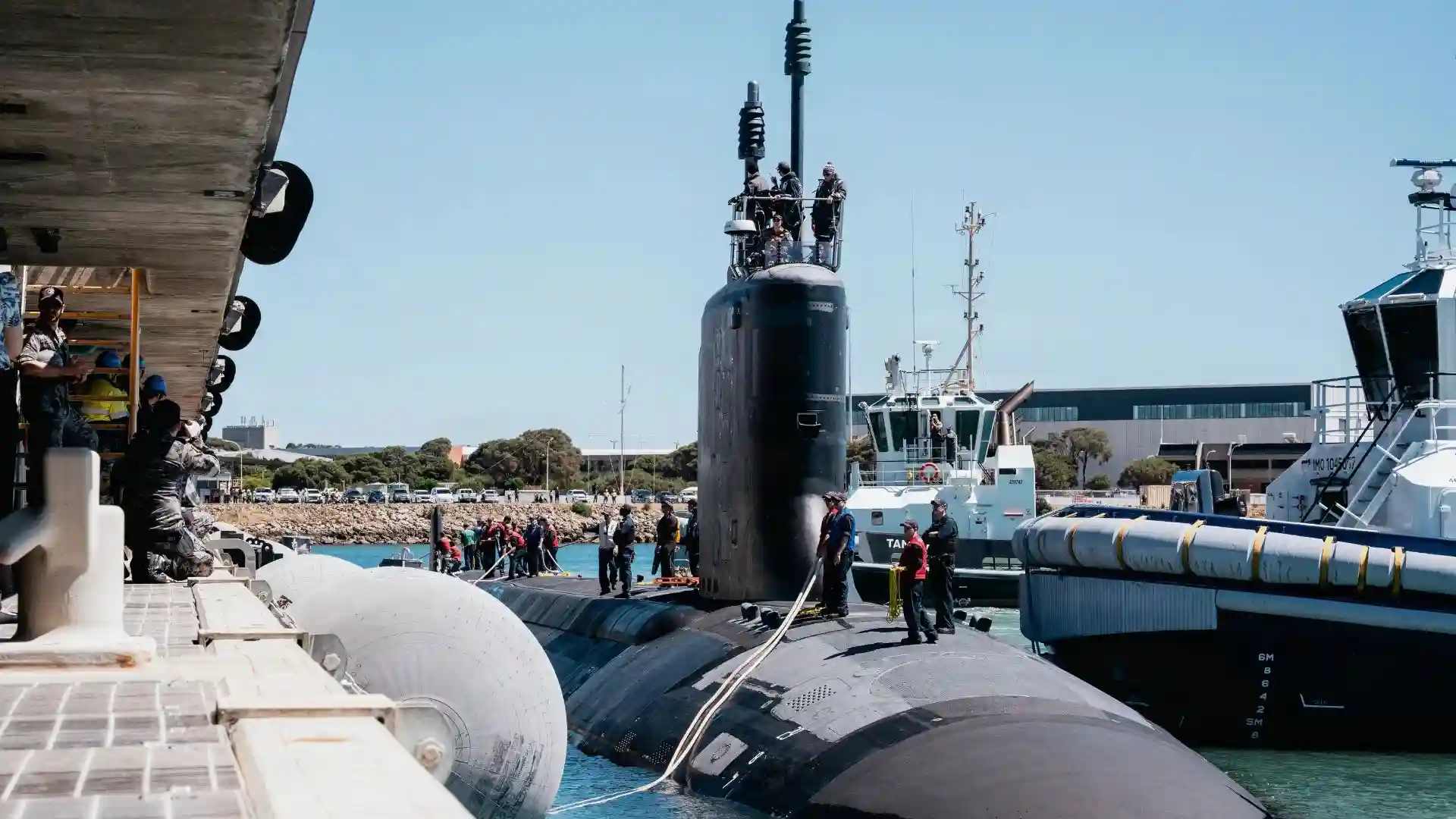
The US Navy Virginia-class fast-attack submarine USS Colorado (SSN 788) arrived at HMAS Stirling in Western Australia on October 27, 2026, to begin a scheduled, monthlong submarine maintenance period (SMP) under AUKUS Pillar I. Over the coming weeks, more than 30 trained and certified Australian civilian technicians from ASC Pty Ltd will perform routine maintenance on a Virginia-class boat in Western Australia for the first time, working alongside specialists from Pearl Harbor Naval Shipyard and Intermediate Maintenance Facility (PHNSY&IMF).
The availability is the fourth SMP conducted in Western Australia since the AUKUS partnership was established and the third in the past 12 months. Colorado is the sixth nuclear-powered attack submarine (SSN) to call at Stirling since the March 2023 Optimal Pathway announcement, the plan under which Australia will acquire, operate and sustain its own conventionally armed, nuclear-powered submarines. On October 26, 2026, Secretary of War Pete Hegseth and his Australian and UK counterparts named Colorado in a joint statement as the first US Navy Virginia-class fast-attack submarine assigned to Submarine Squadron 3. The boat will help formally establish Submarine Rotational Force-West (SRF-West) on its planned return in late 2027.
How AUKUS Submarine Maintenance Has Scaled at HMAS Stirling
Each period at Stirling has shifted more work onto Australian hands. In August 2024, the submarine tender USS Emory S. Land (AS 39) supported work on USS Hawaii (SSN 776), the first time Australian personnel directly maintained a US nuclear-powered submarine on home soil. In late 2025, USS Vermont (SSN 792) completed the first Stirling period without a tender, with PHNSY&IMF leading a blended US-Australian team. In February 2026, HMS Anson became the first Royal Navy Astute-class boat maintained in Australia, with roughly 100 trilateral personnel.
Colorado’s period adds a new layer. During the Vermont period, some 20 ASC personnel returning from training at Pearl Harbor worked alongside more than 100 US shipyard staff; this time, a cadre of about three dozen certified ASC civilian technicians executes routine work on a Virginia-class hull at an Australian pier. “Our Lead Maintenance Activity, Pearl Harbor Naval Shipyard and Intermediate Maintenance Facility, is doing a great job ensuring the Australian personnel trained in Hawaii are ready and able to support our submarines,” said Rear Adm. Doug Adams, director of AUKUS, International & Systems.
The period also exercises Australian-built infrastructure. Technicians will work from a custom metal safety walkway around the sail, known as the sail “racetrack,” and from submarine-specific upgrades to Diamantina Pier. Local support systems include a pure water plant, a high-pressure air compressor and a dehumidifier. According to Capt. Jason Pittman, commander of Submarine Squadron 3, the water plant and racetrack were validated in 2025 and the compressor and dehumidifier during the UK period in February; the racetrack is now being used to conduct actual maintenance.
The Royal Navy will also take part. Royal Australian Navy Rear Adm. David Mann, head of the Australian Submarine Agency’s Virginia Division, described the trilateral team as “testing our infrastructure, validating our nuclear stewardship processes” while upskilling naval and civilian workforces. The Navy has not detailed the scope of the work package. During the 2025 Vermont period, Australian authorities reported that no radiological material was transferred ashore.
USS Colorado Block III Design and the Pearl Harbor Connection
Colorado was commissioned on March 17, 2018, at Naval Submarine Base New London in Groton, Connecticut, as the 15th Virginia-class submarine and the fifth Block III boat. Publicly available specifications indicate a length of 377 feet (114.9 meters), a beam of 34 feet (10.3 meters), a submerged displacement of about 7,800 tons and a submerged speed above 25 knots, with a crew of roughly 130. An S9G pressurized water reactor, designed to run for the life of the ship without refueling, drives a pump-jet propulsor.
Block III reworked roughly 20 percent of the design to cut acquisition costs. Two 87-inch Virginia Payload Tubes, each holding six Tomahawk land-attack cruise missiles, replaced the 12 individual vertical launch tubes of earlier boats, and the water-backed Large Aperture Bow array replaced the spherical bow sonar. Four 21-inch tubes fire Mk 48 heavyweight torpedoes. That matters for AUKUS: the three Virginia-class boats Australia plans to acquire from the early 2030s, with an option for two more, will come from Block III or later production, so hands-on time with these systems feeds directly into sovereign sustainment.
The boat also carries a direct link to the yard leading the Stirling work. Colorado shifted homeport from Groton to Joint Base Pearl Harbor-Hickam in April 2024 for a two-year extended dry-docking availability at PHNSY&IMF, now the Lead Maintenance Activity for the Western Australia periods. “The Australian personnel stepping aboard our ship are true professionals,” said Capt. Justin Reeves, Colorado’s commanding officer.
Analysis: The progression from tender-supported work in 2024 to Australian civilians executing routine maintenance in 2026 targets the hardest constraint on AUKUS Pillar I, which is people rather than piers. SRF-West will rotate up to four US and one UK SSN through Stirling, and three dozen certified ASC technicians is a starting cadre, not a sustainment workforce for five boats. For Washington, every availability Stirling absorbs eases pressure on US public shipyards whose backlogs already keep attack submarines pierside. The real test is whether Australian teams can move from routine SMPs to deeper work while still returning boats to sea on schedule.
Colorado is expected to remain at Stirling for about a month. Mann said the maintenance periods have kept Australia on track to start SRF-West in 2027. Next markers include the scope of the 2027 rotational maintenance plan, growth of ASC’s certified workforce beyond its current cohort, Australia’s first sovereign Virginia-class boat in the early 2030s and the start of SSN-AUKUS construction in Adelaide, slated for the end of the decade.