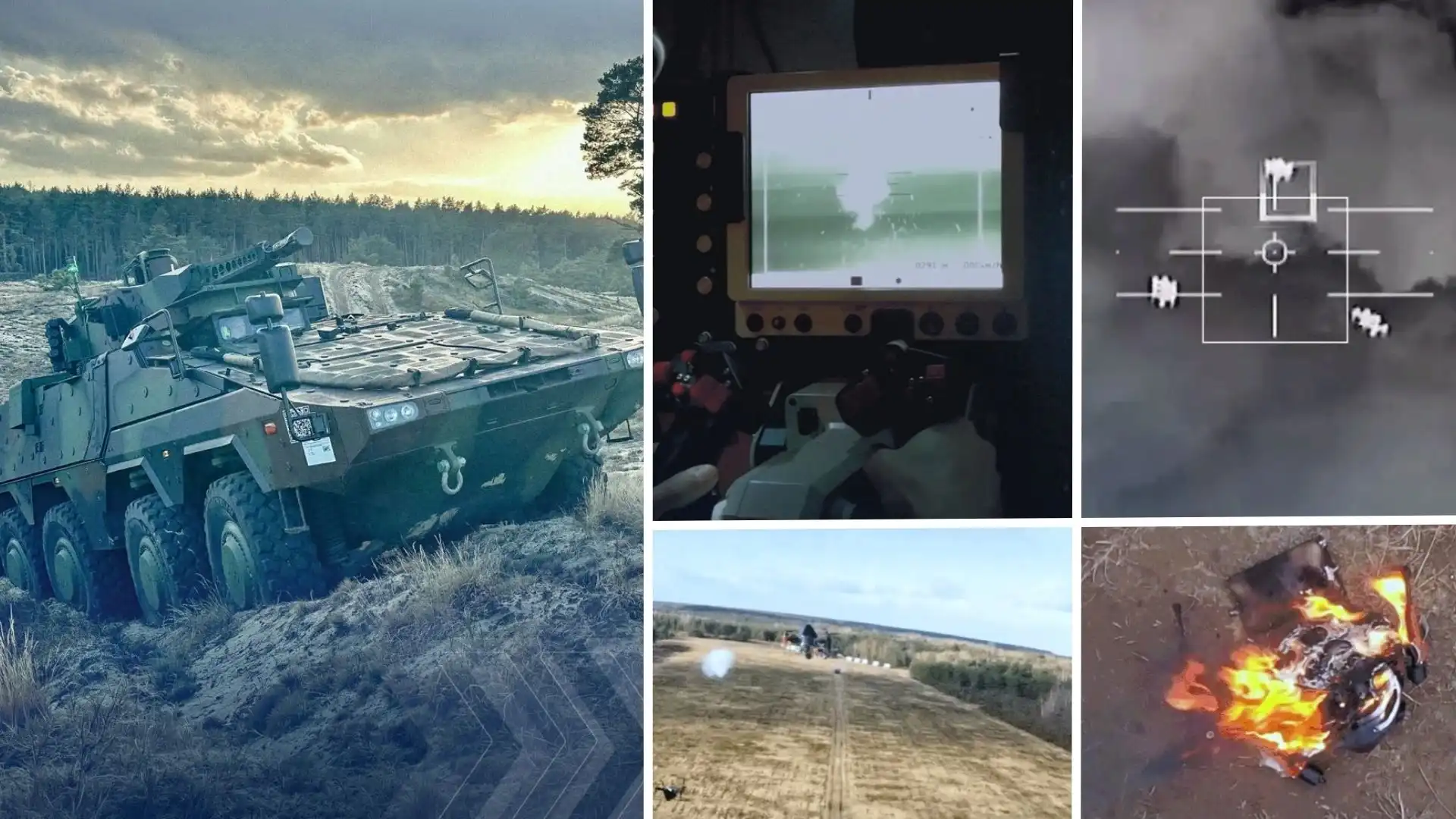
KNDS Deutschland is promoting its Boxer RCT30 wheeled infantry fighting vehicle (IFV) as a counter-drone weapon, stating in a LinkedIn post this week that the 8×8 platform, designated Schakal in German service, is “ideally suited for countering state-of-the-art threats, such as drones.” The post, tagged with counter-unmanned aircraft systems (C-UAS) hashtags and illustrated with field and range imagery, named no new sensor, software, or ammunition, and gave no details of any test against drone targets.
The pitch follows rapid program growth. On October 17, 2025, the Organisation for Joint Armament Cooperation (OCCAR) signed a €4.5 billion contract with ARTEC, the joint venture of Rheinmetall and KNDS Deutschland, covering 270 additional Boxers, including 222 Schakal IFVs: 150 for the Bundeswehr and 72 for the Royal Netherlands Army. On August 7, 2026, OCCAR exercised an option for 69 more, 35 for Germany and 34 for the Netherlands, lifting planned fleets to 185 and 106 vehicles, or 291 combined. The Schakal is slated to become the principal combat vehicle of the German Army’s new Medium Forces.
Boxer RCT30 Firepower: MK30-2/ABM Cannon and Airburst Ammunition
The Schakal mates the Boxer drive module with the unmanned RCT30 turret already fielded on the tracked Puma IFV. Its main armament is Rheinmetall’s fully stabilized MK30-2/ABM automatic cannon firing 30 x 173 mm ammunition from a dual-belt feed. Crews select between two combat natures: the KE DM33 armor-piercing fin-stabilized discarding sabot round for hardened targets, and the KE-TF DM21, a programmable time-fuzed airburst projectile that ejects a cloud of sub-projectiles just short of the target.
Rheinmetall rates the cannon’s effective range at more than 2,000 m against land, air, and maritime targets and describes the DM21 as suited to engaging drones. That ammunition is the core of the KNDS argument. Small multirotor and first-person-view (FPV) drones are difficult to hit with point-detonating rounds; programmable airburst turns a near miss into a probable kill, and a short burst of medium-caliber rounds costs a fraction of a guided interceptor. A twin launcher for Rafael’s Spike LR anti-tank guided missile, known in Bundeswehr service as MELLS, and a coaxial machine gun complete the armament.
Sensors determine whether that firepower reaches small aerial targets. In February 2026, Hensoldt received a contract worth about €290 million from KNDS for 288 digital optronics sets for the Schakal, each comprising the PERI RTWL HD commander’s sight, the WAO HD gunner’s sight, and the Multifunctional Self-Protection System (MUSS). Hensoldt lists hunter-killer capability for the PERI RTWL commander’s sight, letting the commander search for the next target while the gunner engages the current one. Components are interchangeable with the Puma, simplifying logistics across Germany’s two IFV fleets.
Schakal Wheeled IFV Mobility, Protection, and Dismount Capacity
KNDS lists the Boxer RCT30 at 38.5 tonnes in its class A/C configuration, with an MTU V8 engine rated at up to 600 kW, roughly 800 hp, and a top speed above 100 km/h. The vehicle measures about 7.9 m long, 3 m wide, and 3.5 m high, and KNDS describes its armored compartment as seating three crew plus seven soldiers.
The Boxer architecture protects occupants against mines, improvised explosive devices, and ballistic threats, and its mission module can be exchanged on the common drive module. The 2025 contract introduces the latest version of the Boxer drive module, expected to become the standard for all OCCAR Boxer participating states. Wheeled mobility matters to the counter-drone pitch: Medium Forces formations are built to cover long distances by road, and an IFV able to defend itself and its dismounts against loitering munitions and FPV drones reduces the need to attach scarce dedicated air defense to every company.
Qatari and Ukrainian Precedents for Boxer RCT30 Counter-Drone Integration
The counter-drone argument is not new for the RCT30. At the DIMDEX 2024 exhibition in Doha, held March 4 to 6, 2024, the Qatar Emiri Land Forces displayed a Boxer RCT30 fitted with a passive radio frequency (RF) sensor that locates common commercial drones and feeds their positions into the turret’s fire control system. Test video showed multiple quadcopters destroyed, and a Qatari officer said his service was receiving 10 vehicles in that configuration. KNDS showed a similar integration at DSEI 2025 in London, where a Boxer RCT30 carried a Dedrone on-the-move passive RF detector linked to its fire control.
Germany also added nine Boxer RCT30s to its military aid for Ukraine in January 2025, intended to operate alongside RCH 155 wheeled howitzers and protect artillery units against drones. Their combat performance has not been publicly detailed. No equivalent passive RF detection package appears in published descriptions of the German and Dutch Schakal contracts, and KNDS did not say this week whether one is planned.
Analysis: The KNDS post is market positioning rather than a capability announcement, but the underlying logic holds. Any IFV combining a stabilized 30 mm cannon, programmable airburst ammunition, and digital sights is a latent point-defense node; the constraint is detection and cueing, not killing power. Without radar or passive RF cueing, crews must find small, low-signature drones through electro-optical sights alone, the hardest part of the engagement. The Qatari configuration shows KNDS has a cueing solution ready. Whether Berlin and The Hague specify it will determine if 291 Schakals become a distributed counter-drone layer complementing dedicated short-range air defense such as Rheinmetall’s Skyranger 30, also mounted on the Boxer, or remain infantry carriers with incidental anti-drone capability.
The first series-production Schakal vehicles are expected in late 2027, and Hensoldt has said series delivery of the Schakal is scheduled to begin in the fourth quarter of that year. Neither OCCAR nor ARTEC has published a delivery timeline for the 69 vehicles ordered in August 2026, and up to 179 further Schakals remain on option under the 2025 contract. Indicators to watch are any German or Dutch requirement for integrated drone detection and live-fire trials against representative drone threats.