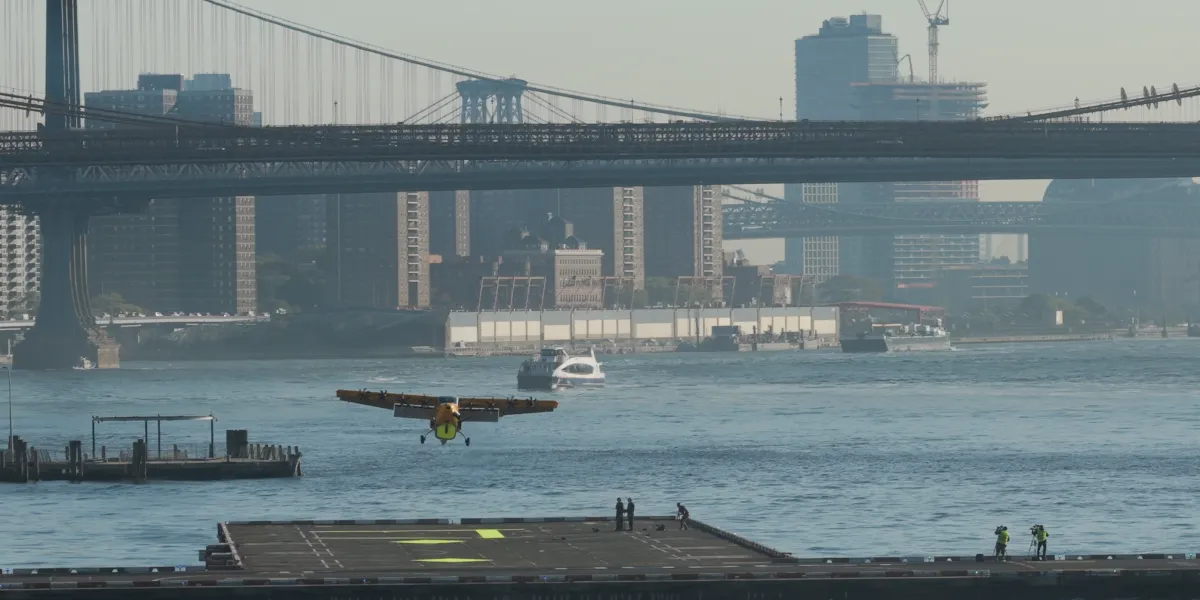
Electra took off and landed its hybrid-electric Ultra Short aircraft at Downtown Skyport in Lower Manhattan, the company announced on October 26, 2026, in what it believes is the first time a fixed-wing aircraft without vertical takeoff capability has used the heliport. A public event at the site capped two weeks of demonstration flights.
The flights, part of Electra’s Life Beyond Runways series, come as the Manassas, Virginia-based company advances its nine-passenger EL9 toward Federal Aviation Administration (FAA) certification. Its blown-lift technology has also drawn sustained US Air Force and US Army funding as both services examine aircraft that do not depend on large, fixed runways.
Electra Ultra Short Blown-Lift Design and EL9 Production Specifications
Ultra Short aircraft combine hybrid-electric propulsion with blown lift, using distributed electric motors to accelerate airflow over the wing and generate lift at low airspeeds. Electra says the configuration allows takeoff and landing in 150 feet, turning heliports, barges, fields, and parking lots into access points. The company has flown its two-seat EL2 technology demonstrator from sites including Downtown Charleston and Atlantic City’s Bader Field and, under the FAA’s advanced air mobility integration pilot program, demonstrated helicopter-like instrument flight performance at Roanoke-Blacksburg Regional Airport using heliports instead of runways.
The production EL9 scales up that architecture. Publicly available specifications indicate eight electric motors along the wing, powered by battery packs and a turbine-driven generator that recharges the batteries in flight, removing any need for ground charging infrastructure. Electra lists a 175-knot cruise speed and a payload of nine passengers or 3,000 pounds of cargo over 330 nautical miles, with a 1,100-nautical-mile ferry range including instrument flight rules (IFR) reserves. Fly-by-wire controls support single-pilot operations.
The FAA has closed the EL9’s G-1 Issue Paper, setting the certification basis for its distributed hybrid-electric propulsion, blown-lift system, and flight controls. Electra has targeted a first EL9 flight in 2027 and service entry in 2029 under FAA Part 23 rules. It claims 2.5 times the payload and 10 times the range of helicopters at 70 percent lower operating cost; those figures have not been independently verified.
AFWERX Funding and the Case for Runway-Independent Military Logistics
Electra explicitly pitches the same capability to defense users: moving people, power, and payload where runways are unavailable, damaged, threatened, or impractical. That pitch rests on a multi-year military track. Electra has received nine contracts from AFWERX, the Air Force’s innovation arm, since December 2020, including a Strategic Funding Increase (STRATFI) agreement combining $30 million in Air Force Small Business Innovation Research (SBIR) and other funds with $55 million in private investment. In September 2024, the EL2 flew demonstrations at Marine Corps Air Facility Quantico and Felker Army Airfield at Joint Base Langley-Eustis before Army, Navy, and Air Force personnel. In September 2025, Electra completed government-directed tests during the Air Force Research Laboratory’s Future Flag 25-3 exercise.
The Army has awarded Electra six contracts, including a $1.9 million SBIR for hybrid-electric propulsion risk reduction on the EL9. Electra plans for the production aircraft’s onboard generator to sustain more than 600 kilowatts continuously and over 1 megawatt in short bursts, enough to power ground equipment at austere sites, and says its fuel consumption is one-third that of helicopters on comparable missions.
Analysis: A fixed-wing landing on a Manhattan heliport proves access, not military utility. The relevant metric for Agile Combat Employment, the Air Force concept of dispersing forces across small and austere locations, is how much payload an aircraft moves per square foot of operating surface under contested conditions. An EL9 delivering 3,000 pounds over 330 nautical miles from a parking lot would fill a logistics gap between rotary-wing lift and C-130-class airlifters. Yet the EL9 has not yet flown, and Electra has not released 150-foot performance figures at maximum gross weight, in hot-and-high conditions, or on unprepared surfaces with a full load.
Electra says it will continue the demonstration series as it moves the EL9 toward certification, production, and service, with first flight the next milestone. On the defense side, the open question is whether the Air Force or Army moves from STRATFI and SBIR funding to a procurement commitment; no military production order has been announced.