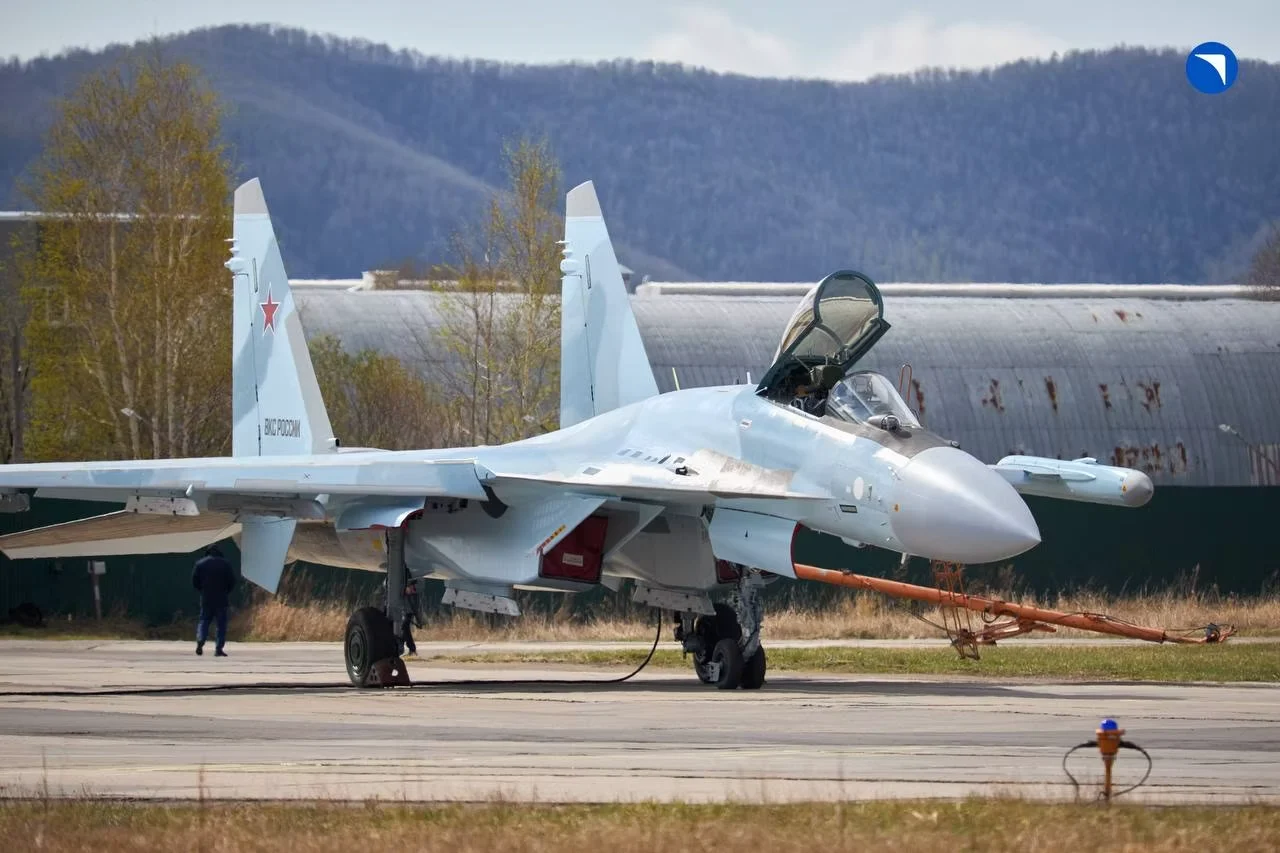
Ethiopia has taken delivery of its first Russian-built Su-35 multirole fighters and will later receive four S-400 Triumf long-range air defense batteries, Prime Minister Abiy Ahmed announced on October 28, 2026, on the sidelines of the third Russia-Africa Summit in Moscow. Abiy said the order covers 12 Su-35s and credited Russian President Vladimir Putin with securing delivery one year ahead of the agreed schedule. Russian state arms exporter Rosoboronexport told Reuters “the first batch of two Su-35 aircraft was delivered to the Ethiopian Air Force today,” without further detail, leaving open how many airframes have physically changed hands. Neither side disclosed the contract value, the S-400 delivery date, or basing locations.
The announcement lands five weeks after war resumed in Tigray. On September 23, 2026, Tigray People’s Liberation Front (TPLF) forces seized airports in the region and pushed into Afar and Amhara, days after seven armed movements, including the TPLF, Fano, and the Oromo Liberation Army, formed an alliance pledged to topple Abiy’s government. Addis Ababa accuses Eritrea of backing the rebels, and the renewed fighting has severed relations between the two neighbors; Asmara denies the charge. In the 2020 to 2022 war, which killed hundreds of thousands, federal air power, particularly foreign-built armed drones, helped turn the tide.
Ethiopia Su-35 Fleet: Irbis-E Radar, Thrust Vectoring, and Payload
The Su-35, NATO reporting name Flanker-E, is a single-seat, twin-engine evolution of the Su-27, built by the Komsomolsk-on-Amur Aircraft Plant (KnAAPO) and marketed by Moscow as a 4++ generation fighter. Publicly available specifications indicate two Saturn AL-41F1S turbofans rated at about 142 kN each in afterburner, with three-dimensional thrust-vectoring nozzles, a top speed of Mach 2.25, and a ferry range of roughly 3,600 km on internal fuel. The aircraft carries up to 8,000 kg of ordnance on 12 hardpoints alongside a 30 mm GSh-30-1 cannon.
The sensor suite centers on the Irbis-E passive electronically scanned array radar, which the manufacturer credits with detecting a 3 m² target at up to 350 km to 400 km, tracking 30 targets and engaging eight simultaneously, supplemented by the OLS-35 infrared search-and-track system. Standard weapons include R-77 and R-73 air-to-air missiles, Kh-31 anti-radiation missiles, Kh-59 standoff missiles, and KAB-series guided bombs. Moscow has not stated which munitions package accompanies the Ethiopian aircraft.
The capability jump is substantial. The Ethiopian Air Force’s front-line fighter force rests on an aging Su-27 fleet, estimated in open sources at between 16 and 22 airframes, plus ex-Indian Su-30K fighters inducted in January 2024. The service unveiled Russian Yak-130 advanced jet trainers at its 90th anniversary airshow in January 2026, a lead-in platform consistent with a Flanker conversion pipeline. Documents attributed to Rostec and leaked in October 2025 listed Ethiopia as a customer for six Su-35s; Abiy’s figure of 12 suggests the order grew or that the leak captured only part of it.
Four S-400 Triumf Batteries and Ethiopia’s Regional Threat Picture
The S-400 Triumf, NATO designation SA-21 Growler, would give Ethiopia its first strategic-range surface-to-air capability. Publicly available specifications credit its 91N6E acquisition radar with detection out to 600 km and its interceptor family with engagement ranges up to 400 km, though export customers have typically fielded the 48N6E3 missile, rated at about 250 km. Abiy did not specify the interceptor mix or the number of launchers per battery.
Neither system answers the immediate threat from Tigray. TPLF forces operate no combat aircraft, and the federal campaign has leaned on armed drones, including the Turkish Baykar Akinci inducted in January 2024. The Su-35 and S-400 are built to contest a peer air force. In the Horn of Africa, that points toward Eritrea, whose small air arm has fielded MiG-29 and Su-27 fighters, and toward Egypt, which remains at odds with Addis Ababa over the Grand Ethiopian Renaissance Dam. Abiy framed the purchase in deterrent terms, saying it would help Ethiopia “pre-emptively deter aggression.”
Analysis: Russia delivering a front-line fighter a year early, while its own Aerospace Forces absorb Su-35 losses in Ukraine, signals that Moscow is prioritizing political returns in Africa over domestic replenishment. For Washington, the S-400 order carries sanctions exposure under the Countering America’s Adversaries Through Sanctions Act (CAATSA), the authority used against Türkiye’s defense procurement agency in December 2020 over the same system. Egypt reportedly shelved its own Su-35 purchase under similar pressure. Addis Ababa has now accepted that risk in the middle of a civil war.
Key unknowns remain the S-400 delivery schedule, the timing of any Su-35s beyond the first batch, pilot conversion status, and the weapons package. There is no verified evidence that the new fighters will be committed to the Tigray theater. Any US response under CAATSA will be the next marker to watch.