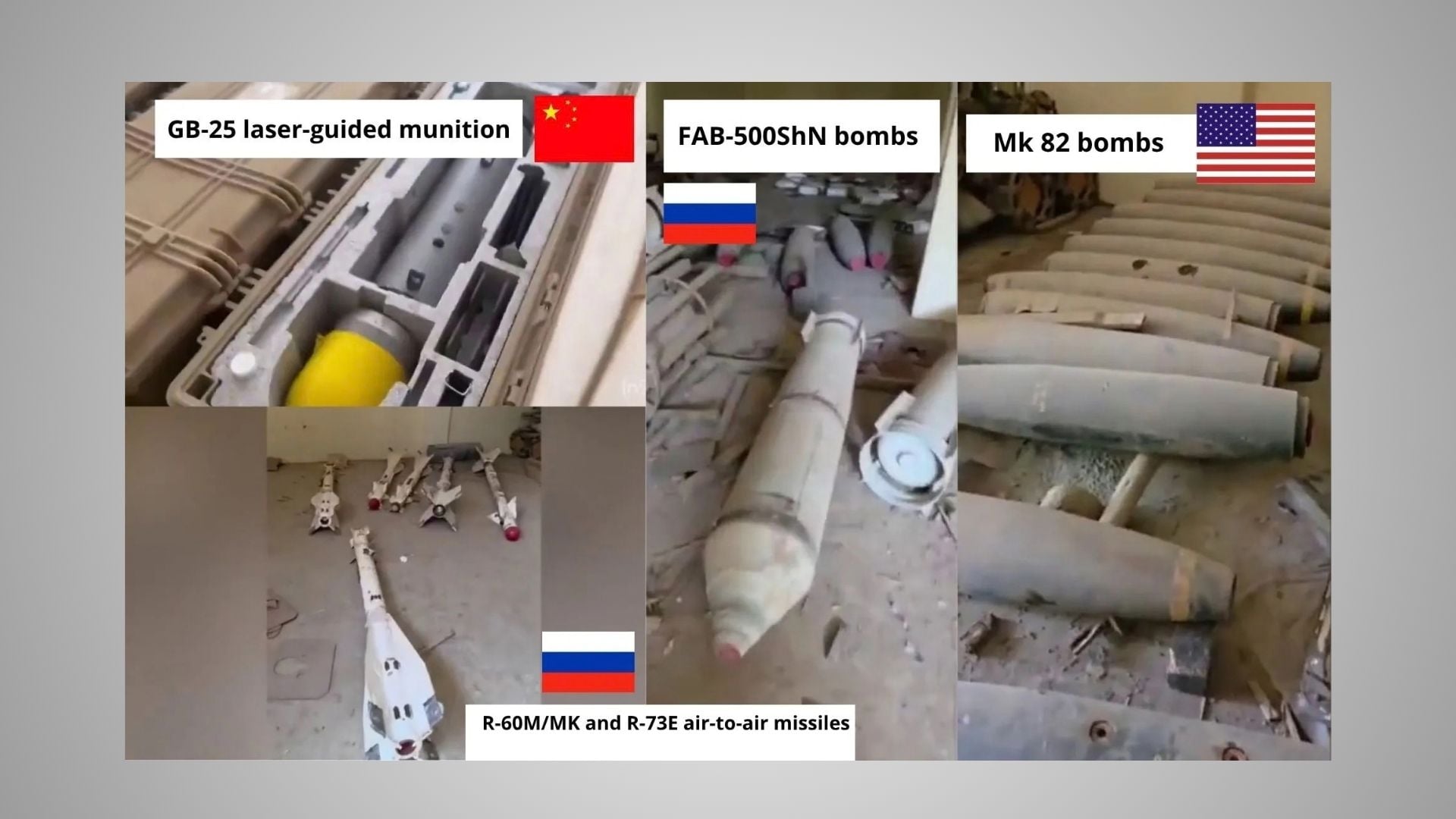
Ethiopian National Defense Force (ENDF) troops have filmed a cache of air-delivered weapons in Mekelle, the capital of the Tigray Region, and presented it as equipment belonging to the Tigray Defense Forces (TDF). The footage, which circulated widely on social media on October 8, 2026, shows guided and unguided bombs, air-to-air missiles, and what appear to be components of an Iranian-made Mohajer-6 unmanned combat aerial vehicle (UCAV). Neither the recovery site nor the date of filming has been independently verified.
The display follows the federal recapture of Mekelle on October 3, 2026, after government troops and the allied Tigray Peace Force secured the city’s Alula Aba Nega Airport. Tigrayan forces had seized that airport, along with Shire and reportedly Axum, on September 23, three days after the Tigray People’s Liberation Front (TPLF) and six other armed and opposition groups announced an alliance to remove Prime Minister Abiy Ahmed’s government. The fighting is the heaviest since the 2020-2022 war, which the African Union estimates killed more than 600,000 people before the Pretoria agreement of November 2, 2022.
Mekelle Weapons Cache: Guided Bombs, Air-to-Air Missiles, and a Mohajer-6
Open-source analysts identified Chinese-made GB-25 laser-guided munitions, US-designed Mk 82 general-purpose bombs, Soviet-designed FAB-500ShN bombs, R-60M and R-73E air-to-air missiles, and a dismantled airframe consistent with the Mohajer-6. Each identification rests on imagery alone.
The GB-25 belongs to China’s GB guided bomb family, earlier marketed as Tiange. Publicly available specifications indicate that later GB variants pair a laser seeker with satellite and inertial navigation, and that the designation corresponds to the family’s 25-kilogram class, a weight generally associated with armed drones. The Mk 82 is the 500-pound low-drag bomb with roughly 87 kilograms of explosive fill. Mk 82-pattern bodies are produced in several countries, so imagery alone cannot establish US manufacture or the supply route.
The FAB-500ShN is a parachute-retarded, impact-fuzed bomb built for low-level attack runs. Open-source data list a weight of about 513 kilograms, including roughly 221 kilograms of explosive, a profile suited to ground-attack aircraft such as the Su-25, which Ethiopia operates. Both missile types also match the Ethiopian Air Force inventory. The infrared-guided R-73E, with a publicly reported range of up to 30 kilometers, arms Flanker-family fighters; Ethiopia flies Su-27s and two Su-30Ks delivered in January 2024. The older R-60M, a short-range missile publicly listed at about 44 kilograms, equips Soviet-era types including the Su-25.
The Mohajer-6, built by Iran’s Qods Aviation Industries, has a 10-meter wingspan, an operational range of about 200 kilometers, and capacity for roughly 40 kilograms of precision munitions, according to publicly available specifications. The US State Department said in October 2022 that Iran had delivered Mohajer-6 UCAVs to Ethiopia in the summer of 2021.
Attribution Gaps: Why Air-Delivered Munitions Complicate the TDF Claim
Every item in the footage requires a crewed combat aircraft or a medium-altitude drone to employ, and there is no public evidence that Tigrayan forces operate either. Analysts who flagged the video assessed that the materiel more plausibly represents older ENDF stocks, or a mix of federal and Tigrayan holdings.
Mekelle’s history allows several scenarios. The city hosted the ENDF Northern Command headquarters, which Tigrayan forces overran in November 2020, and it changed hands twice during the last war: federal forces captured it on November 28, 2020, and withdrew on June 28, 2021. Either transition could have left air munitions behind. The Mohajer-6 parts are equally ambiguous: a dismantled airframe could be a federal drone that crashed, was shot down, or was stripped for parts, and the analysts who highlighted it described TDF ownership only as a possibility.
Provenance also carries a compliance dimension. Under the Pretoria framework, the TPLF began handing heavy weapons to the ENDF in January 2023 at Agula, 36 kilometers from Mekelle. Any air munitions retained by Tigrayan forces after that process would raise disarmament questions that the footage alone cannot answer.
Analysis: The footage reveals more about the information contest than about Tigrayan capability. Presenting air-delivered ordnance as TDF equipment supports Addis Ababa’s narrative that Tigrayan forces rearmed beyond the Pretoria terms, a claim tied to federal accusations of Eritrean backing that Asmara has denied. Until lot numbers, markings, or storage locations are documented, the more defensible reading is that the cache reflects the ENDF’s own multi-supplier air arsenal, drawn from Chinese, Russian, Iranian, and Western-pattern sources. Mekelle’s record shows how readily such stockpiles change hands in a contested city.
Key unknowns are the recovery site, the condition and serviceability of the munitions, and whether the Mohajer-6 parts carry identifiable serial numbers. Independent documentation by weapons-tracing researchers would settle provenance. A government-allied commander said on October 6 that operations to expand control beyond Mekelle were continuing with drone support, while the location of TPLF leaders who left the city before it fell has not been confirmed.