The Office of Naval Research (ONR) awarded Integer Technologies, a small business based in Columbia, South Carolina, a $23,133,600 cost-plus-fixed-fee contract on October 28, 2026, for the Threat Resilient Integrated Defense for Enhanced Naval Technologies (TRIDENT) program. The science and technology effort will develop threat-informed zero trust architecture (ZTA) frameworks for the cyber-physical security of shipboard power systems. Integer is teaming with Florida State University (FSU) and its Center for Advanced Power Systems (CAPS), and work is expected to conclude in October 2030.
The award arrives as the Pentagon pushes zero trust beyond enterprise IT and into operational technology (OT), the control systems that run physical equipment. Department components must reach target-level zero trust on IT networks by the end of fiscal 2027. Separate OT guidance from the department’s chief information officer lists 105 activities and capability outcomes, 84 at target level and 21 at advanced level, and a Pentagon official has cited notional OT deadlines of fiscal 2030 and fiscal 2033, dates that remain subject to revision. Shipboard electrical plants fall squarely in that category.
TRIDENT Brings Zero Trust Shipboard Power Security to Naval Platforms
According to the contract notice, the TRIDENT architecture is meant to let naval platforms maintain situational awareness of their cyber-physical state, dynamically adjust their cyber posture, and fight through adversarial attacks while preserving system performance. That final requirement defines the engineering problem. Zero trust assumes no implicit trust inside a network: every device and transaction is verified, privileges are minimized, and networks are segmented. On a ship’s power control network, that verification overhead can interfere with fault protection and power converter control, functions that often operate on millisecond timescales.
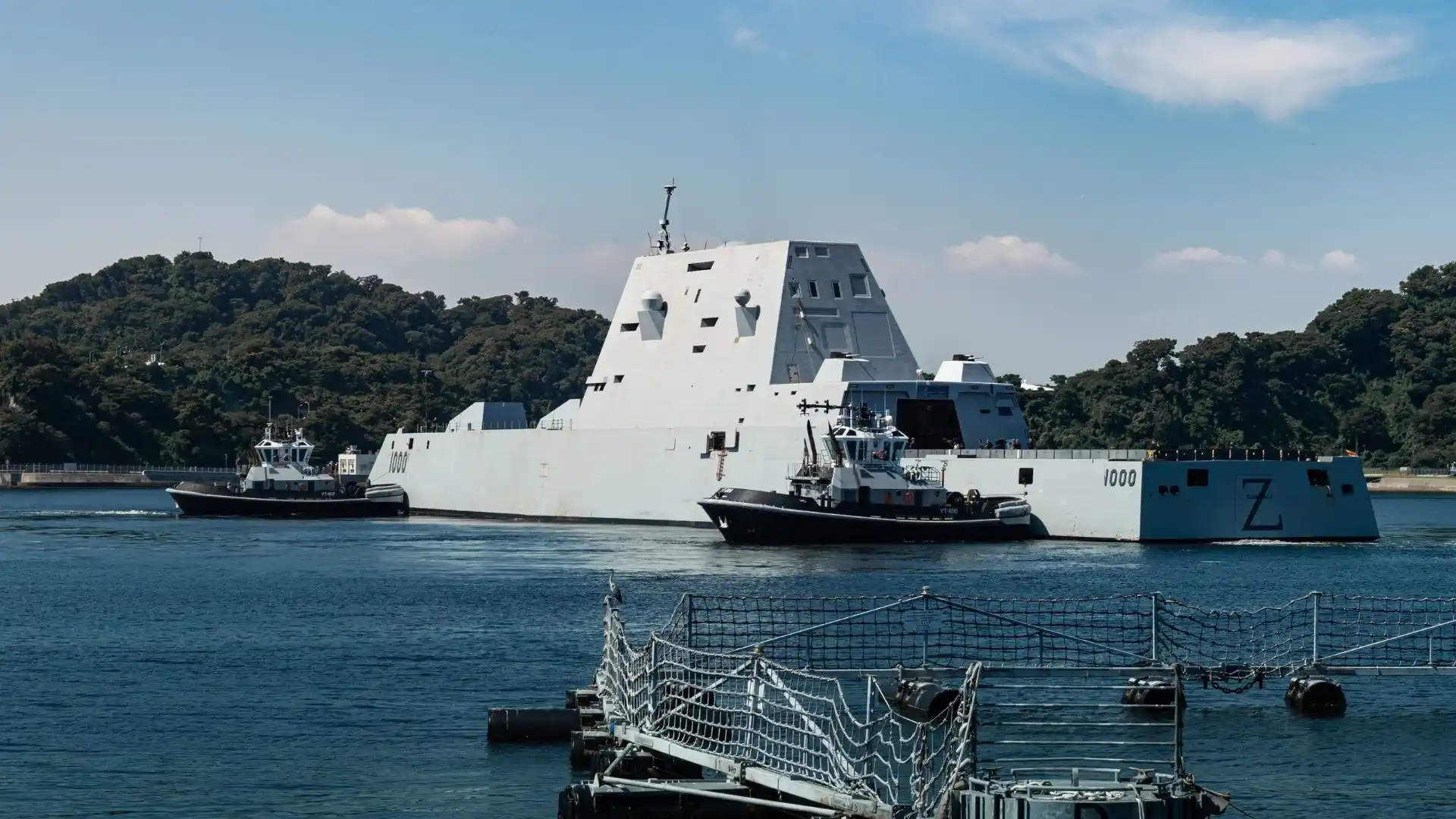
The notice names two constraints explicitly: low-latency requirements for integrated power systems (IPS), and the integration of legacy and modern equipment. An IPS pools generation into a single electrical plant that serves both propulsion motors and ship service loads. The Zumwalt-class destroyer (DDG 1000) was the first US Navy surface combatant fitted with one; publicly available specifications indicate roughly 78 megawatts from two Rolls-Royce MT30 main turbine generators and two RR4500 auxiliary turbine generators. That design places propulsion, sensors, and weapons on a common electrical backbone, so a compromised controller can degrade several mission areas at once.
The legacy problem is equally demanding. Fleet power plants mix older controllers built without any authentication capability with modern networked power electronics, and much of that equipment cannot be patched or replaced on demand. A threat-informed framework typically builds its controls around documented adversary tactics against industrial control systems rather than generic compliance checklists. The notice does not identify which ship classes TRIDENT will address or which threat models will shape the work.
How Integer Technologies and FSU CAPS Will Execute the TRIDENT Contract
The contract (N0001427C1303) combines a 36-month base period with a 36-month option period that begins 12 months after execution and runs concurrently. Fiscal 2026 research, development, test and evaluation (RDT&E) Navy funds of $10,133,600 were obligated at award, fully funding the base period. The notice does not itemize the option, but the totals imply roughly $13.0 million in unexercised value. ONR competed the award under long-range broad agency announcement N0001425SB001 for Navy and Marine Corps science and technology; because that solicitation accepts proposals year-round, the number of offers received is unknown.
Integer, a science and technology company whose work spans cyber, energy, and maritime autonomy, holds several prior ONR awards. A $7.9 million award announced in July 2024 with Benedict College funded research into automated cyber-physical security to make intelligent autonomous systems more resilient to cyberattacks. A $9.8 million award the same month, with Louisiana State University, covered intelligence, autonomy, and decision-making for networks of maritime autonomous systems, and the company received option exercises in January and July 2026 on its Intelligent Autonomous Systems for Seabed Warfare contract.
CAPS brings test infrastructure the Navy already relies on. Founded in 2000, the center operates the largest real-time digital simulator installation at any US university alongside 5-megawatt AC and DC test beds for power hardware-in-the-loop work, and it became the first university test site accredited by the Navy for that type of testing. Cybersecurity for power systems is an established CAPS research line, and the center holds a separate Naval Sea Systems Command contract for shipboard power and energy research running through June 2031. The TRIDENT notice nonetheless lists Columbia as the sole place of performance and does not break out the FSU share of the work.
Analysis: TRIDENT treats the ship’s electrical plant as cyber terrain rather than purely engineering infrastructure. As electrical loads grow, the distribution system becomes a high-value target: an adversary able to manipulate generation or load management can blunt a combatant without touching its combat system. The Pentagon’s OT guidance supplies principles but no platform-specific standards for naval power, and the department has said further guidance for weapon systems is in development. A government-funded framework built on hardware-in-the-loop testing could inform those standards, but TRIDENT remains an early-stage science and technology effort, not a fielded capability.
The option period should begin around October 2027, and the base period runs to about October 2029, with completion in October 2030, close to the notional fiscal 2030 target for OT zero trust. Key unknowns include the transition path to Naval Sea Systems Command programs, the ship classes in scope, and whether forthcoming Pentagon guidance will set explicit zero trust requirements for shipboard power systems.