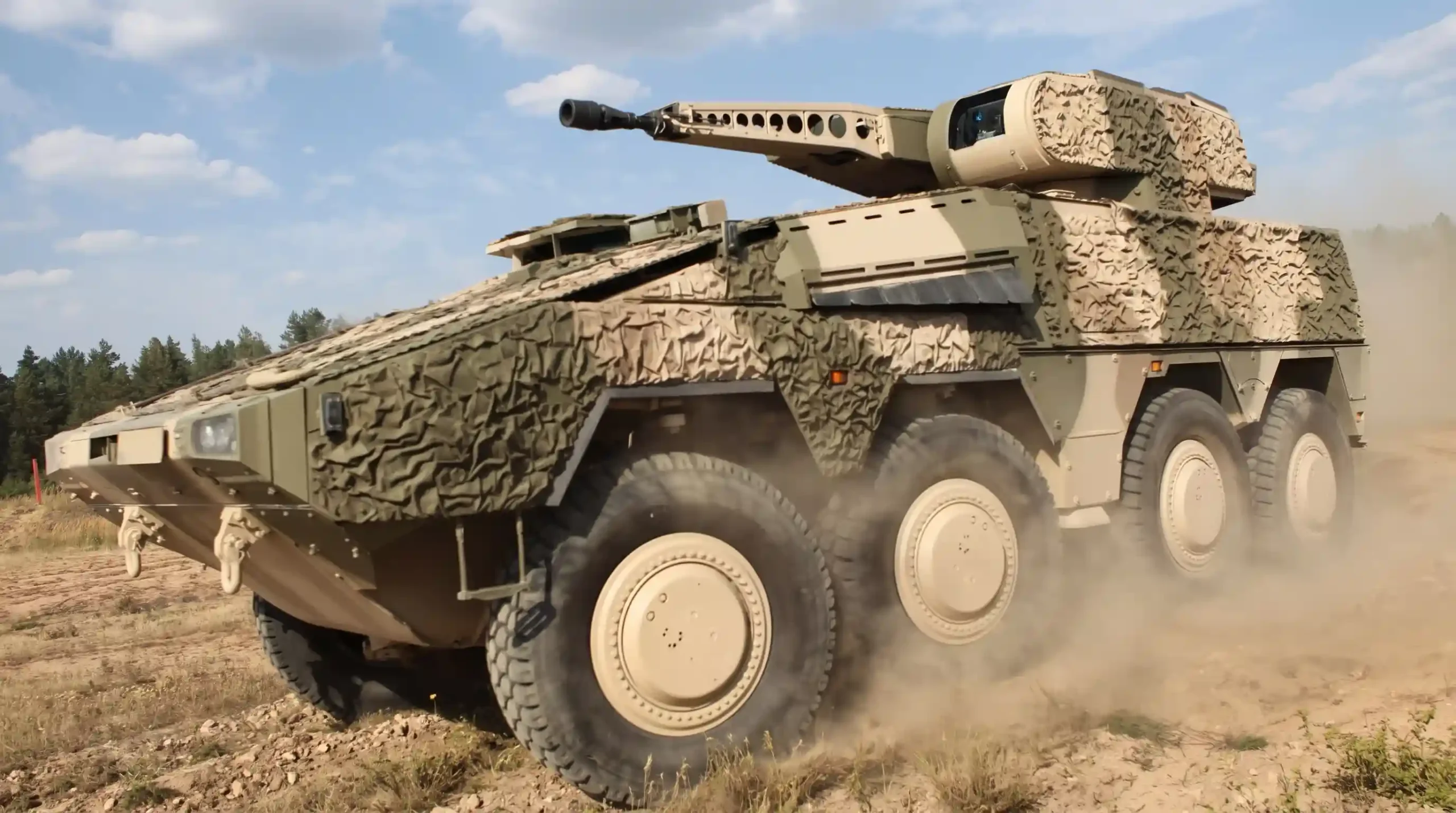
Rheinmetall announced on October 29, 2026, that it has booked its share of an order for 69 additional Schakal wheeled infantry fighting vehicles (IFVs) for the German and Dutch armies, two option call-offs worth a medium three-digit million-euro sum to the group. The Organisation for Joint Armament Cooperation (OCCAR) placed the order with Artec GmbH, the Boxer prime contractor owned by Rheinmetall and KNDS Deutschland, covering 35 vehicles for the Bundeswehr and 34 for the Royal Netherlands Army. Deliveries are planned between May 2032 and November 2033.
The call-offs draw on options written into the main Schakal contract signed in October 2025, which covered 222 vehicles, 150 for Germany and 72 for the Netherlands, at a total value of €4.7 billion, of which Rheinmetall accounted for almost €3.4 billion. The Bundestag Budget Committee approved the first option tranche on June 24, 2026, and KNDS Deutschland disclosed the call-off on August 7. The order lifts the planned German fleet to 185 vehicles and the Dutch fleet to 106, for a combined 291. Schakal is the main weapon system of the German Army’s new medium forces, positioned between light infantry and heavy armor.
Schakal IFV Option Call-Off: Numbers, Timeline, and Industrial Share
Artec, split 64 to 36 between Rheinmetall and KNDS Deutschland according to Rheinmetall, remains OCCAR’s single contracting entity for Boxer. Neither Rheinmetall nor OCCAR has disclosed a unit price for the option vehicles; the tranche’s total value across both partners is unpublished.
Series deliveries under the 2025 base contract are slated to begin in late 2027, with the first Dutch vehicles expected by the end of 2028 and German deliveries running to 2031, according to published program timelines. The option vehicles follow from May 2032, extending production into late 2033.
Dr. Björn Bernhard, head of Rheinmetall’s Vehicle Systems Division, said that “the activation of additional options for the Schakal confirms our customers’ confidence in this state-of-the-art system,” adding that the call-offs give industry and suppliers greater planning security.
When the base contract was announced in October 2025, it carried options for up to 248 further vehicles, of which 200 were reportedly earmarked for Germany. Rheinmetall’s October 29 statement refers to an option for up to 200 additional vehicles. The company has not explained the difference, so the number of vehicles still available under option remains unconfirmed.
Boxer Chassis, Puma Turret: Inside the Schakal Weapon Architecture
Schakal, marketed by KNDS as the Boxer RCT30, mates the 8×8 Boxer drive module with the unmanned 30 mm turret of the tracked Puma IFV. ARTEC’s published data list a maximum gross vehicle weight of up to 38.5 tonnes, an MTU 8V199 TE20/21 diesel delivering up to 600 kW (816 hp), and a top speed above 100 km/h. The crew of three sits entirely in the hull, alongside a dismount squad of six grenadiers.
The main armament is Rheinmetall’s fully stabilized MK30-2/ABM autocannon, firing 30×173 mm ammunition to an effective range of up to 3,000 meters, according to ARTEC. With programmable airburst ammunition, the vehicle can also engage drones and aircraft, according to KNDS. A coaxial 7.62 mm MG5 covers the close-in fight. A two-round launcher on the left of the turret fires the Multi-Role Lightweight Guided Missile System (MELLS), the Bundeswehr designation for the Spike LR family, with ground-launched ranges of about 4,000 meters for Spike LR and 5,500 meters for Spike LR2.
The fully stabilized turret carries over the Puma’s hunter-killer-capable sighting and adds 360-degree all-round observation, and KNDS says the vehicle can engage moving targets while itself on the move. Protection levels for the Schakal configuration have not been published.
For comparison, the tracked Puma weighs about 43 tonnes in its Level C protection configuration. Rheinmetall says the wheeled Schakal lets medium forces cover long distances independently in the shortest possible time, and that because the vehicle belongs to the Boxer family, training, logistics, and lifecycle costs are reduced. Turret, cannon, and ammunition are shared with the Puma.
Arminius and the Industrial Stakes of Germany’s Boxer Expansion
Rheinmetall frames the program as protecting Europe’s 8×8 market from foreign competition. Key assemblies come from German sites run by Rheinmetall, KNDS Deutschland, MTU, Hensoldt, and a network of smaller suppliers. KNDS says the RCT30 is now under contract with four nations, while the baseline Boxer serves with seven.
The larger variable is Arminius, the Bundeswehr’s planned bulk procurement of Boxer variants. Rheinmetall Chief Executive Armin Papperger told analysts on August 6, 2026, that a firm order worth around €25 billion was expected to be finalized in December 2026. German defense outlet Hartpunkt reported that the firm order covers roughly 1,800 vehicles and that Schakal IFVs are slated for procurement through Arminius. A parliamentary debate is scheduled for December 9. Rheinmetall now states that, should Arminius be commissioned, German industry has guaranteed significantly accelerated delivery of the Schakal option vehicles. It did not say how far the May 2032 start could move.
Analysis: The 69 vehicles matter less for their number than for what they confirm. Berlin and The Hague are standardizing on a single wheeled IFV while the Dutch Army’s 13 Light Brigade already operates within the German 10th Panzer Division, turning an organizational arrangement into a materiel one. The delivery dates expose the constraint: vehicles ordered in 2026 will not arrive before mid-2032, so production capacity, not funding, now sets the pace at which German medium forces reach full strength for NATO’s eastern flank. The Arminius acceleration pledge is only as valuable as industry’s ability to add line capacity rather than reshuffle slots.
Near-term milestones are the Arminius contract, expected in December 2026 with a parliamentary debate scheduled for December 9, and first Schakal series deliveries in late 2027. Open questions include the size of the remaining option pool, unit cost, and whether an Arminius award would contractually pull the 2032 to 2033 window forward. First Dutch vehicles, due by end-2028, will test the bi-national fielding plan.