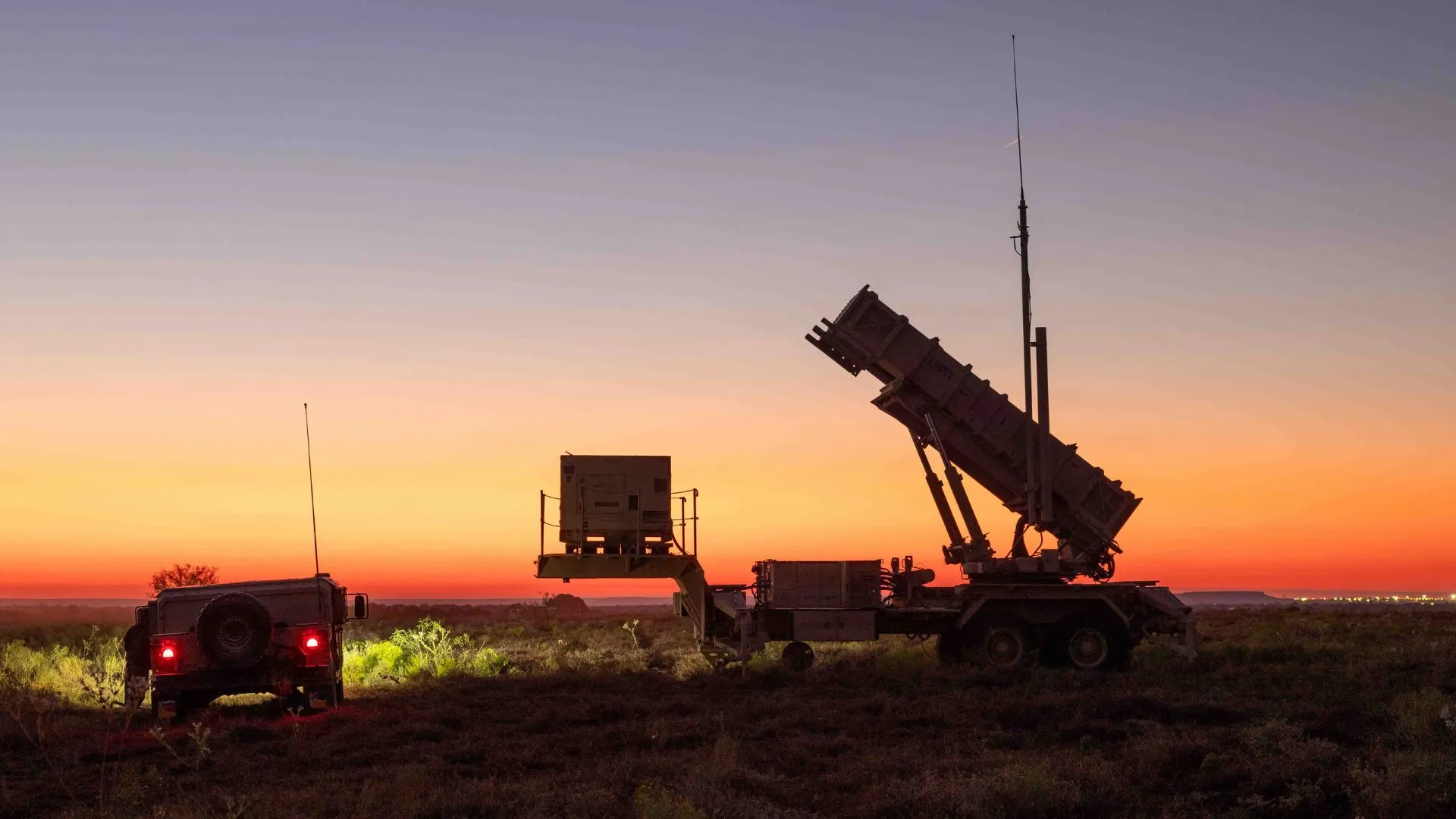
The U.S. Army on October 29, 2026, awarded Lockheed Martin an Other Transaction Agreement (OTA) to develop the Future Interceptor, a next-generation missile intended to strengthen the service’s Integrated Air and Missile Defense (IAMD) portfolio against advanced air and missile threats. The total estimated project value is $1.08 billion, combining $660.4 million in government funding with a $423 million cost-sharing commitment from Lockheed Martin, according to the Army.
The award revives a requirement the Army shelved two years ago. The service began concept development for a Lower Tier Future Interceptor (LTFI) in fiscal 2020 as a potential replacement for Lockheed Martin’s Patriot Advanced Capability-3 Missile Segment Enhancement (PAC-3 MSE). In 2024, the Army ended LTFI, then a Lockheed Martin and Raytheon competition, largely over projected cost. Army acquisition officials said in October 2025 that the service was likely to reverse course, and the fiscal 2026 budget added funding. It returns as heavy Patriot use in the Middle East and Ukraine drains interceptor stocks.
Army Future Interceptor Requirements, Funding, and Prototype Testing Plan
The Army says the Future Interceptor must improve on four parameters: engagement range, altitude, velocity, and maneuverability. The service describes the weapon as a complement to existing IAMD systems that reinforces layered defense, not a stand-alone replacement. Army budget documents for program element 0604403A describe the mission as defending against current and emerging missile and hypersonic threats. The requirement sits in the lower tier of U.S. missile defense, where Patriot operates beneath the Terminal High Altitude Area Defense (THAAD) system.
Under the agreement, the Army and Lockheed Martin will advance prototype development and conduct testing and evaluation against established operational requirements. The award carries no production commitment. Future development and production decisions will hinge on prototype performance, operational requirements, available resources, and applicable acquisition processes, the Army said. Budget documents describe an acquisition strategy built on competitive OTAs, a vehicle that allows faster prototyping than a traditional program of record.
Army budget documents project nearly $1.7 billion for the effort from fiscal 2028 through 2031, starting with $332.8 million in fiscal 2028. That follows concept-definition work funded at less than $16 million a year from fiscal 2020 through 2025.
Army leaders tied the program to the service’s new warfighting guidance, How the Army Fights. “We’re pursuing a mix of exquisite and low-cost munitions,” said Gen. Christopher LaNeve, Vice Chief of Staff and Acting Chief of Staff of the Army. “The Future Interceptor is exactly the type of cutting-edge technology we need.”
The Army did not disclose range or altitude thresholds, unit cost, planned quantities, or a fielding date.
PAC-3 Edge Design: New Seeker, Three-Pulse Motor, Patriot Integration
The Army’s announcement does not name the interceptor design. Lockheed Martin unveiled PAC-3 Edge on October 9, 2026, as its Future Interceptor entry and said it was one of two companies advanced to the next stage. The Army has not said whether the second competitor retains a role.
PAC-3 Edge retains the hit-to-kill architecture of the PAC-3 MSE, which destroys targets through direct impact rather than a proximity-fuzed blast. Publicly available specifications indicate the MSE pairs a Ka-band active radar seeker with a dual-pulse solid rocket motor and enlarged control fins, and that the Patriot M903 launcher carries up to 12 MSE rounds.
Edge changes the seeker and the motor. Lockheed developed a new seeker at its Strigo Product Center, backed by a $250 million company investment, and executives have described plans to spend about $800 million on the seeker overall. Northrop Grumman designed the multi-pulse solid rocket motor, which Lockheed executives describe as a three-pulse design built for greater range and altitude. Additional pulses let an interceptor hold energy in reserve for the terminal phase, where maneuvering ballistic and hypersonic targets compress engagement timelines. Upgraded flight controls target performance at range and altitude.
Integration will govern how fast the weapon reaches units. Lockheed designed PAC-3 Edge for the Integrated Battle Command System (IBCS), the M903 launcher, containerized launchers, and HIMARS Flex, and plans to build it on its PAC-3 line in Camden, Arkansas. M903 and IBCS compatibility would let Patriot battalions field the round without new fire units, while the 360-degree Lower Tier Air and Missile Defense Sensor (LTAMDS) radar provides the full-azimuth coverage a longer-reach interceptor can exploit. Lockheed plans to begin testing in 2027 and targets deployment in 2031.
Analysis: The financing says as much as the technical scope. Lockheed Martin is underwriting about 39 percent of the project, a stake reflecting both its bid to own the successor to its flagship interceptor and the Army’s push to shift development risk onto industry after cost concerns killed LTFI. Lt. Gen. Frank Lozano, who cited those costs in 2024 as program executive officer for missiles and space, now oversees the effort as Portfolio Acquisition Executive, Fires. An MSE-derived missile reusing existing launchers, battle management, and a production base expanding under a seven-year PAC-3 MSE procurement worth up to $58.6 billion offers a lower-risk path than a clean-sheet design. The trade-off is concentration: if Edge reaches production, one prime will supply both current and next-generation hit-to-kill interceptors for Patriot units.
Prototype testing, which Lockheed plans to start in 2027, is the next milestone, followed by the fiscal 2028 funding ramp that Congress must still appropriate. The 2031 deployment date remains a company target; the Army has published no fielding schedule. Performance thresholds, unit cost, procurement quantities, and the second competitor’s status remain undisclosed.