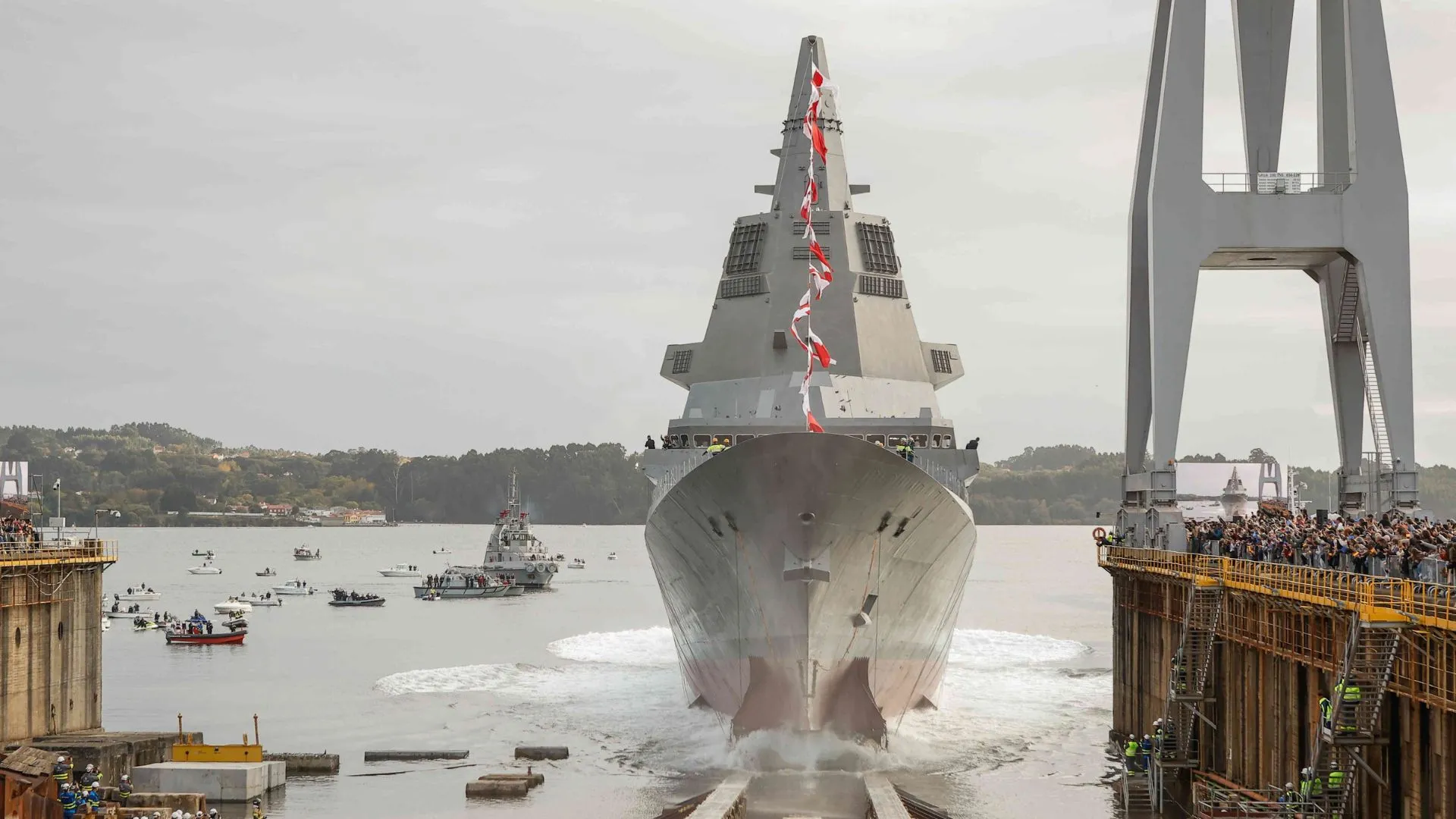
Navantia has launched the F112 frigate Roger de Lauria, the second of five F110-class multi-mission frigates for the Spanish Navy, at its Ferrol shipyard in A Coruña, the shipbuilder announced on October 27, 2026. The hull slid off Slipway 3 at high tide four months ahead of the delivery schedule agreed with Spain’s Ministry of Defence.
The F110 programme, valued at an estimated €4.32 billion under an implementation order signed in 2019, received a further €443.6 million in December 2025 to cover technical changes. It will replace the six Santa María-class frigates the Spanish Navy has operated since 1986. Lead ship F111 Bonifaz, launched in September 2025, is now in its systems installation and start-up phase, with sea trials scheduled for 2027. Roger de Lauria will complete outfitting alongside the shipyard quay before delivery in 2029. According to Navantia, the hull entered the water with a level of installation and assembly far higher than usual at this stage of construction, repeating the approach applied to F111.
F112 Roger de Lauria Build Status and F110 Series Production
The ship is named after Roger de Lauria, admiral of the fleets of the Crown of Aragon and Sicily, and was sponsored by his descendant, Almudena de Arteaga. Attendees included Secretary of State for Defence María Amparo Valcarce, Director-General for Armament and Materiel Aniceto Rosique, Chief of Staff of the Spanish Navy Admiral Antonio Piñeiro, and Navantia Chairman Ricardo Domínguez.
The production line behind F112 is already loaded. Five blocks of the third ship, F113, are on the slipway in Ferrol, while initial work on F114 has started at Navantia’s new Digital Block Factory. Spanish Navy planning calls for one frigate entering service per year through 2032, a cadence intended to retire the Santa María class without a gap in escort numbers.
Navantia puts domestic content at 65%, with the balance supplied by international partners. The programme is expected to sustain around 9,000 jobs over more than ten years across approximately 500 Spanish companies. Navantia itself supplies the core of the SCOMBA combat system, the Integrated Platform Control System (SICP), and engines and other systems produced at its sites in the Bay of Cádiz and Cartagena.
SCOMBA, SPY-7 and the Digital Twin: Inside the F110 Frigate
Publicly available specifications indicate a hull 145 metres long and 18 metres in beam, and a displacement of about 6,100 tonnes. The sensor architecture centres on the integrated mast, which houses Lockheed Martin’s AN/SPY-7(V)2 S-band solid-state radar; each Flight I array is reported to carry 68 sub-array suites. SCOMBA, developed by Navantia’s Systems business unit, processes sensor, radar and weapons data in real time and connects to Lockheed Martin’s International Aegis Fire Control Loop. Navantia says the integrated mast optimises use of the electromagnetic spectrum and reduces the ship’s radar signature.
Open-source data lists a Leonardo 127/64 LW Vulcano gun firing extended-range guided ammunition, a 16-cell Mk 41 vertical launch system able to carry up to 64 quad-packed RIM-162 ESSM Block 2 interceptors, two quadruple launchers for the Naval Strike Missile, which Spain ordered from Kongsberg in December 2023, and twin 324 mm launchers for Mk 54 lightweight torpedoes. Propulsion is a combined diesel-electric or gas (CODLOG) plant built around a General Electric LM2500 gas turbine, with electric drive intended to cut radiated noise during anti-submarine operations. Navantia has not published crew figures, though it states that automation will reduce manning requirements.
The digital layer is the main departure from previous Spanish escorts. The digital twin, developed with the Spanish Navy and the Directorate-General for Armament and Materiel, uses Internet of Things sensors, cloud computing and machine learning to support data-driven maintenance. It is complemented by the Integrated Services System (SSI), a neural network linked to sensors embedded in the ship’s lighting infrastructure and developed with the University of Vigo. Navantia also stresses growth margin: the design can absorb additional capabilities without a fundamental redesign.
Analysis: The four-month lead on F112 shows that Ferrol’s high pre-launch outfitting model is repeatable across hulls, but hull schedule is not the programme’s critical path. The real test is F111’s 2027 sea trials, the first at-sea integration of SPY-7, the Aegis fire-control loop and SCOMBA on a Spanish frigate. The magazine is the other pressure point. Sixteen Mk 41 cells suit an anti-submarine-led escort, yet they leave the F110 well short of the 48-cell F100 air-defence frigates. Navantia has already presented a Flight II integrated air and missile defence variant with 64 cells and a displacement of about 6,700 tonnes, but no contract for that configuration has been announced.
The next milestones are F111’s sea trials in 2027, the launch of F113, and the delivery of Roger de Lauria in 2029. Madrid’s decision on whether to fund the Flight II design will determine whether the F110 line remains an anti-submarine series or becomes the Spanish Navy’s next air-defence backbone.