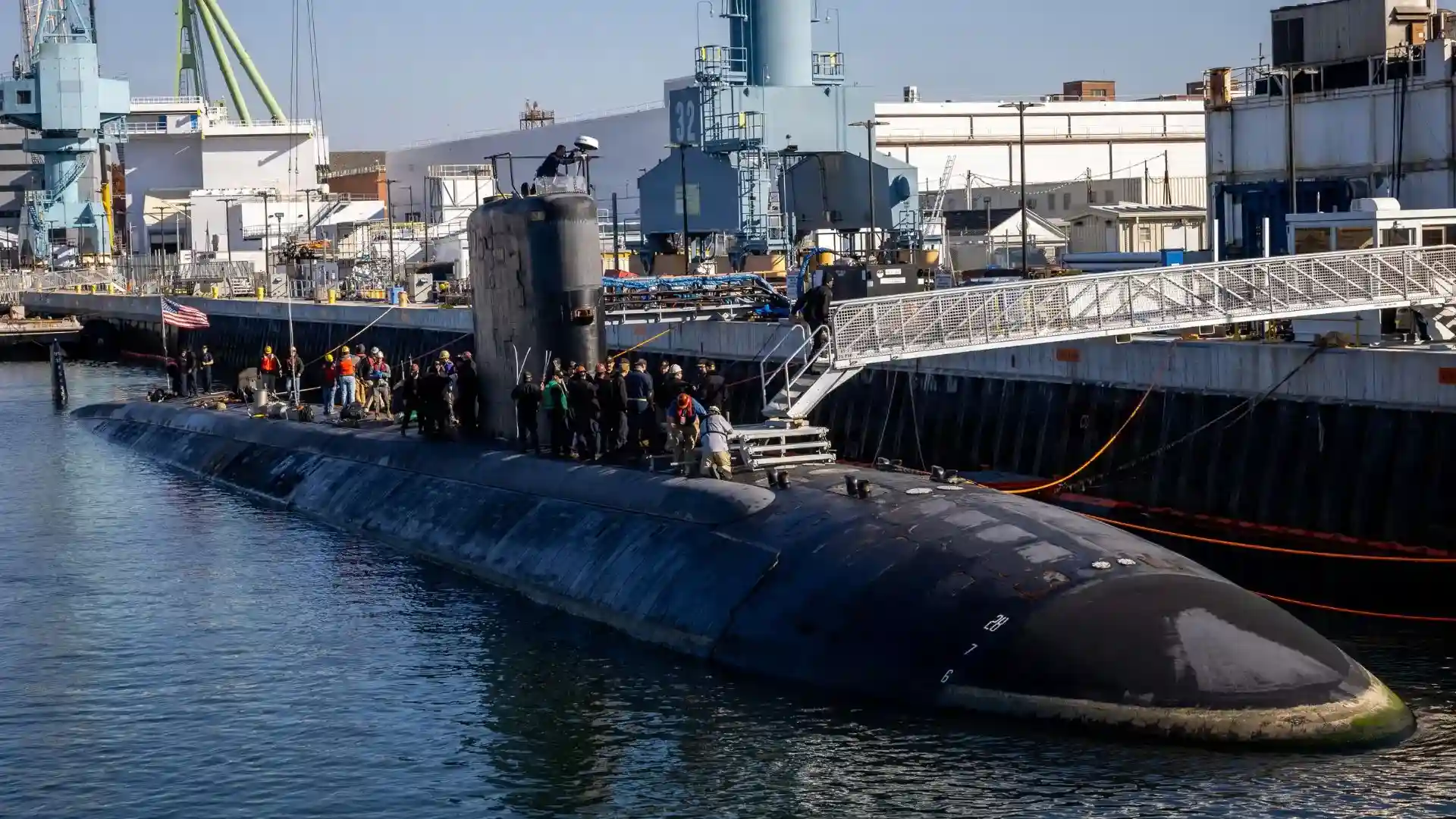
The U.S. Navy’s Los Angeles-class attack submarine USS Columbia (SSN 771) arrived at Portsmouth Naval Shipyard (PNSY) in Kittery, Maine, on October 29, 2026, to begin an overhaul under the Service Life Extension Program (SLEP), the Navy’s effort to keep a handful of late-build Los Angeles-class boats in service beyond their planned retirement.
The availability follows work on USS Cheyenne (SSN 773), the first boat to complete the program, and USS Hampton (SSN 767) at the same yard, and it comes as the Navy tries to bridge a gap in its attack submarine force while Virginia-class production runs below the two-boats-per-year rate the service has sought. The boat should not be confused with the Columbia-class ballistic missile submarine program, whose lead hull, the future USS District of Columbia (SSBN 826), remains under construction at General Dynamics Electric Boat in Groton, Connecticut.
USS Columbia SSN 771: Flight III Design and Strike Capabilities
Commissioned on October 9, 1995, Columbia was the last Los Angeles-class submarine built at Electric Boat’s Groton yard. It belongs to the Flight III, or Improved Los Angeles (688i), subgroup, the final 23 hulls of the class (SSN 751 to SSN 773), which also includes USS Greeneville (SSN 772) and Cheyenne, the last boat built.
Publicly available specifications for the 688i boats indicate a length of about 360 feet (110 meters), a beam of 33 feet (10 meters) and a submerged displacement of roughly 6,900 tons. Propulsion comes from a single S6G pressurized water reactor driving one shaft, with the Navy listing top speed only as in excess of 25 knots. The Flight III design moved the diving planes from the sail to the bow and hardened the sail for under-ice operations, configuring these boats for under-ice operations the earlier flights could not perform.
Armament combines four 21-inch (533 mm) torpedo tubes for Mk 48 Advanced Capability (ADCAP) heavyweight torpedoes with 12 Vertical Launch System (VLS) tubes in the bow for Tomahawk land-attack cruise missiles. The Navy’s release highlights exactly those two roles: long-range Tomahawk strike and special operations forces insertion. The bow VLS tubes give the boat a dedicated strike magazine without consuming torpedo room space needed for anti-submarine and anti-surface missions.
Columbia’s last major yard period was an engineered overhaul at Pearl Harbor Naval Shipyard that began in October 2018 and concluded on May 17, 2021. The boat returned to Joint Base Pearl Harbor-Hickam from its most recent deployment on June 1, 2025, and Cmdr. William Murphy took command on November 18, 2025. Columbia now falls under Submarine Squadron 2, whose commodore, Capt. Mike Poplawski, said he expects the overhaul to deliver “a formidable warship at the exact point of need.”
Lessons From Cheyenne and Hampton Shape the Columbia Overhaul
Cheyenne served as the pathfinder. The Navy announced in November 2020 that it planned to refuel six Los Angeles-class boats to shore up attack submarine numbers, with Cheyenne first in line. In April 2022, it became the first boat to dock in PNSY’s rebuilt Dry Dock 1 using the new Super Flood Basin, a Shipyard Infrastructure Optimization Program project. It undocked on February 6, 2025, departed for sea trials on December 12, 2025, and completed its Engineered Refueling Overhaul that month. According to the Navy, the work extends Cheyenne’s total service life beyond 44 years. The availability had initially been scoped at 30 months.
Hampton followed, arriving at Kittery on November 21, 2024, and entering dry dock on March 8, 2025. Shipyard Commander Capt. Jesse Nice said the yard aims at “surpassing our previous achievements” on both boats with Columbia.
The Navy’s release leaves key parameters open. It does not state the planned duration, the cost, or whether Columbia will receive a new reactor core, as Cheyenne did. Because Columbia’s 2018 to 2021 Pearl Harbor availability already served as a mid-life overhaul, the precise scope of the SLEP package for this hull remains unconfirmed.
Analysis: The SLEP calculation turns less on money than on dry dock time. Portsmouth is the Navy’s lead public yard for attack submarine overhauls, and every 688i that occupies a dock for a multiyear refueling overhaul is a dock unavailable to the Virginia-class maintenance backlog. Cheyenne’s availability, scoped at 30 months, ran from early 2022 to December 2025. If Columbia tracks closer to the original estimate, each extended hull buys roughly a decade of additional service at a manageable industrial cost. If it repeats Cheyenne’s timeline, the net gain in deployable attack submarines shrinks, and the case for extending further Los Angeles-class boats weakens.
The next public milestones are Columbia’s dry-docking at Kittery and, later, its undocking and sea trials. Hampton’s redelivery will offer the first indication of whether PNSY has shortened the learning curve established on Cheyenne. Whether the Navy extends SLEP to additional Los Angeles-class hulls will depend on Virginia-class delivery rates and on how quickly Portsmouth returns Columbia to the fleet.