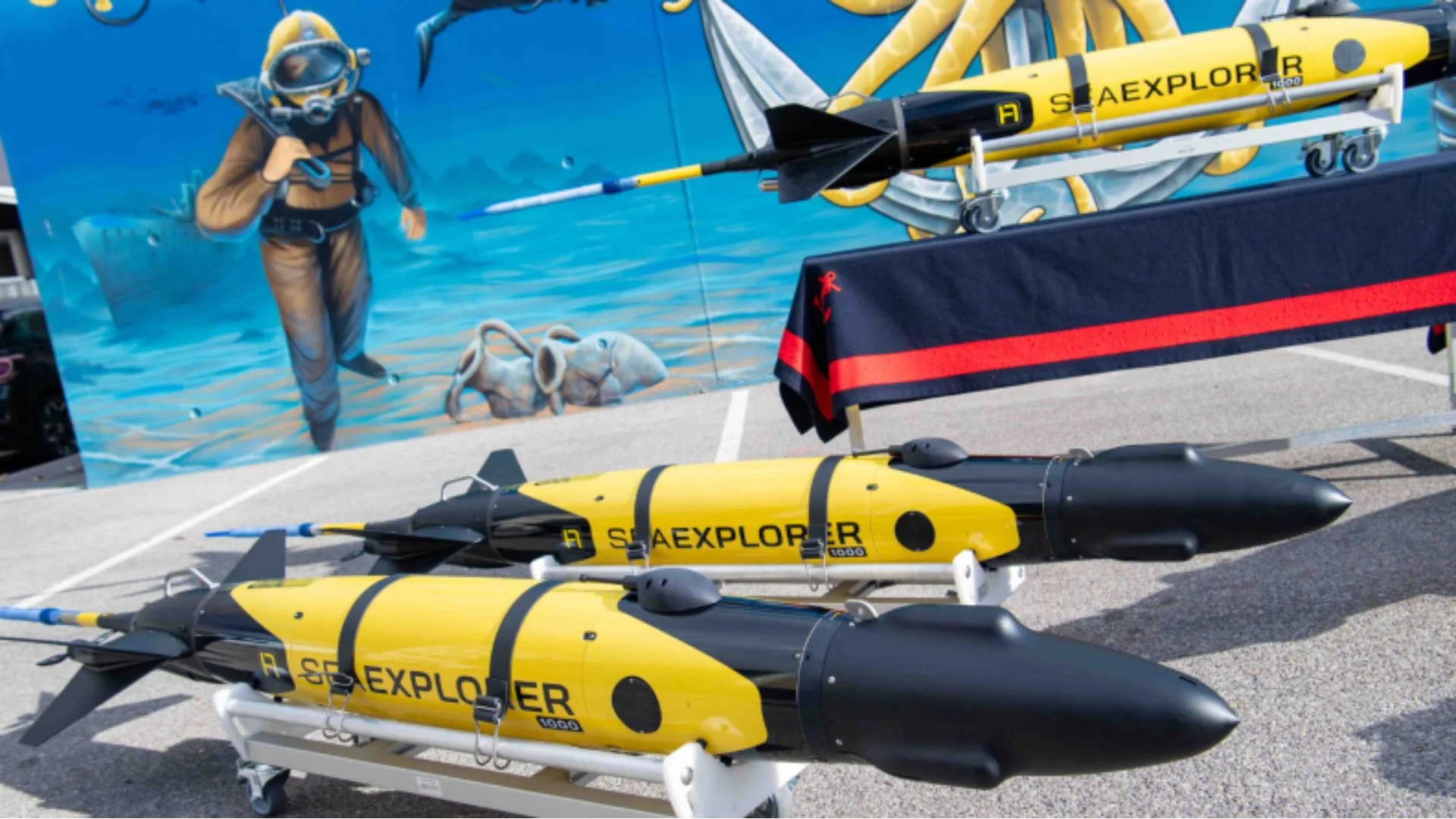
The French Navy’s Naval Action Force (Force d’action navale, FAN) deployed an anti-submarine warfare (ASW) detachment operating four Alseamar underwater gliders, a class of uncrewed underwater vehicle (UUV), to NATO’s REPMUS 26 exercise in Troia, Portugal, the first time the force has sent such a detachment, according to the French Navy. The detachment combined ASW specialists from the multi-mission frigate (FREMM) Bretagne with glider pilots from CENTEX FAN, the force’s experimentation unit.
REPMUS, short for Robotic Experimentation and Prototyping using Maritime Uncrewed Systems, ran from August 31 to September 25, 2026, under Portuguese Navy leadership with NATO’s Centre for Maritime Research and Experimentation (CMRE). The 2026 edition drew more than 3,700 participants from 36 navies and roughly 300 uncrewed aerial, surface and underwater systems, according to French Navy figures. For Paris, the stakes were specific: the gliders were recently acquired by the FAN commander (ALFAN), and the detachment’s task was to assess whether the technology is mature enough to open a new line of ASW operations built on French-made UUVs.
French Navy Underwater Gliders Join an Allied ASW Barrier
Over nearly two weeks, the detachment took part in 17 serials followed by a 48-hour live exercise (LIVEX) conducted entirely with uncrewed systems. French sailors piloted the gliders autonomously in demanding scenarios against other UUVs configured to emulate a submarine credibly for both active and passive detection.
The central objective of the 2026 edition was interoperability between allied uncrewed aerial vehicles (UAV), uncrewed surface vessels (USV) and UUVs, and the ability to run multi-domain operations with autonomous assets. That depends on drones and their command-and-control (C2) nodes, afloat or ashore, exchanging tactical data in a common format. By applying STANAG 4817, the NATO standardization agreement governing that exchange, the four French gliders demonstrated two capabilities, according to the French Navy:
- Integration into an allied ASW barrier alongside other UUV types, sonar-equipped USVs and UAVs carrying ASW sensors.
- Transmission of tactical data into NATO’s Common Operational Picture (COP).
The operational logic is distributed sensing. Gliders act as offboard sensors operating far from the host ship, forming a network that covers large areas autonomously and pushes detection of submarine threats earlier and farther out. For a FREMM whose organic ASW suite rests on a hull-mounted sonar, a CAPTAS-4 towed array and an embarked NH90 helicopter, offboard nodes extend the surveillance footprint without committing the frigate’s own position.
SeaExplorer Design: Buoyancy Engine, 1,000-Meter Dives, Four-Week Endurance
Imagery released by the French Navy shows the vehicles carrying Alseamar’s SeaExplorer branding; the exact variant was not specified. The gliders weigh about 60 kilograms and carry no propulsion. A hydraulic buoyancy system changes the vehicle’s depth while fixed wings convert vertical motion into forward glide, producing a sawtooth trajectory between the surface and depths of up to 1,000 meters. The Navy puts operational endurance at roughly four weeks.
Publicly available manufacturer specifications for the SeaExplorer family indicate a hull 0.25 meters in diameter and 2 meters long, a weight of 59 kilograms in air, a 1,000-meter depth rating and a maximum speed of about 1 knot. Navigation and communications rely on GPS, Iridium satellite link and radio when the glider surfaces. Alseamar lists acoustic intelligence and ASW among the platform’s defense applications, and its military 1000-M version can be fitted with wing-mounted electric thrusters.
The figures define the trade-off. A 1-knot glider cannot pursue a submarine, but its quiet buoyancy propulsion and multi-week endurance suit persistent passive listening along transit routes, chokepoints or the approaches to a naval force. The four-week figure cited by the French Navy sits well below the multi-month endurance quoted commercially for scientific profiling, a gap that typically reflects sensor power draw and mission tempo. The Navy did not disclose the acoustic payload carried at REPMUS.
Analysis: REPMUS 26 shows the French Navy treating gliders as ASW network nodes rather than oceanographic tools. The proof point was not endurance or depth, both established in civilian use, but STANAG 4817 compliance and COP integration, which determine whether a French sensor can cue an allied frigate or maritime patrol aircraft. Low-cost persistent sensors offer a way to stretch a limited frigate fleet. Their value will hinge on how quickly a glider contact reaches a shooter, a latency question that surface-only communications leave open.
ALFAN has made the operational employment of naval drones by combat ships one of its main priorities for its units. Key unknowns remain the size of the Alseamar order beyond the four gliders deployed, the acoustic payload selected and the timeline for pairing glider teams with deployed FREMMs. The French Navy said the gliders could provide advanced detection of several target types for a naval force once the technology is mastered, an indication that operational status has not yet been reached.