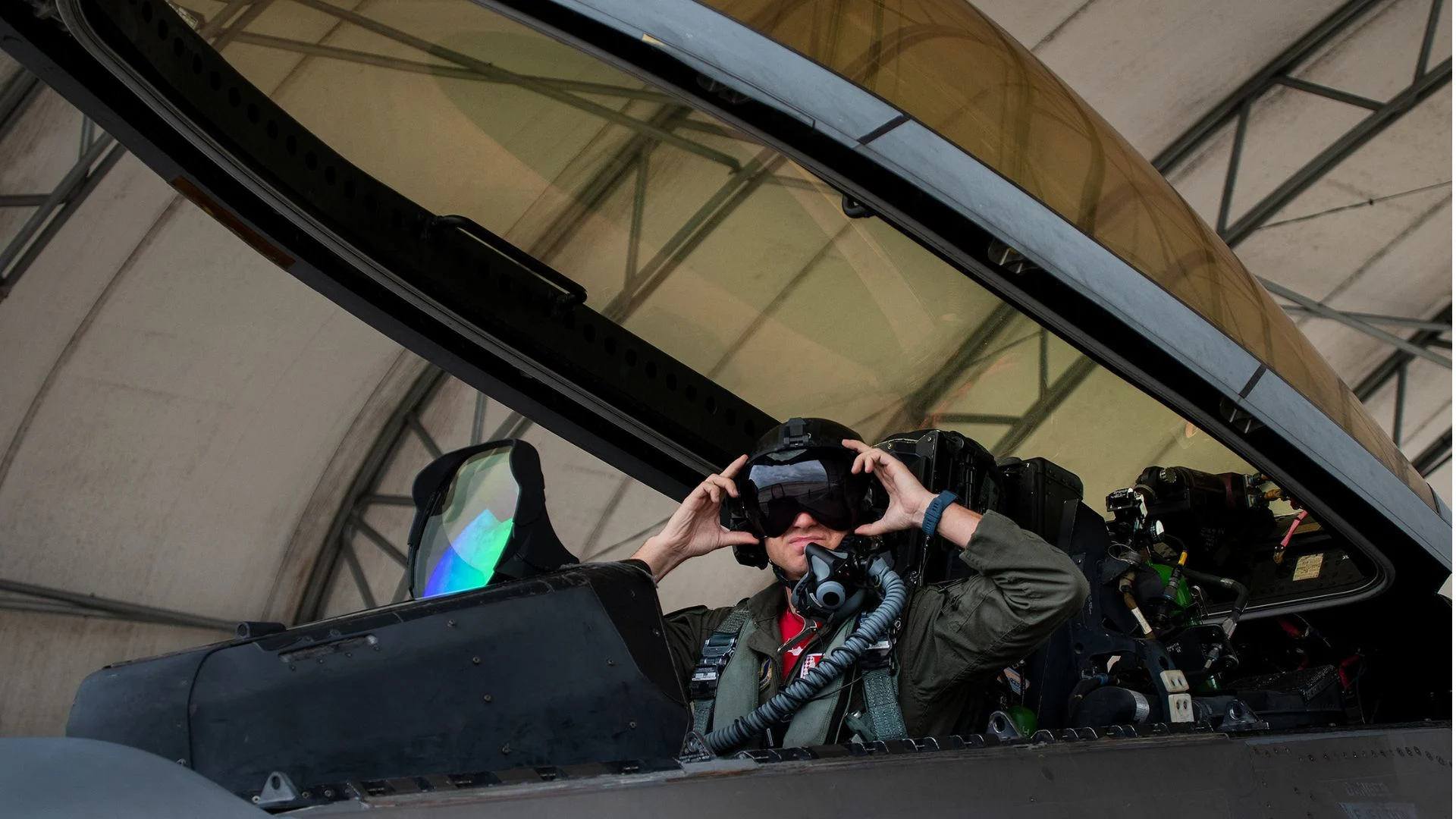
The US Air Force awarded LIFT Airborne Technologies LLC of Carson City, Nevada, an $83.4 million ceiling indefinite-delivery/indefinite-quantity (IDIQ) contract on October 30, 2026, for delta development, qualification, production, and fielding of the Next Generation Fixed Wing Helmet (NGFWH) across multiple Air Force aircraft types, according to the Pentagon’s contract announcement.
The award moves the program from prototyping toward production after a multiyear effort to replace the HGU-55/P, the service’s standard fixed-wing aircrew helmet since the 1980s. The NGFWH grew out of an AFWERX helmet challenge launched in 2018 that drew more than 100 design submissions, and Air Combat Command (ACC) selected LIFT’s design in June 2022. At the time, the Air Force projected a production contract in 2024, placing this award roughly two years behind the original schedule.
Contract Terms for the Next Generation Fixed Wing Helmet
The Air Force Life Cycle Management Center (AFLCMC) at Wright-Patterson Air Force Base, Ohio, is the contracting activity under contract FA8606-27-D-B002. Fiscal 2026 research, development, test and evaluation (RDT&E) funds totaling $4,095,959 were obligated at award, about 4.9% of the ceiling. Work will be performed in Carson City and is expected to be completed by October 30, 2036.
The contract is a Small Business Innovation Research (SBIR) Phase III follow-on acquisition. Phase III status lets the Air Force award production work to a small business that matured the technology under earlier SBIR phases without a new full and open competition. The “delta development” language indicates engineering work remains before qualification, although the announcement does not specify which changes are required.
Several details remain undisclosed: unit price, total quantities, the aircraft fielding sequence, and which helmet-mounted displays fall within scope. Program figures released in 2022 put the prototype effort at $20 million and the total program at up to $400 million against the AFLCMC requirement. The Air Force has not explained how the $83.4 million ceiling relates to that broader estimate.
AV 2.2 Design Targets Neck Strain and Helmet-Mounted Devices
LIFT designates the helmet AV 2.2. Publicly available information indicates a carbon fiber shell, a dynamic fit system, rear ventilation, an integrated night vision goggle mount requiring no separate bracket, and Active Noise Reduction as standard. LIFT chief executive Guido Rietdyk has set a goal of keeping the helmet under 2.2 pounds in any size or configuration; that figure is a company target, not a verified specification.
The legacy HGU-55/P was not designed to carry modern helmet-mounted displays and night vision devices, which shift the center of gravity and amplify neck loads under high-G maneuvering. ACC framed the program around reducing long-term neck and back injuries, extending aircrew careers, and improving fit across a more diverse aircrew population, including female aviators poorly served by legacy sizing.
In March 2023, five F-22A Raptor pilots from the 301st Fighter Squadron flew the helmet during a second round of developmental testing at Eglin Air Force Base, Florida, conducted by the 46th Test Squadron and the 28th Test and Evaluation Squadron. The HC-130J Combat King II and B-1B Lancer were named as the next test platforms. ACC plans to field the helmet first to F-15E Strike Eagle aircrew. F-35 pilots are excluded; they fly with a dedicated, custom-fitted helmet-mounted display system reported at roughly $400,000 per unit.
Analysis: The award confirms that the Air Force and Navy will field different helmets under programs sharing the same name. In January 2026, the Navy selected Gentex’s PURSUIT system for its own NGFWH effort, backed by a $22.6 million IDIQ for more than 5,000 helmets across the E-2D, F/A-18, EA-18G, T-45, and T-6 fleets. The Air Force instead carried a nontraditional small business from an AFWERX challenge through SBIR Phase III to a production vehicle, displacing Gentex, the HGU-55/P manufacturer. That path validates SBIR as an entry route into aircrew equipment production, but the two-year slip and a modest initial obligation drawn from RDT&E funds show the program has not yet reached funded production at scale.
Next milestones include completion of qualification, airworthiness certification aircraft by aircraft, and the first delivery orders for F-15E crews. The fiscal 2027 budget request and the first task orders under FA8606-27-D-B002 will show whether production funding follows at the pace a ten-year ordering period implies.