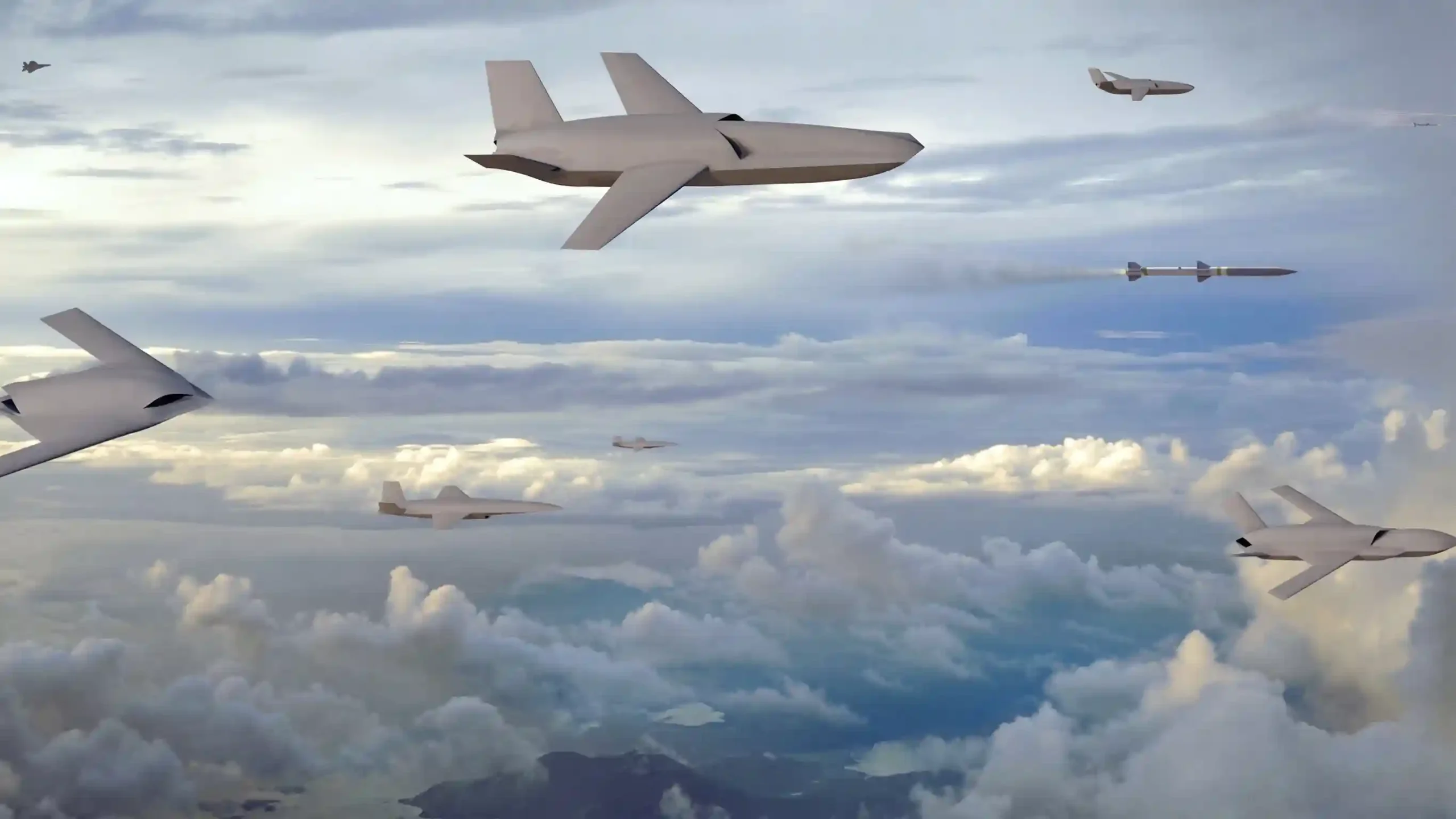
General Atomics Aeronautical Systems (GA-ASI) is developing NextGen, a large hybrid-electric flying-wing drone built for combined intelligence, surveillance, and reconnaissance (ISR) and strike missions, with a company target of more than 60 hours of unrefueled endurance. Spokesperson C. Mark Brinkley disclosed the program in a Gambit family update shared with The War Zone (TWZ) and published October 30, 2026, and said NextGen work will feed into the stealthy Gambit 4 concept.
The disclosure comes as the Gambit line shifts from concepts to production hardware. The Air Force ordered the FQ-42A Vengeance, the Gambit 2 derivative, into production in June 2026 under Increment 1 of its Collaborative Combat Aircraft (CCA) program, and Secretary of the Air Force Troy Meink set a goal on September 14, 2026, of at least 500 CCAs in service by 2032. NextGen targets a different mission: the persistent ISR and strike role long held by GA-ASI’s own MQ-9 Reaper, whose publicly acknowledged endurance is about 27 hours.
General Atomics NextGen: Hybrid-Electric Propulsion and 60-Hour Endurance
Brinkley was explicit that the General Atomics NextGen design is not a CCA. Speaking to TWZ, he described it as “novel hybrid-electric propulsion on a fully armed, fully outfitted, ISR/Strike wing,” adding that the company’s engine team has promised more than 60 hours aloft without refueling. He characterized the aircraft as a substantially larger flying wing but released no dimensions, gross weight, payload, sensor fit, or first flight date.
GA-ASI has not detailed the NextGen powertrain. Publicly available specifications for the company’s earlier hybrid work offer the clearest indication of the architecture. Reporting from the 2023 Paris Air Show described a 13,000-lb Gambit 4 demonstrator powered by the Heavy Fuel Engine (HFE) 2.0, a 400-hp diesel derived from the Thielert Centurion that drives electric thrusters, with two 50-kW boosters for takeoff and payload power. Whether NextGen retains that layout is unconfirmed.
The operational logic is endurance and signature. A series hybrid lets the engine run at its most efficient setting while electric motors drive propulsors buried in the planform, cutting infrared and acoustic signatures on top of the radar-signature benefits of a tailless wing. More than 60 hours would more than double the MQ-9 figure. Alexander tied the same target in 2022 to covering the South China Sea without dependence on aerial refueling, a direct answer to tanker vulnerability in a Pacific fight.
From MQ-Next to GHOST: The Hybrid-Electric Flying Wing Lineage
NextGen is the latest name in a lineage GA-ASI has pursued publicly since at least 2021, when it released a stealthy flying-wing concept for the Air Force’s MQ-Next Reaper successor effort. By 2022, the company was citing a 60-hour hybrid-electric goal for that design. On May 27, 2025, the Air Force Research Laboratory (AFRL) awarded GA-ASI a sole-source, $99,292,613 cost-plus-fixed-fee contract for GHOST, a hybrid-electric ducted-fan next-generation ISR/strike unmanned aerial system, with work in Poway, California, due for completion in August 2028.
Neither GA-ASI nor AFRL has explained how GHOST, MQ-Next, NextGen, and Gambit 4 relate, and the company has said it cannot discuss GHOST. Program timing is also unclear. In 2023, GA-ASI said it would self-fund a 13,000-lb Gambit 4 demonstrator and fly it by 2026. Brinkley now counts two Gambit variants flying and two more on track to become flying prototypes, a tally that excludes Gambit 4, and no flight of that demonstrator has been disclosed.
GA-ASI is not alone in this design space. DARPA’s XRQ-73, built by Northrop Grumman and Scaled Composites under the Series Hybrid Electric Propulsion AiRcraft Demonstration (SHEPARD) program, first flew in April 2026 from Edwards Air Force Base, California. At about 1,250 lb, the Group 3 XRQ-73 sits an order of magnitude below the 13,000-lb Gambit 4 class, pointing to different payload and mission tiers rather than head-to-head competition.
Gambit 6 Live-Fire Plans and FQ-42A Production Momentum
The update also covered the wider Gambit family, built around a common core chassis of landing gear, baseline avionics, and other hardware. Gambit 6, the ground-attack derivative of the Gambit 2 fighter, is slated for a company live-fire of a ground-attack munition in early 2027 from a company-owned airframe. GA-ASI says the effort draws on FQ-42A live-fire preparation, with the first missile shot planned before the end of 2026, and on years of internal air-to-ground releases from the MQ-20 Avenger.
Internal carriage is the differentiator GA-ASI is pressing. Anduril released images in September 2026 of its FQ-44A Fury fit-checked with Joint Direct Attack Munitions and 70mm rocket pods on underwing stations. GA-ASI argues that a CCA lacking low observability and an internal weapons bay gives up survivability, the attribute that decides whether such aircraft can operate inside dense air defenses.
Industrial and test milestones are accumulating. GA-ASI named Spirit Defense, a Boeing company, as FQ-42 fuselage design-build partner on October 23, 2026, after delivering an FQ-42 to Creech Air Force Base, Nevada, on September 18, 2026, for test and evaluation units. AFRL announced on October 27, 2026, that the XQ-67A, the Gambit 1 testbed, had flown over the Nevada Test and Training Range under the Demon APE program with new sensors, mission computers, power and thermal management hardware, and beyond-line-of-sight datalinks.
Analysis: NextGen shows GA-ASI building two franchises from one design philosophy: affordable mass through CCA, and persistence through a large, low-signature hybrid-electric wing. The second case is harder to close. GHOST is a technology maturation award, not a procurement line, and the Air Force’s stated MQ-9 successor push, 500 Massed Modular Aircraft by 2032 at a reported target of about $10 million per aircraft, prizes quantity and price over the endurance and survivability NextGen promises. A fully outfitted 60-hour strike wing will need a contested-ISR requirement the Air Force has yet to define publicly.
Near-term markers are concrete: the FQ-42A’s first missile live-fire and its participation in Exercise Emerald Flag, then the Gambit 6 air-to-ground shot in early 2027. GHOST runs to August 2028. NextGen’s size, payload, sensor suite, customer, first flight date, and link to GHOST all remain unknown.