The US Air Force and the Defense Innovation Unit (DIU) have narrowed the Massed Modular Aircraft (MMA) program to seven companies that will compete to build a low-cost, semi-autonomous successor to the MQ-9A Reaper. Anduril, Chaos Industries, General Atomics Aeronautical Systems (GA-ASI), Grid Aero, Otto Aerospace, Shield AI, and Swarm Aero received notice on September 30, 2026, as first reported by Air & Space Forces Magazine, citing multiple sources.
The downselect follows a costly year for the Reaper fleet. A Congressional Research Service report dated May 13, 2026, counted 24 MQ-9s lost during Operation Epic Fury, the 40-day campaign against Iran that began February 28. GA-ASI no longer builds the MQ-9A, and its MQ-9B can exceed $30 million per aircraft as equipped. DIU’s July 7 solicitation called reliance on aircraft in that price class unsustainable against layered air defenses built on increasingly cheap interceptors. Air Force Secretary Troy Meink said on September 14 that the service wants 500 MMAs fielded by 2032.
Massed Modular Aircraft Requirements: Range, Payload, and a $10 Million Target
DIU’s solicitation sets a minimum payload of 2,800 pounds, an unrefueled combat radius of at least 2,300 nautical miles while carrying that payload, and a one-way self-deployment range of at least 8,000 nautical miles. The aircraft must cruise at 200 knots or faster and operate from runways of 6,000 feet or shorter. A modular open systems approach, autonomous control, and hybrid satellite and mesh communications complete the core requirement, along with capacity for sensor payloads such as the full-motion video turrets central to today’s MQ-9 mission.
Publicly available specifications indicate the MQ-9A carries up to 3,850 pounds of payload, 850 pounds internally and 3,000 pounds on wing stations, powered by a single Honeywell TPE331-10 turboprop of roughly 900 shaft horsepower. It has a 66-foot wingspan, a maximum takeoff weight of about 10,500 pounds, and a 50,000-foot ceiling. MMA accepts about 1,000 pounds less payload in exchange for a radius sized for transoceanic operations. That is a Pacific requirement, not a Middle East one.
Air Force leaders said in a September 3 briefing that they expect to pay about $10 million per MMA airframe, excluding sensors and mission equipment. The solicitation describes a risk-tolerant aircraft built for high-rate manufacture and flown in numbers large enough to sustain pressure on an adversary even as some are shot down.
GA-ASI Wildfire and Swarm Aero Gamera Set the Disclosed Benchmarks
Only two contenders have shown designs publicly. GA-ASI unveiled Wildfire on September 10, 2026, as a clean-sheet aircraft drawing on its MQ-9 and FQ-42A Collaborative Combat Aircraft (CCA) experience. The company says Wildfire can carry two AGM-158C Long Range Anti-Ship Missiles (LRASM) or four Joint Strike Missiles (JSM), exceeds the 8,000-nautical-mile ferry requirement, and will fly with collaborative autonomy. GA-ASI has not released Wildfire’s engine, dimensions, endurance, or price, and none of its figures have been demonstrated in flight. The loadout signals a doctrinal shift: the MQ-9A typically carries AGM-114 Hellfire missiles and 500-pound GBU-12 or GBU-38 bombs, while Wildfire is pitched as a standoff maritime strike platform.
Swarm Aero, an Oxnard, California, startup founded in 2022, displayed a full-scale model of its Gamera Group 5 aircraft on September 14. The company claims a wingspan of about 72 feet, an unrefueled range of 9,000 nautical miles, and more than 2,800 pounds of payload across seven stations, enough for JASSM-ER or LRASM. Gamera uses a Honeywell TPE331 turboprop, the same engine family as the MQ-9A, limiting propulsion risk. Swarm Aero says its Legion autonomy software can manage groups of up to 80 aircraft. All Gamera figures remain company claims.
Otto Aerospace, Anduril, and Shield AI Enter With Undisclosed MMA Designs
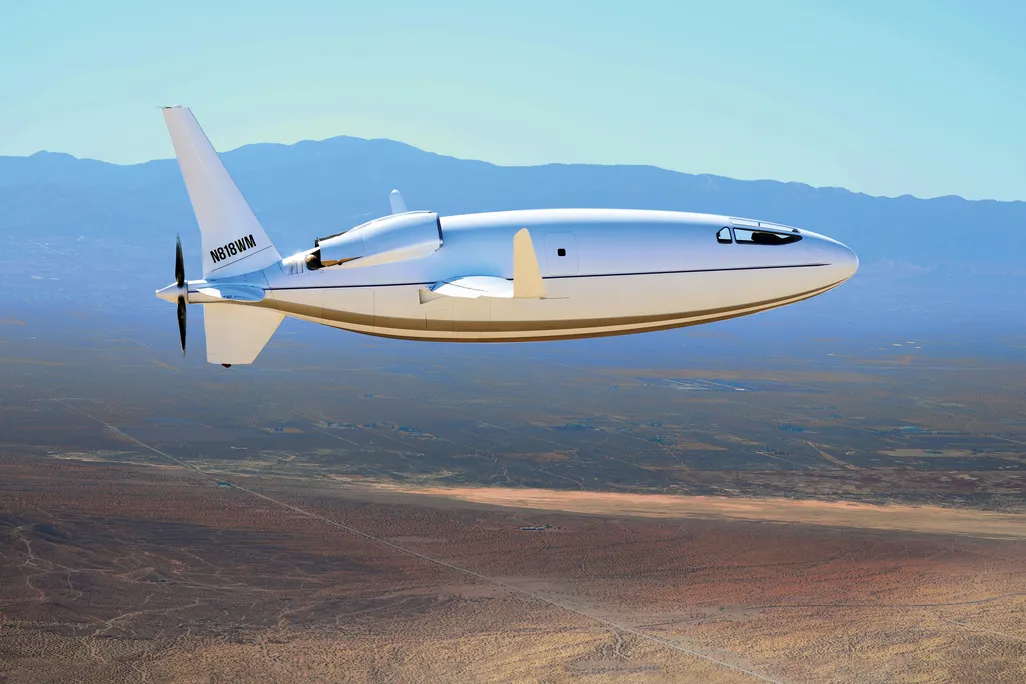
Otto Aerospace is the least conventional name on the list. Its designs exploit laminar flow, shaping fuselage and wings to keep airflow smooth and cut drag. The crewed Celera 500L demonstrator, a teardrop-shaped pusher powered by a turbocharged V12 piston engine, reached 15,000 feet and 250 miles per hour in testing. Otto projects its Phantom 3500 business jet will burn about 115 gallons of fuel per hour, against roughly 300 for comparable jets, and in May completed flight tests of a small laminar-flow drone for the Defense Advanced Research Projects Agency (DARPA). Otto has not disclosed an MMA proposal, but the logic is direct: against a 2,300-nautical-mile radius, lower drag converts into less fuel, a smaller airframe, or more payload.
Anduril builds the FQ-44A Fury, one of two CCA designs the Air Force has ordered into production alongside GA-ASI’s FQ-42A, but has shown no MMA design. Shield AI’s offering is unknown; its V-BAT and the in-development X-BAT bracket the requirement. Grid Aero is developing the twin-engine Lifter Lite cargo drone with AFWERX funding. Chaos Industries, known primarily for counter-drone radars, shows no public drone design.
Analysis: The shortlist reflects a requirement in which unit cost, not survivability, is the binding variable. At $10 million per airframe, the Air Force could buy roughly three MMAs for the price of one fully equipped MQ-9B, and the 500-aircraft objective would cost about $5 billion before sensors. Meeting a 2,300-nautical-mile radius with 2,800 pounds of payload at that price rewards firms that can cut fuel weight and structural cost, which explains why an aerodynamics specialist sits beside the incumbent Reaper builder. The operational bet is cost exchange: an MMA force carrying LRASM-class weapons compels an adversary to spend surface-to-air interceptors on $10 million airframes, narrowing the gap that left the Reaper fleet so exposed over Iran.
Each company will now submit a proposal to build an MMA prototype, according to an industry source. The Air Force has not publicly confirmed the seven names, and how many firms bid in July remains unknown. DIU wants a prototype within a year of contract award and fielding at scale as early as 2029, ahead of the original target of 20 mission-ready aircraft in fiscal 2031. The next decision point is whether the Air Force funds one design or several, as it did with CCA.