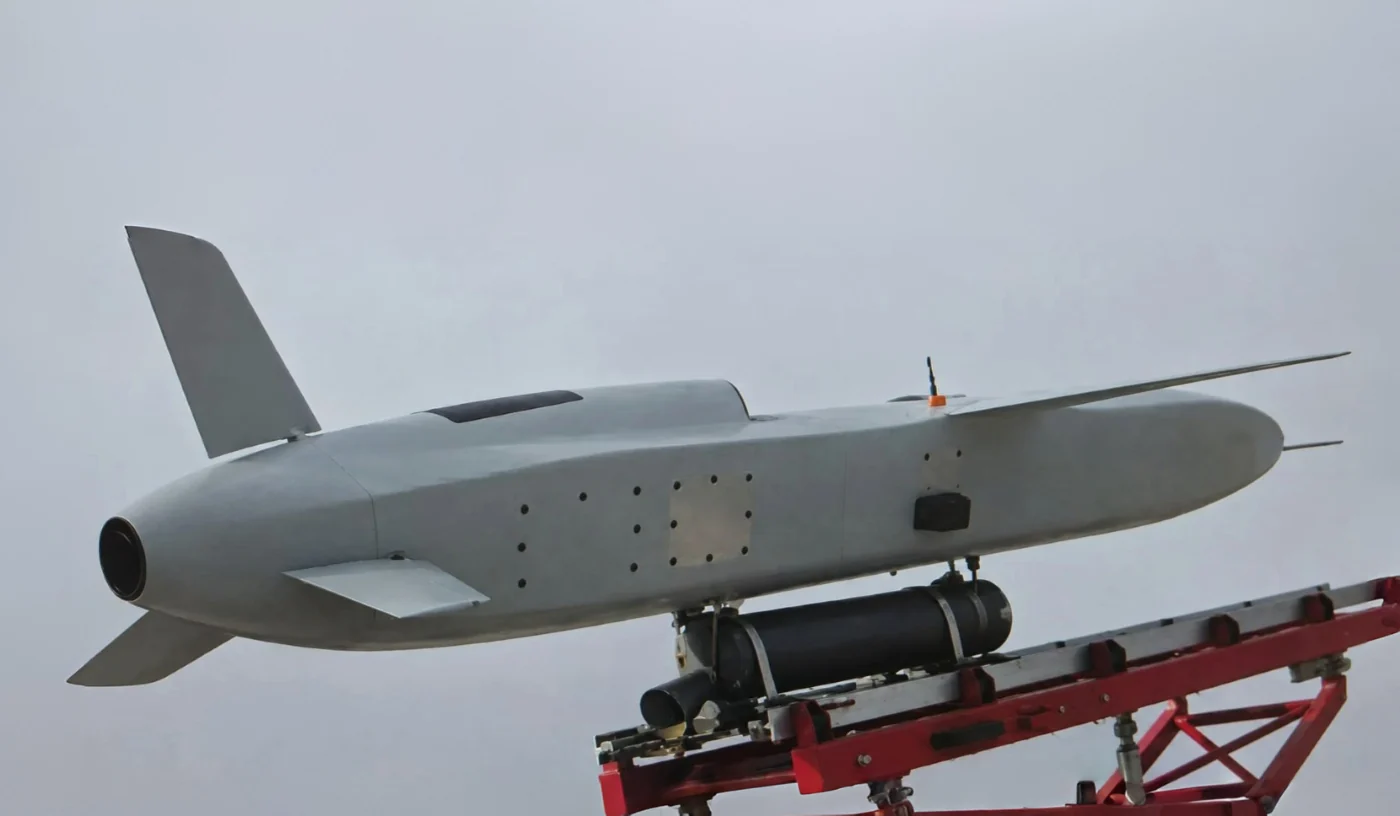
Russia’s new Filin cruise missile has appeared for the first time on its ground launcher, fitted with a solid-fuel booster beneath the fuselage, in a photograph circulated by a Russian pro-war blogger. The image confirms the launch method described by Ukraine’s Defense Intelligence Directorate (HUR), but it does not show where or when it was taken, nor the vehicle or rail system that carries the launcher.
The photo follows HUR’s October 22, 2026, disclosure of the weapon on its War&Sanctions portal, where the agency published an interactive 3D model, a technical profile and a breakdown of 81 components. According to HUR, Russian forces began using the Filin against Ukraine in late summer 2026. The missile is built by NPO Molniya, part of the state-owned Tactical Missiles Corporation (KTRV), and HUR described it as the latest product of a Russian industrial push toward low-cost, jet-powered, ground-launched strike weapons.
Filin Cruise Missile Launch Sequence and Airframe Design
The photograph shows a booster-assisted launch arrangement. A solid-propellant booster mounted under the lower fuselage accelerates the missile off the launcher and into flight, then separates once the Filin’s own turbojet takes over for the cruise phase. The configuration removes any dependence on combat aircraft and allows the weapon to be fired from a simple ground rail.
HUR identifies the powerplant as the R500 turbojet produced by Reynolds LLC, a subsidiary of UEC-Saturn within the state-owned United Engine Corporation (UEC). The same engine was previously found in the S-71K Kover and S-71M Monokhrom air-launched cruise missiles. Reusing the R500 in a ground-launched airframe points to a shared propulsion base across Russia’s new compact cruise missiles and a simplified supply chain.
The airframe is small by cruise missile standards. HUR data gives a fuselage length of about 3.5 m (11.5 ft), a wingspan of 3 m (9.8 ft) and a maximum launch weight of roughly 210 kg. The body uses carbon-fiber and fiberglass composites, and some elements are 3D-printed. The design features a straight wing, a conventional tail and a dorsal air intake for the turbojet. Composite construction and additive manufacturing cut weight and production time, two variables that matter more than individual performance for a weapon intended to be fired in volume.
Range, Warheads and Guidance: Where Filin Fits in Russia’s Strike Mix
According to performance figures declared by Russian sources and relayed by HUR, the Filin reaches a maximum speed of 800 km/h and a range of 600 to 1,200 km depending on configuration. It can cruise at altitudes up to 6 km or descend to ultra-low altitude to complicate detection. Two warhead weights are listed, 50 kg and 100 kg, in high-explosive, penetrating and thermobaric variants. None of these performance figures has been independently verified.
For navigation, HUR identified a Chinese-made navigation unit paired with a Russian Kometa satellite-navigation module with 16 antenna channels, designed to resist electronic jamming. Of the 81 components HUR catalogued, 35 originate from US manufacturers and 22 from Chinese manufacturers. HUR also linked the missile’s onboard equipment to a Russian firm involved in producing the Garpiya, a domestically built variant of the Geran-2 long-range attack drone.
That profile places the Filin between two existing tiers. Geran-type drones are slower, propeller-driven and cheap enough to be launched in large salvos. Full-size cruise missiles such as the Kh-101 carry a warhead of roughly 400 kg, according to publicly available specifications, but cost far more per round and depend on Tu-95MS and Tu-160 bombers. A 100 kg warhead is a fraction of that payload, yet at 800 km/h the Filin cuts reaction time for Ukrainian mobile fire groups built around intercepting drones that fly at roughly 180 km/h.
Analysis: The Filin is less a technological leap than a production-economics decision. By combining a shared turbojet, a composite airframe, 3D-printed parts and a booster-assisted rail launch, Russia is building a missile that sits in the cost gap between drones and strategic cruise missiles. Its main operational effect falls on Ukrainian air defense allocation: a jet-powered target at 800 km/h is too fast for many gun-based and interceptor-drone defenses tuned against Geran-class threats, yet cheap enough that engaging it with high-end surface-to-air missiles is a poor exchange. The 35 US-origin components also show that Western export controls have not closed Russia’s access to commercial electronics for programs fielded in 2026.
Key unknowns remain the Filin’s production rate, unit cost, launcher vehicle and the units fielding it, as well as whether the 1,200 km figure applies only to the lighter 50 kg variant. The weapon joins a widening set of low-cost Russian strike systems identified by Ukrainian officials in recent months, including the S8000 Banderol cruise missile and jet-powered Geran variants. Recovered wreckage should show how much of the declared performance holds up in combat.