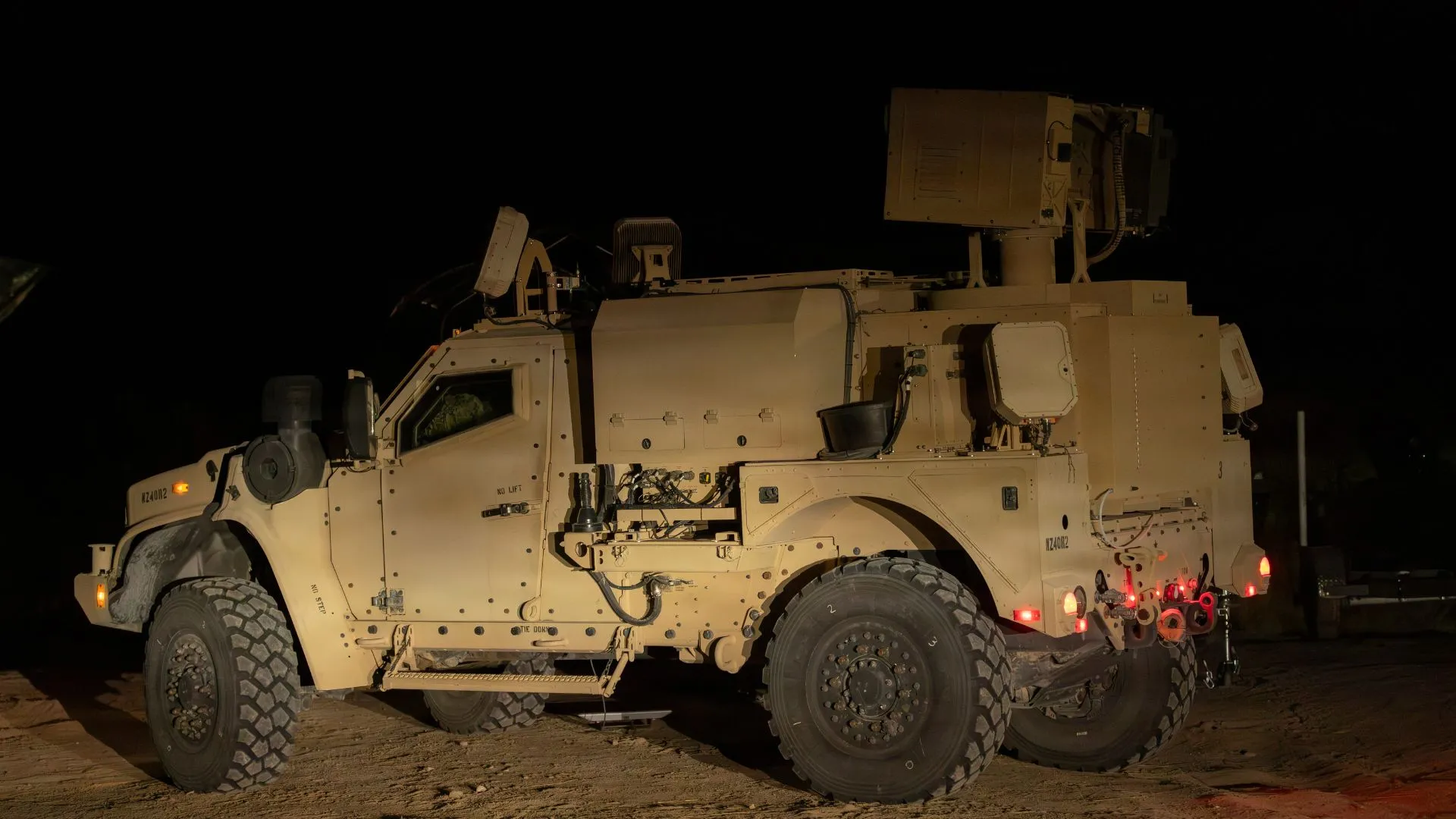
Leonardo DRS will provide power management, environmental control and rugged integration expertise for AeroVironment’s LOCUST X3 laser weapon under the U.S. Army’s Enduring-High Energy Laser (E-HEL) production program, the company announced on November 2, 2026. AeroVironment (AV), the E-HEL prime contractor, selected DRS as a subcontractor for the mobile counter-unmanned aircraft system (C-UAS) laser, which the Army plans to field on the Joint Light Tactical Vehicle (JLTV) and in palletized configurations. Neither company disclosed the value of the subcontract.
The selection follows the Army’s September 2, 2026, award of a $464.8 million other transaction agreement (OTA) to AV for E-HEL production, which the service described as its first production contract for a high-energy laser weapon system. Under the agreement, AV will deliver dozens of LOCUST X3 systems over the next several years to defeat Group 1 through Group 3 drones. The award moved Army directed energy into a program of record after the 50-kilowatt Directed Energy Maneuver Short-Range Air Defense (DE M-SHORAD) Stryker prototypes drew critical soldier feedback in the Middle East.
What the Leonardo DRS Laser Subcontract Covers on LOCUST X3
DRS will supply the subsystems that keep a vehicle-mounted laser in the fight: power management, plus the environmental control and thermal management hardware that removes waste heat from the laser system. Available electrical power and cooling capacity together determine how long the laser can dwell on a target and how many engagements it can sustain.
That is the practical limit behind the regenerating magazine the Army cites as a core E-HEL advantage: the magazine is only as deep as the power and thermal architecture allows. On a JLTV, those subsystems shape combat performance as much as the laser source itself.
“Evolving drone threats demand systems that deliver reliable performance in demanding operational environments,” said Aaron Hankins, vice president and general manager of Leonardo DRS Land Systems. “Our team is applying experience in vehicle integration, power and thermal management to help AV deliver a mobile high-energy laser capability for the U.S. Army.”
The work builds on a rapid-prototyping effort in which DRS, AV and other partners integrated a mobile C-UAS directed-energy capability into an armored vehicle. DRS provided vehicle integration, power, thermal management and systems engineering for U.S. government live-fire evaluations and training in 2024 and 2025. The company has not named that program or its host vehicle. DRS is also the mission equipment package integrator for the Army’s Stryker-based M-SHORAD Increment 1.
LOCUST X3 Specifications and the E-HEL Production Ramp
AV unveiled the LOCUST X3, the third generation of the LOCUST family, on March 24, 2026, at the Association of the United States Army (AUSA) Global Force symposium. The laser uses spectral beam combining to deliver up to 30 kilowatts, with the architecture scalable to lower-power configurations. A modular beam director handles pointing, and AV_Halo PINPOINT software automates detection, tracking and engagement. The design follows a modular open systems approach (MOSA) with 11 defined platform interfaces, according to publicly available specifications, letting the same weapon move between a JLTV, a pallet and potentially the Infantry Squad Vehicle (ISV), an integration still under review.
The target set spans Group 1 through Group 3 unmanned aircraft. Group 3 covers drones weighing up to 1,320 pounds, a band that includes Shahed-class one-way attack munitions. AV has not published an effective engagement range, and company officials have said higher power does not change it. The gain lies in shorter dwell times per target and faster cycling between threats.
The LOCUST lineage originated at BlueHalo, which AV acquired in 2025. Earlier 20-kilowatt variants entered Army service as the JLTV-mounted Army Multi-Purpose High Energy Laser (AMP-HEL) and the Palletized High Energy Laser (P-HEL), including near El Paso, Texas, for southern border operations. To meet E-HEL demand, AV announced a $30 million investment in its Albuquerque, New Mexico, facility in March 2026. Company executives have described an initial output of 20 to 30 systems per year, with plans to scale beyond that within 12 to 24 months.
Analysis: The DRS selection shows where the production risk in E-HEL sits. Laser sources have matured across a decade of Army and Navy demonstrators; what has repeatedly limited fielded performance is the size, weight, power and cooling (SWaP-C) envelope of the host vehicle and reliability in heat, dust and vibration. By bringing in a supplier with live-fire integration experience on an armored platform, AV is buying down that risk rather than building it in-house as volume rises. For the defense industrial base, E-HEL is also seeding a directed-energy supply chain. If the Army scales the program, power and thermal suppliers such as DRS hold positions that recur with every unit and platform variant, whichever laser source wins future competitions.
The next milestones are deliveries of initial E-HEL systems for government acceptance testing, which AV expects over the coming year, and a decision on ISV integration. Key unknowns remain: the exact number of systems under the OTA beyond “dozens,” the fielding schedule, and the value and duration of the DRS subcontract. Acceptance testing against Group 3 targets will shape whether the Army expands E-HEL quantities.