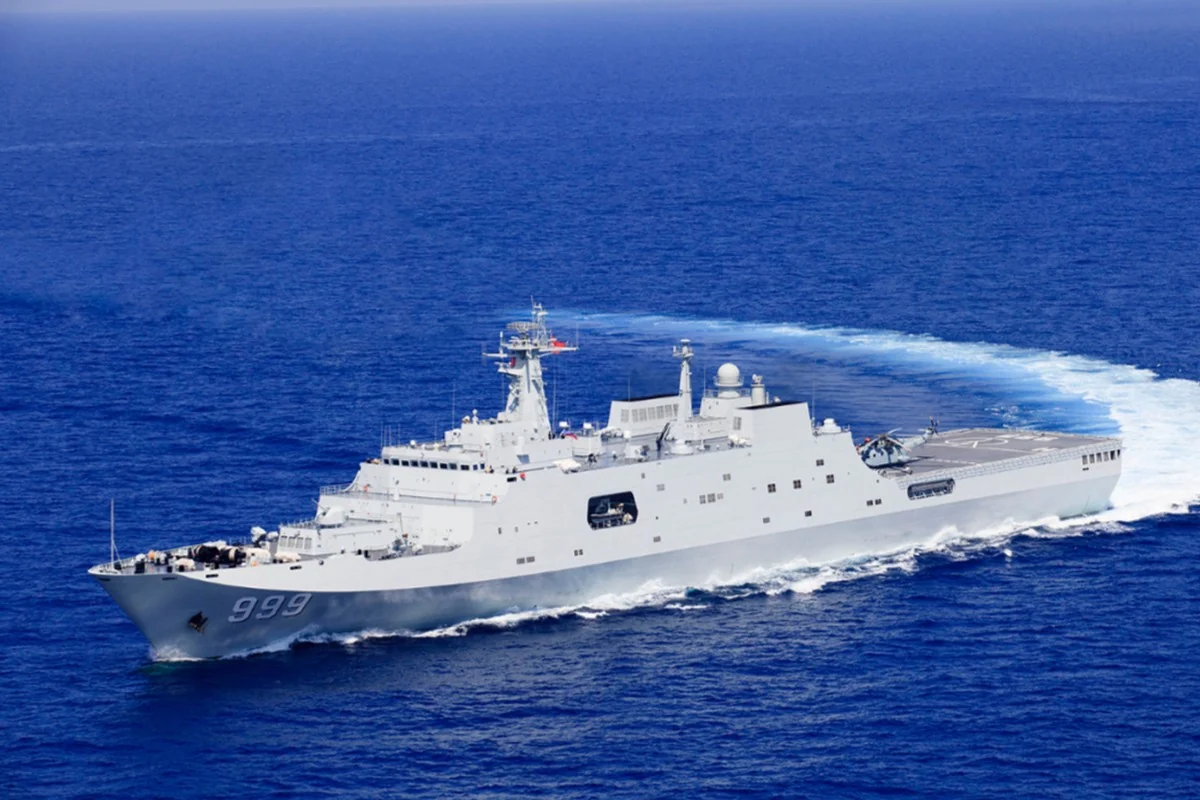
China’s People’s Liberation Army Navy (PLAN) is building Type 071 amphibious transport docks (LPDs) at a second shipyard for the first time. Satellite imagery dated October 4, 2026, obtained by Naval News, shows two hulls side by side at an advanced stage of construction in a drydock operated by CSSC Offshore and Marine Engineering (COMEC), also known as Guangzhou Shipyard International (GSI), on Longxue Island in Guangzhou.
Until now, Hudong-Zhonghua Shipbuilding in Shanghai built every Type 071 hull: eight for the PLAN, commissioned between 2007 and 2020, and one export ship, HTMS Chang, for the Royal Thai Navy. Hudong has recently resumed production of the class. A second production line expands the PLAN’s amphibious lift at a time when long-standing US assessments continue to identify a shortage of dedicated landing ships and logistics support as a constraint on any large-scale assault across the Taiwan Strait.
Two Type 071 LPD Hulls Take Shape at COMEC Longxue
According to Naval News, which reviewed the imagery but is not cleared to publish it, both hulls measure 210 meters overall, matching the dimensions and distinctive profile of the Type 071, designated the Yuzhao class by the US Office of Naval Intelligence (ONI). The drydock sits roughly 2 kilometers south of COMEC’s main naval construction facilities on Longxue and appears to have been modernized in recent years, including the installation of a new full gantry crane for block assembly.
The lead hull already carries its main sensor mast and most of its superstructure, which Naval News assesses could allow a launch by the end of 2026 or early 2027. The second hull would follow within a few months. The contract award, the planned number of COMEC-built hulls and any design changes relative to earlier ships have not been disclosed.
In Shanghai, Hudong-Zhonghua’s Changxing Island facility launched the ninth PLAN hull in late August 2026. Naval News counted two further hulls under construction at Hudong, putting the new batch at a minimum of five ships. More recent assessments reported by the South China Morning Post place the total at six, four at Hudong and two at Longxue. According to Janes Fighting Ships, a second Shanghai hull was launched in October, and neither launched ship has entered service.
Yuzhao-Class Design: Well Deck, Aviation and Lift Capacity
The Type 071 is a well deck-equipped landing platform dock comparable in role to the US Navy’s San Antonio class and the Royal Navy’s Albion class. Naval News puts its displacement at approximately 22,000 tons; other open-source references cite up to 25,000 tons, a gap that likely reflects different load conditions.
Publicly available specifications indicate a beam of about 28 meters and a combined diesel and diesel (CODAD) propulsion plant built around four diesel engines, for a maximum speed of around 25 knots and an estimated range of about 6,000 nautical miles at 18 knots. The well deck accommodates up to four Type 726 air-cushion landing craft, supplemented by smaller landing craft on davits, while the flight deck and hangar support medium-lift helicopters such as the Z-8. Open-source estimates put troop capacity at roughly 400 to 800 marines plus armored vehicles, figures Beijing has not officially confirmed. Defensive armament consists of a 76 mm main gun and four 30 mm close-in weapon systems.
In 2024, the Type 071 Siming Shan (986) also became the first major PLAN ship to be fitted for testing with an apparent laser-based directed energy weapon.
The operational value of the design lies in what it puts ashore. An air-cushion-capable well deck allows the PLAN to land armored vehicles from over the horizon, keeping the ship outside the densest coastal defenses, a capability the older beaching tank landing ships of the Type 072 family cannot offer.
COMEC Joins Hudong in Expanding PLAN Amphibious and Auxiliary Production
The move mirrors the Type 903 fleet replenishment oiler program. COMEC and Hudong delivered the first nine Type 903 and 903A oilers between 2005 and 2019; for the latest batch of at least five ships, Wuhu Shipyard in Anhui province has joined COMEC and launched three hulls in the past two years.
COMEC has become one of the PLAN’s busiest auxiliary builders. Its recent output includes two sets of three amphibious barges designed as mobile shore connectors for large-scale landing operations, two classes of submarine support ships, Type 903A oilers, two hulls of a very large replenishment ship succeeding the Type 901, and, most recently, a second variant of a suspected unmanned underwater vehicle (UUV) mothership.
Hudong, meanwhile, carries China’s heaviest amphibious workload: Type 071 LPDs, Type 075 landing helicopter docks and the catapult-equipped Type 076 amphibious assault ship. Adding Guangzhou to the Type 071 program could increase the pace at which new amphibious ships join the PLAN over the next few years.
Analysis: Restarting the Type 071 is the fastest available route to more amphibious lift. Rather than waiting on a new design, Beijing is reopening a mature line at two yards at once. Combined with the shore-connector barges built at the same Guangzhou yard and the PLA’s established use of civilian roll-on/roll-off ferries, the program points to a deliberate effort to close the lift and logistics gap that US assessments have long identified as the weakest link in a cross-strait invasion. If all six new hulls reach the fleet, the PLAN’s Type 071 force would grow from eight to 14 ships, a 75 percent increase in dedicated LPD capacity.
The next observable milestones are the float-out of the lead COMEC hull, expected around the turn of the year, and sea trials of the two ships already launched in Shanghai. Key unknowns remain the final size of the batch, whether the Guangzhou hulls incorporate design changes, and whether COMEC will take on further warship orders. With frigate and destroyer construction appearing to slow, the current surge in submarine, auxiliary and amphibious construction suggests China’s naval buildup is shifting emphasis rather than losing pace.