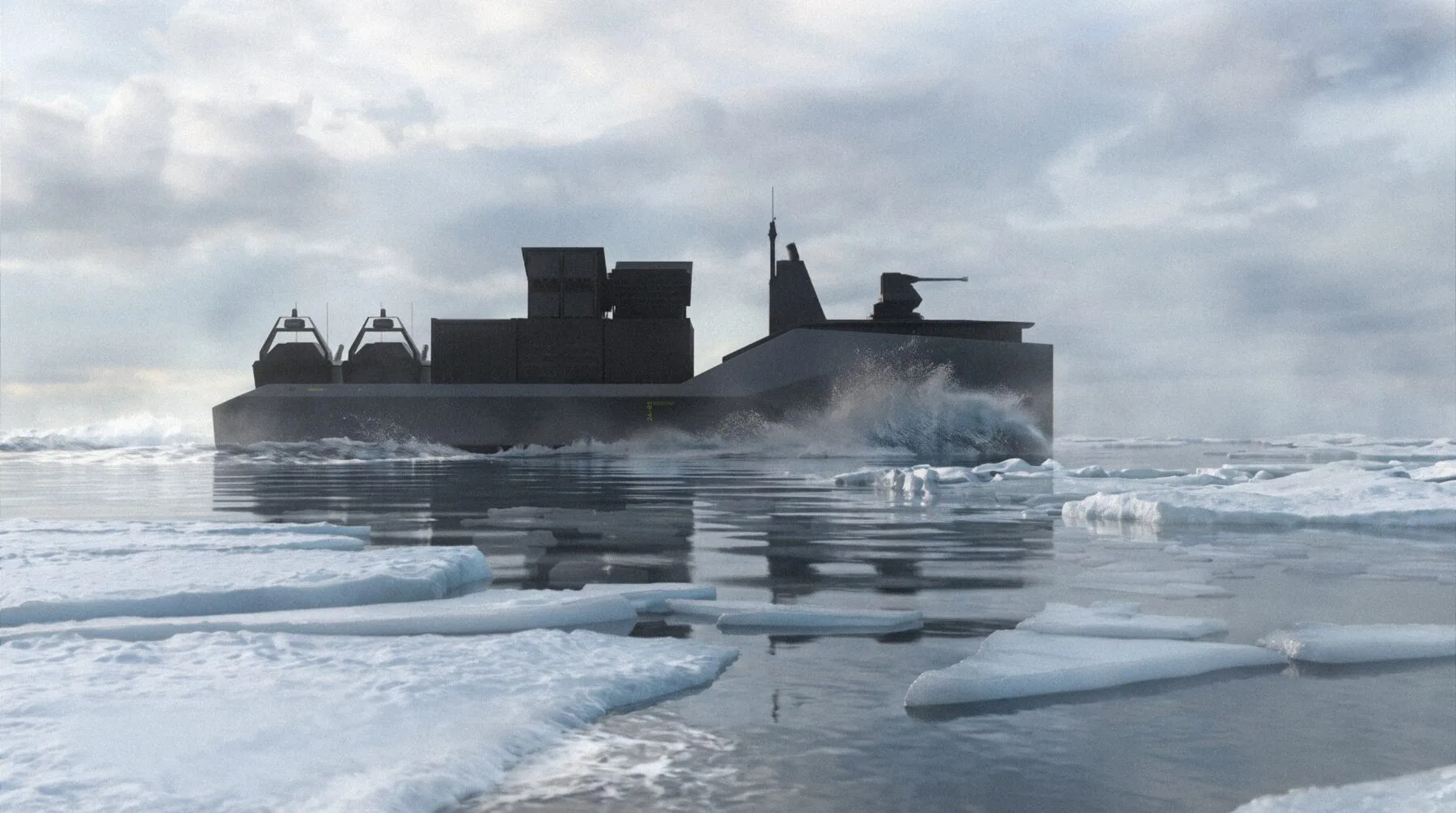
German defense technology company STARK unveiled the Vanta 24 on November 3, 2026, an armed uncrewed surface vessel (USV) of approximately 24 meters that the company describes as the first of its kind designed specifically for Baltic Sea operations. STARK says the platform will be fitted for anti-ship missiles, a 30 mm gun, and long-range radar, and will be able to escort warships, guard undersea infrastructure, and track tankers of the sanctions-evading shadow fleet, either alongside the Royal Navy and allied fleets or independently.
The announcement lands as NATO navies search for cheaper ways to sustain presence in contested northern waters. A series of suspected sabotage incidents against undersea cables led NATO to launch Baltic Sentry in January 2025 to protect critical undersea infrastructure, a mission that still leans heavily on crewed warships. STARK frames Vanta 24 as a way to offload that persistent surveillance burden. According to the company, the British, Norwegian, and German armed forces are already adopting the hybrid navy concept, which pairs uncrewed boats with large conventional warships to generate flotilla-level mass with smaller crews and lower costs.
Vanta 24 Autonomous Vessel Design: Weapons, Radar, and Baltic Hardening
STARK has released only top-level specifications. The vessel measures approximately 24 meters, sprints at more than 35 knots, and offers a payload of up to 50 tonnes, a figure that is large for a hull of this length and has not been independently verified. STARK has not published displacement, beam, draft, or propulsion data, nor a range figure, stating only that the vessel can remain in Northern European waters for weeks at a time.
The announced weapons fit combines anti-ship missiles with a 30 mm gun. STARK has not named either system, the missile load, or the gun mount. The radar is described as able to track both air and surface contacts, but no designation or detection range has been released. Radar performance will determine whether Vanta 24 can credibly serve as a picket ahead of a carrier strike group, a role STARK explicitly assigns to it.
The hull is engineered for Baltic ice, freezing temperatures, and short, steep waves, while retaining the ability to operate in the North Sea, North Atlantic, and High North. That combination places Vanta 24 closer to an uncrewed fast attack craft than to the expendable explosive boats Ukraine has used in the Black Sea.
From Vanta 6 to Vanta 24: Minerva Control and Industrial Scaling
STARK describes Vanta 24 as the third and largest member of the Vanta line. The family entered service through the 6-meter Vanta 6, which STARK credits with a range of up to 900 nautical miles at low speed and a claimed top speed of 46 knots. A Vanta-based boat named Seetaube was handed to the Bundeswehr’s Cyber and Information Domain Service in August 2026 for maritime reconnaissance trials. The 12-meter Vanta 12 followed with a stated range of up to 1,200 nautical miles, a payload of up to 2 tonnes, and demonstrated launches of STARK’s Cascade loitering munitions during NATO’s REPMUS exercise. Vanta 24’s stated payload is 25 times that of Vanta 12.
A single operator can control all three vessel types together through STARK’s Minerva command-and-control software, which the company says connects to allied navies’ existing command systems. STARK has not specified which combat management systems or tactical datalinks Minerva currently supports. On the industrial side, STARK has signed a letter of intent with Flensburger Schiffbau-Gesellschaft (FSG) in Germany, which the company estimates could build up to 100 Vanta-family vessels per year, and a production partnership with Seasight Solutions in Ringkøbing, Denmark. Neither agreement has been publicly tied to Vanta 24.
Johannes Schaback, STARK’s chief technology officer, said European sovereign waters and the cables beneath them are being tested daily, adding: “Navies cannot meet that with crewed warships alone.”
Analysis: Vanta 24 is STARK’s bid to move from attritable sensor and strike boats into the heavier class of uncrewed combatants that navies would task with escort and picket duty. That shift raises the bar. A 24-meter armed platform operating for weeks among dense commercial traffic in the Baltic, the Channel, and the North Sea will face scrutiny on human control over missile release, collision regulations, and survivability. If the 50-tonne payload claim holds, the vessel could carry a strike load comparable to a small crewed missile boat at a fraction of the cost, giving NATO’s northern flank a scalable way to free frigates for high-end anti-submarine and air defense tasks.
STARK has not disclosed a launch customer, unit cost, prototype date, or trials schedule. The next markers to watch are the selection of the missile and gun systems, confirmation of the radar, and any testing in Baltic winter conditions. Germany and Denmark, where STARK already has Vanta production partners, along with the UK and Norway, are the most likely first evaluators.