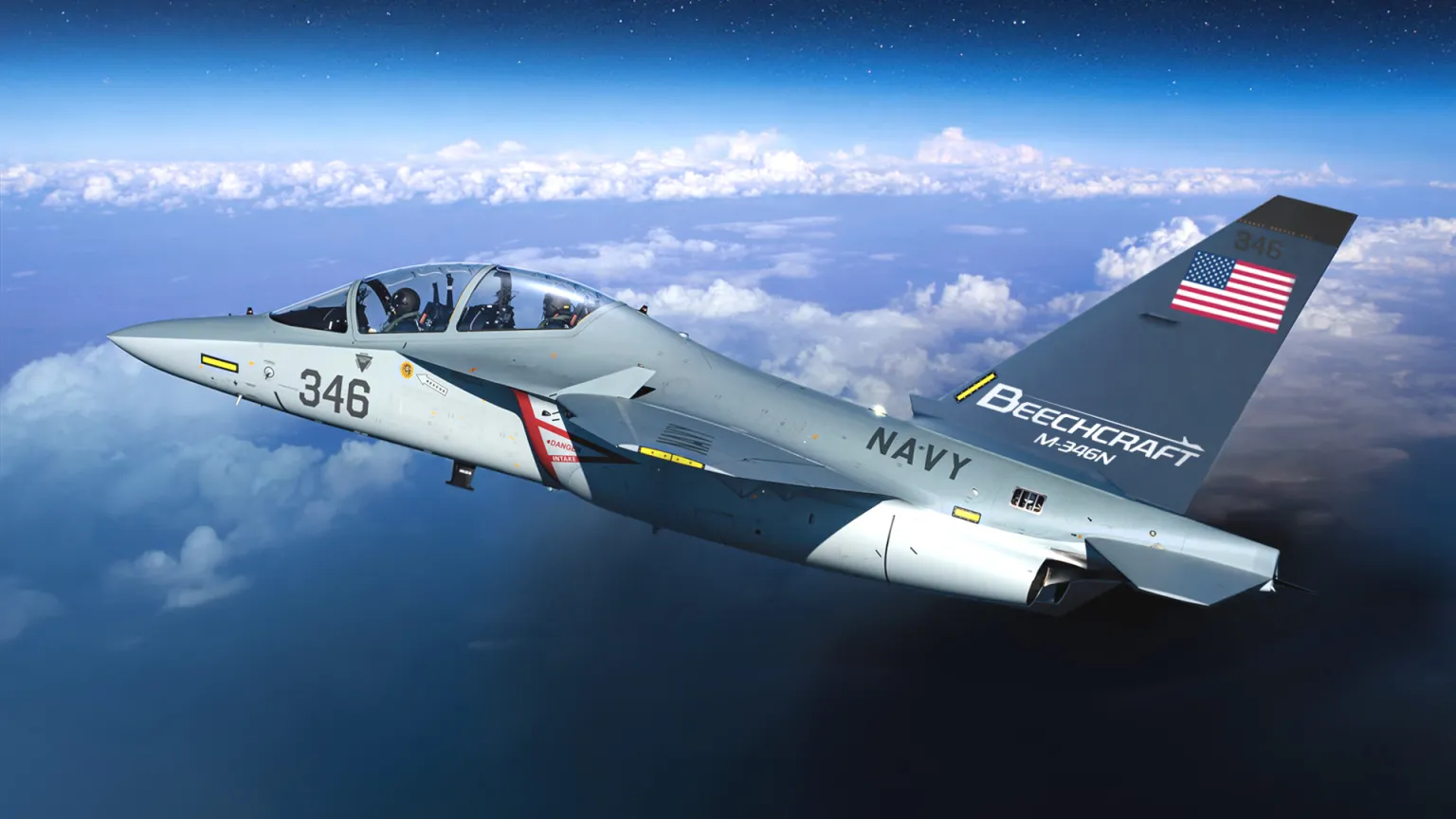
Sierra Nevada Corporation (SNC) has withdrawn from the U.S. Navy’s Undergraduate Jet Training System (UJTS) competition, declining to submit its Freedom Jet ahead of the October 30, 2026, proposal deadline, Breaking Defense first reported on November 3. The decision leaves the team of Textron Aviation Defense and Leonardo, offering the Beechcraft M-346N, as the only known major bidder to replace the service’s T-45C Goshawk trainers.
SNC’s exit completes a steady contraction of the field. Lockheed Martin dropped its TF-50N, developed with Korea Aerospace Industries (KAI), in April. Boeing followed in June, citing issues tied to the General Electric F404 turbofan and UJTS engine qualification requirements for its T-7A Red Hawk derivative. Northrop Grumman left the SNC-led team in September. The Navy seeks up to 216 advanced jet trainers and a simulator package to replace just under 200 Goshawks, and has raised the program’s cost ceiling from approximately $1.8 billion to $2.7 billion.
Why SNC Declined to Bid on the Navy Jet Trainer Program
SNC framed the decision around contract terms rather than the aircraft. The company said it “could not responsibly bid the UJTS program under the current contract structure” and that it stands “ready to re-engage if the approach is revisited.” The statement named PMA-273, the Naval Undergraduate Flight Training Systems Program Office at Naval Air Systems Command (NAVAIR), which manages the T-45. SNC has not specified which terms it objected to.
The funding profile is the most visible pressure point. The Navy has detailed an initial award value of $52.8 million in fiscal 2027 and $181 million in fiscal 2028, a back-loaded ramp against the $2.7 billion target that has drawn industry concern. SNC has not confirmed this was the deciding factor.
Freedom Jet was the only clean-sheet entrant in the competition. SNC claimed it would cost approximately 40% less to operate than trainers already on the market. SNC also designed the twin-engine aircraft to retain carrier qualification and field carrier landing practice (FCLP) capability, options the Navy has chosen not to require.
Textron Aviation Defense confirmed it responded to the request for proposals (RFP). The Navy has not disclosed how many proposals it received; Stavatti Aerospace said on October 30 that it had submitted a bid, which the service has not confirmed.
M-346N Specifications and the Case for a Mature Platform
The M-346N is a navalized derivative of the Leonardo M-346 Master, a tandem-seat, twin-engine advanced jet trainer with a full-authority fly-by-wire flight control system. Publicly available specifications for the baseline M-346 indicate two Honeywell F124-GA-200 non-afterburning turbofans rated at 6,280 lbf of thrust each, a maximum level speed of 590 knots true airspeed, a service ceiling of 45,000 feet, and a structural envelope of +8/-3 g. The airframe was designed to replicate the high angle-of-attack handling of modern fighters, letting syllabi shift tasks out of costlier frontline aircraft.
The M-346 family is in service with Italy, Israel, Singapore, Poland, and Greece, among others. For the Navy, that installed base means an established production line, an engine with an existing supply chain, and documented sustainment data. The engine point matters here: Boeing cited engine qualification issues when it withdrew, while the F124 is already proven across the M-346 fleet.
The M-346N’s naval-specific modifications, avionics fit, embedded training architecture, and bundled simulator package have not been publicly detailed, and those elements will shape life-cycle cost as much as the airframe.
How UJTS Rewrites Carrier Training Requirements for Naval Aviators
The T-45 entered Navy service in the early 1990s and remains the service’s only fast-jet trainer, preparing Navy and Marine Corps aviators, as well as foreign students, for carrier aviation and tactical strike missions. The fleet has suffered hypoxia-like physiological episodes that prompted a new oxygen system, and several crashes, most recently in May 2026, when both pilots survived.
UJTS breaks with the Goshawk’s carrier-capable design. The Navy’s March RFP stated that the new trainer will not be required to land on aircraft carriers or to touch down during FCLP. The aircraft must instead support FCLP wave-offs, and the Navy asked industry to propose simulation capabilities to train aviators for carrier landings. Carrier qualification has already been removed from the tactical air syllabus, although it remains a graduation requirement for future E-2 Hawkeye pilots and foreign student aviators.
The Navy argues that live, virtual, and constructive (LVC) training and assisted carrier landing technology such as Magic Carpet have changed what aviators need from a trainer, and that the revised syllabus speeds students through the pipeline amid pilot shortages. Critics have raised safety concerns, and the decision remains contested.
Analysis: The Navy now heads into source selection on a roughly $2.7 billion program with a single known major offer. That removes the price tension a two-way competition would have provided and narrows the service’s leverage on cost, schedule, and technical data terms. The outcome also reflects how the requirement was written: by dropping carrier landings and FCLP touchdowns, the Navy shaped UJTS toward a mature land-based trainer and away from the carrier-capable, clean-sheet hedge SNC was offering. An M-346N award would trade design competition for lower development risk, a defensible choice given the T-45’s age, but one that leaves little fallback if negotiations with the sole bidder stall.
The UJTS program office said the government is “in source selection with the intent to award the UJTS procurement in 4QFY27,” placing a decision between July and September 2027. That window has already slipped from June 2027 and, before that, from March 2027, while first deliveries have been projected for 2032. Key unknowns include how many proposals the Navy received, whether Congress funds the $52.8 million fiscal 2027 tranche as requested, and whether the service reopens or restructures the competition, the scenario under which SNC has said it would return.