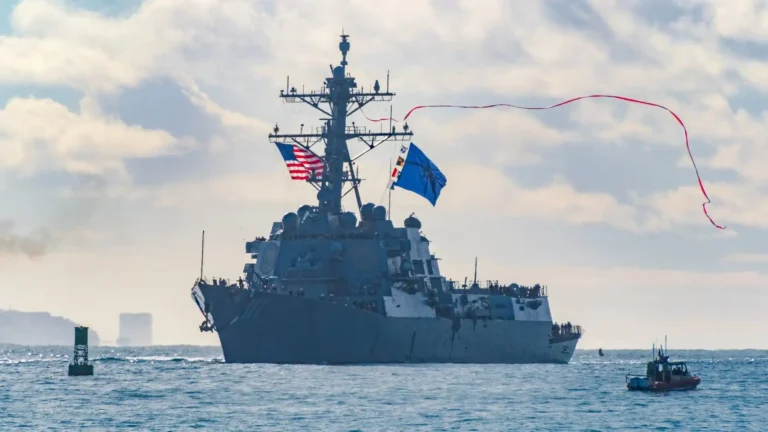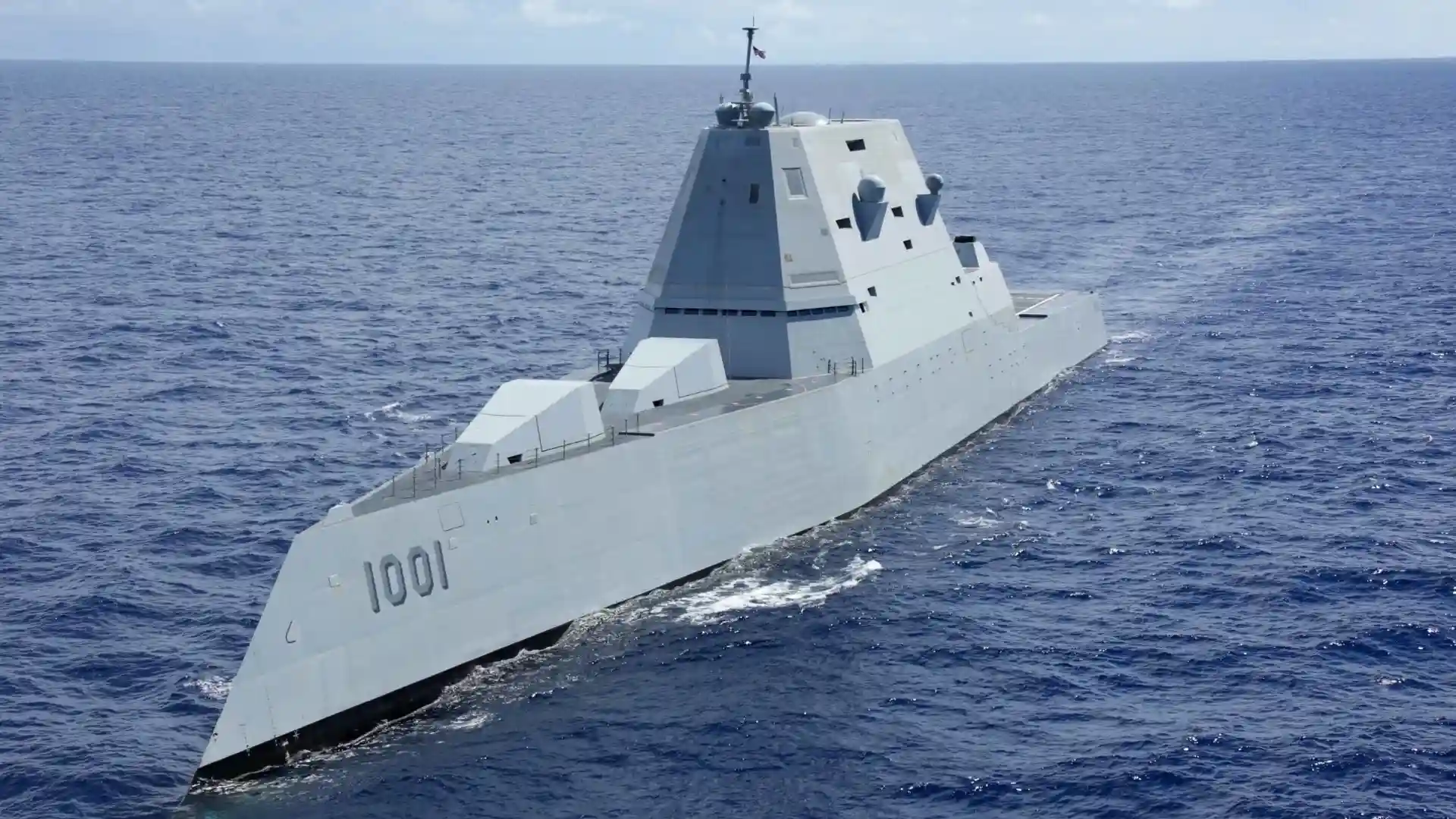
The U.S. Navy’s Zumwalt-class program office, PMS 500, will host an industry day in Washington, D.C., on December 9, 2026, to prepare the Conventional Prompt Strike (CPS) Depot Modernization Period (DMP) for USS Michael Monsoor (DDG 1001), the second ship of the class. A special notice posted on November 17 by Naval Sea Systems Command (NAVSEA) on behalf of Portfolio Acquisition Executive (PAE) Maritime sets the availability for May 2028 through August 2030 and frames the event as a technical exchange on industry capability and capacity.
The notice sets a firm window for Michael Monsoor’s hypersonic conversion. In a July 2026 report, the Government Accountability Office (GAO) identified the destroyer as the only ship of the class that had not yet begun modernization, with work then scheduled to start in February 2027. The new dates push the start back by roughly 15 months. GAO found the overall CPS integration effort 24 months behind schedule. Lead ship USS Zumwalt (DDG 1000) was 94 percent through its build yard modernization at Huntington Ingalls Industries’ Ingalls Shipbuilding in Pascagoula, Mississippi, in January 2026, with completion expected in the fourth quarter of fiscal 2026, 10 months later than planned, while the future USS Lyndon B. Johnson (DDG 1002) is receiving CPS during its mission systems activation, with delivery expected in 2028.
Michael Monsoor CPS Work Package: Launchers, Computing, and Power
PMS 500 divides the DDG 1001 availability into four lines of effort. Hypersonic payload integration covers large-scale structural modifications, compartment reconfiguration, and installation of the CPS payload module and launcher infrastructure. A second package modernizes the Total Ship Computing Environment Infrastructure (TSCEI) hardware and software, adds open architecture enhancements, and builds the tactical weapon control interfaces. A third expands the auxiliary plant, power conversion and distribution, and chilled water cooling to support the new mission systems. The fourth bundles dry-docking, hull, mechanical and electrical (HM&E) overhaul, and signature-managed hull preservation.
The configuration validated on Zumwalt indicates the scope. Ingalls removed the twin 155mm Advanced Gun System mounts and installed four 87-inch large missile vertical launch tubes, each loaded with an Advanced Payload Module carrying three rounds, for 12 missiles per ship. The CPS missile shares its two-stage solid rocket booster and Common Hypersonic Glide Body with the Army’s Long-Range Hypersonic Weapon, known as Dark Eagle. The booster is too large for the class’s existing Mk 57 Peripheral Vertical Launch System cells, which drove the gun-mount removal. The Navy variant uses a cold-gas canister ejection before motor ignition. Publicly reported figures put the weapon’s range at about 1,725 miles and its speed above Mach 5.
The power and cooling tasks address documented risk. GAO reported persistent reliability problems with the class’s integrated power system, and in August 2025 the Navy added 230,000 hours and $20 million to Zumwalt’s modernization contract for unplanned work, including the removal of more cabling than expected from the forward section.
Master Ship Repair Agreement Holders and the Industrial Base Test
The notice targets companies that already hold a current PAE Maritime Master Ship Repair (MSR) Agreement and possess the dry-dock or pier-side infrastructure needed for the job. Firms without one may participate if they intend to secure an agreement before award. Attendance is limited to companies that answered the earlier Sources Sought notice, N00024-26-R-4443; new respondents must submit by December 4, 2026. Each company may register up to five attendees. PMS 500 will post a Request for Information (RFI) with targeted technical questions before the event.
The announcement is issued under FAR 15.201 and is not a request for proposal. It carries the product service code for non-nuclear ship repair on the West Coast, consistent with Michael Monsoor’s San Diego homeport, although the place of performance is left blank. Ingalls, which performs the modernization and activation work on DDG 1000 and DDG 1002, has handled CPS integration on both ships. The notice does not state the acquisition strategy, the estimated contract value, or whether Ingalls will compete. GAO reported that the estimated cost of upgrading all three ships has risen from $1.8 billion to at least $2 billion.
Analysis: Moving the third CPS integration into the depot repair base would widen the pool of yards able to install large-diameter hypersonic launchers. It also transfers risk. The structural, cabling, and power lessons learned at Pascagoula must carry over to a new performer, and the 27-month availability will keep Michael Monsoor out of the operational force until late 2030. The binding constraint may lie elsewhere, however. GAO estimates each missile at about $67 million and reports that Lockheed Martin’s facility can produce six to seven rounds per year against the 12 needed to stabilize production. Even with all three hulls converted, magazine depth, not launcher count, is likely to cap the class’s strike capacity.
The next milestones are the RFI release ahead of December 9 and any follow-on solicitation from PAE Maritime. Zumwalt is slated to conduct the first CPS flight test from the ship in the third quarter of fiscal 2027, a result that will shape the DDG 1001 design baseline. Key unknowns remain the contract vehicle, award date, cost ceiling, and whether Michael Monsoor deploys again before entering dry dock in May 2028.