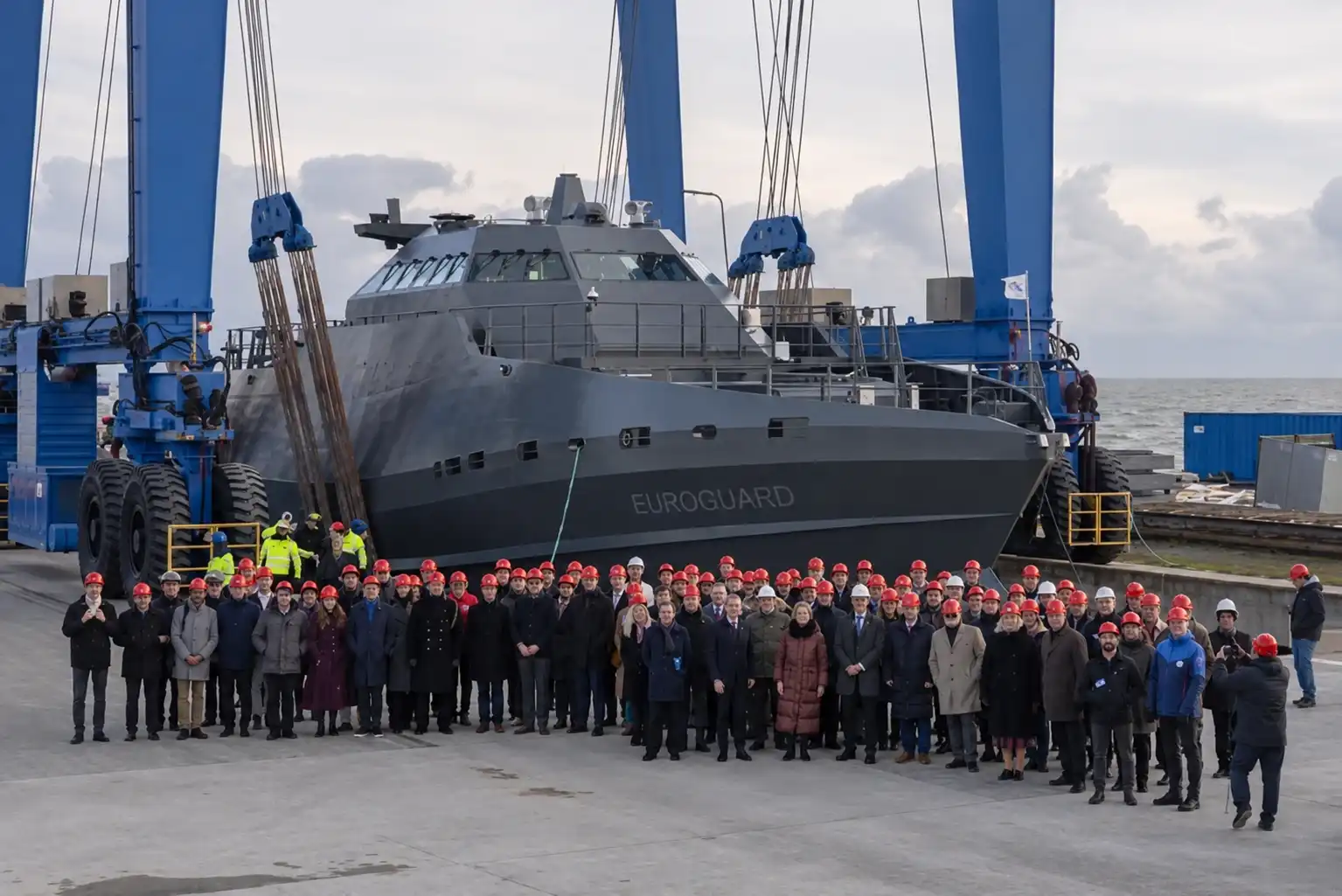
Estonian shipbuilder Baltic Workboats launched the EUROGUARD semi-autonomous naval vessel at its Nasva shipyard on the island of Saaremaa on November 18, 2026, completing the hull phase of one of the largest maritime projects financed by the European Defence Fund (EDF). Estonian President Ülle Madise christened the 45-meter prototype, which the European Commission presents as a platform for maritime surveillance in the Baltic Sea and for the protection of undersea cables, energy infrastructure and strategic sea routes.
The launch comes as Baltic littoral states harden their seabed networks after the Balticconnector gas pipeline damage in October 2023 and the Estlink 2 power cable outage in December 2024. EUROGUARD, short for European Goal-based Multi-mission Autonomous Naval Reference Platform Development, was selected under the EDF 2022 call. Its grant agreement runs for 48 months, from December 1, 2023, to November 30, 2027, with the official kick-off held in Estonia in January 2024. Its total budget is about €95 million, including €65 million from the EDF. The project is linked to the Permanent Structured Cooperation (PESCO) Medium Size Semi-Autonomous Surface Vehicle (M-SASV) initiative, and Brussels ties it to the Readiness 2030 agenda and the defense of the EU’s eastern flank.
EUROGUARD Vessel Specifications and Modular Mission Design
Publicly available specifications from the builder give a length of 45.0 meters, a beam of 9.4 meters and a maximum draught of 3.0 meters, with a displacement of up to 335 tonnes and a payload allowance of up to 100 tonnes. A hybrid propulsion plant delivers at least 20 knots, and the design targets a range of at least 2,000 nautical miles with 10 days of endurance.
Those figures put the prototype well above the small uncrewed surface vessels that dominate current European experimentation, and in the displacement range of a coastal patrol vessel. The 100-tonne payload margin and 10-day endurance leave room for heavy mission equipment, such as mine countermeasure drones or seabed monitoring systems, deployed far from port.
The ship is built around interchangeable mission modules. Baltic Workboats lists naval mine countermeasures; intelligence, surveillance and reconnaissance (ISR); anti-surface warfare; anti-submarine warfare; seabed warfare and critical infrastructure protection; search and rescue; and the deployment and control of unmanned systems. The Commission’s description is narrower, citing surveillance, mine detection and clearance, search and rescue and undersea infrastructure protection. Which modules will be integrated for trials has not been specified.
The core deliverable is the autonomy stack: autonomous navigation and route planning, obstacle and threat detection, collision avoidance, sensor fusion, secure communications and remote control from shore. The vessel can sail with or without a crew, although the Commission limits uncrewed operation to situations where it is possible, a reflection of the unsettled regulatory framework for uncrewed ships.
From EDF Demonstrator to European Naval Procurement
The consortium has grown from 23 entities at kick-off to 29 organisations from 10 European countries, according to the Commission. Participating states listed by the builder are Estonia, Poland, Sweden, the Netherlands, Belgium, Italy, France, Denmark, Spain and Norway. Industrial partners include Naval Group and Thales of France, Leonardo of Italy, Navantia of Spain, Kongsberg of Norway and Damen of the Netherlands. Estonia leads both tracks: Baltic Workboats coordinates industry, while the Estonian Centre for Defence Investments (ECDI) coordinates the member states.
That arrangement places a mid-sized yard known for workboats, patrol craft and ferries at the head of several of Europe’s largest naval primes. Estonian officials describe EUROGUARD as the largest warship built in the country since it restored independence in 1991.
The schedule is tight. Outfitting and mission system integration come next, followed by sea trials in Estonian waters with the Estonian Navy, expected to begin in spring 2027 and run for roughly eight months. Estonian Navy chief of staff Ain Pärna has called the ship a sound test platform but said it is too early to judge whether it fits the service’s needs. Baltic Workboats has indicated that a production EUROGUARD would likely be larger and structurally different from the demonstrator, and that several foreign governments have expressed interest in leasing the prototype or using it for trials and training.
Analysis: EUROGUARD is less a warship than a test of whether the EDF can move a collaborative naval concept from paper to water on schedule. The payoff lies in validating modular payloads and a shared autonomy architecture, the capability Baltic states need to patrol dense cable and pipeline networks with few crewed hulls. The risk is familiar: an EDF demonstrator carries no guaranteed path to procurement, and the Estonian Navy’s reserved stance signals that operational requirements have not yet converged. Without a multinational acquisition commitment, EUROGUARD could validate technologies that migrate into national designs rather than seed a common European class.
The next milestones are completion of outfitting, integration of the first mission modules and the start of sea trials in spring 2027. With the grant agreement ending November 30, 2027, little margin remains if trials run long. Key unknowns include the propulsion supplier, the sensor and effector fit, the eventual owner of the prototype, and whether any participating state funds a production variant.