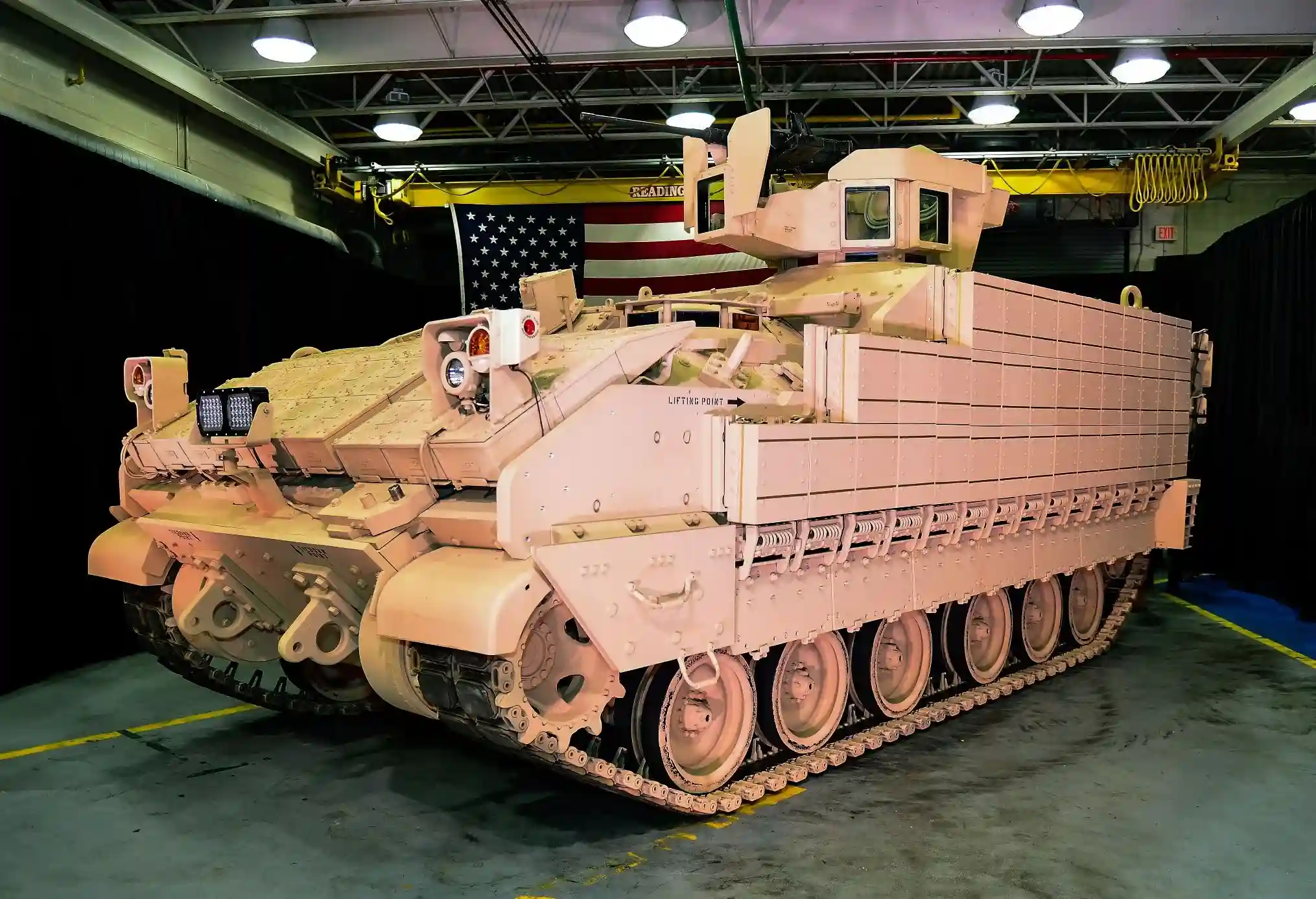
RENK America said on November 19, 2026, a drive-by-wire upgrade to its HMPT transmission enables the Autonomous AMPV, a self-driving version of the U.S. Army’s Armored Multi-Purpose Vehicle developed by BAE Systems and Forterra. The Muskegon, Michigan-based drivetrain maker said the kit integrates with Forterra’s AutoDrive autonomy stack, keeps the same footprint as the current transmission, and requires no changes to vehicle architecture. An initial demonstration is planned for February 2027.
The Autonomous AMPV made its public debut at the Association of the U.S. Army (AUSA) annual meeting in Washington, D.C., in October 2026, a year after BAE Systems and Forterra announced their partnership on September 30, 2025. The project belongs to BAE Systems’ AMPV capability kit series, launched in August 2025 with company funds to use the AMPV as a testbed for modular upgrades. RENK’s announcement addresses a less visible obstacle to ground autonomy: giving a computer reliable command of a 36-ton tracked drivetrain.
How RENK’s Drive-by-Wire Kit Enables the Autonomous AMPV
A drive-by-wire (DBW) layer converts the driver’s physical inputs into electronic commands, so that an autonomy computer can issue the same commands without a human at the controls. RENK America describes its solution as a plug-and-play upgrade to the existing Hydro-Mechanical Power Transmission (HMPT), with no significant redesign of the vehicle. For a fielded fleet, that avoids reworking the hull or the powerpack installation.
On the AMPV, the HMPT 800 is paired with a Cummins VTA903E-T675 diesel rated at 676 hp, according to publicly available specifications. The HMPT 800 is rated for tracked vehicles of up to 45 metric tons and engines of up to 800 hp, which leaves margin for added mission equipment. In June 2026, the Army awarded RENK America a five-year indefinite-delivery/indefinite-quantity (IDIQ) contract worth up to $691 million to produce and sustain the transmission. RENK America says the HMPT is fielded across 100% of the Army’s medium tracked vehicle fleet.
Integration began earlier in 2026 at BAE Systems’ Sterling Heights, Michigan, facility, where the DBW hardware was installed, before the vehicle moved to Forterra’s headquarters in Clarksburg, Maryland, for autonomy development, Bill Sheehy, BAE Systems’ vice president of ground maneuver futures, told Defense Daily at AUSA. Sheehy said the vehicle is not yet fully autonomous and that the partners are still working through how the autonomy stack and the DBW system operate together. According to Sheehy, the three companies have invested about $8 million of their own money in the effort.
Corey Johnson, chief executive officer of RENK America, framed the approach around fielded hardware:
“We’re focused on delivering capability that works in the real world. Leveraging what’s already fielded and trusted is how you accelerate without taking unnecessary risk.”
AutoDrive Integration and the Path to Bradley, Paladin, and MLRS
Forterra’s AutoDrive is a full-stack system combining sensors, software, and computing hardware, with a perception suite built largely around lidar and supplemented by cameras and radar, according to company materials. Forterra says AutoDrive is integrated on more than 200 vehicles in active service. In January 2025, the U.S. Marine Corps awarded Oshkosh Defense the Pentagon’s first production contract for off-road autonomous driving, integrating Forterra’s package on the ROGUE Fires vehicle. The specific sensor fit on the Autonomous AMPV has not been disclosed.
The AMPV itself replaces the M113 family in Armored Brigade Combat Teams (ABCTs). Built on a turretless chassis derived from the Bradley, it comes in five baseline variants: the M1283 General Purpose, M1284 Medical Evacuation, M1285 Medical Treatment, M1286 Mission Command, and M1287 Mortar Carrier. BAE Systems received a full-rate production contract in 2023. Sheehy cited use cases such as moving vehicles to concealed positions while crews rest and running crewless resupply shuttles.
RENK America says the same DBW kit could bring autonomous capability to other HMPT-powered platforms, naming the Bradley Fighting Vehicle, the M109 Paladin self-propelled howitzer, and the M270 Multiple Launch Rocket System (MLRS). No integration timeline, unit cost, or target autonomy level has been released for any of these vehicles.
Analysis: The relevance of this announcement lies in the retrofit path rather than in the autonomy software. Applying autonomy to legacy armor has typically stalled on vehicle integration, where each platform needs custom actuators and control interfaces. Because the HMPT is common across the Army’s medium tracked fleet, a DBW kit that fits within the existing transmission footprint could in principle give ABCT vehicles a common hardware foundation for autonomy. That positions the drivetrain supplier as a gatekeeper for fleet-wide autonomy. The limits are equally clear: the Autonomous AMPV is an industry-funded demonstrator with no announced Army requirement or program of record, and cross-country autonomy for heavy tracked vehicles remains a harder problem than on-road driving.
The February 2027 demonstration is the next milestone. Sheehy said BAE Systems wants to place an Autonomous AMPV with an Army unit, possibly through the Transforming in Contact initiative, to gather soldier feedback. Whether the Army funds autonomy as an AMPV upgrade, and whether the DBW kit migrates to the Bradley, Paladin, and MLRS, remain open questions with no published decision points.