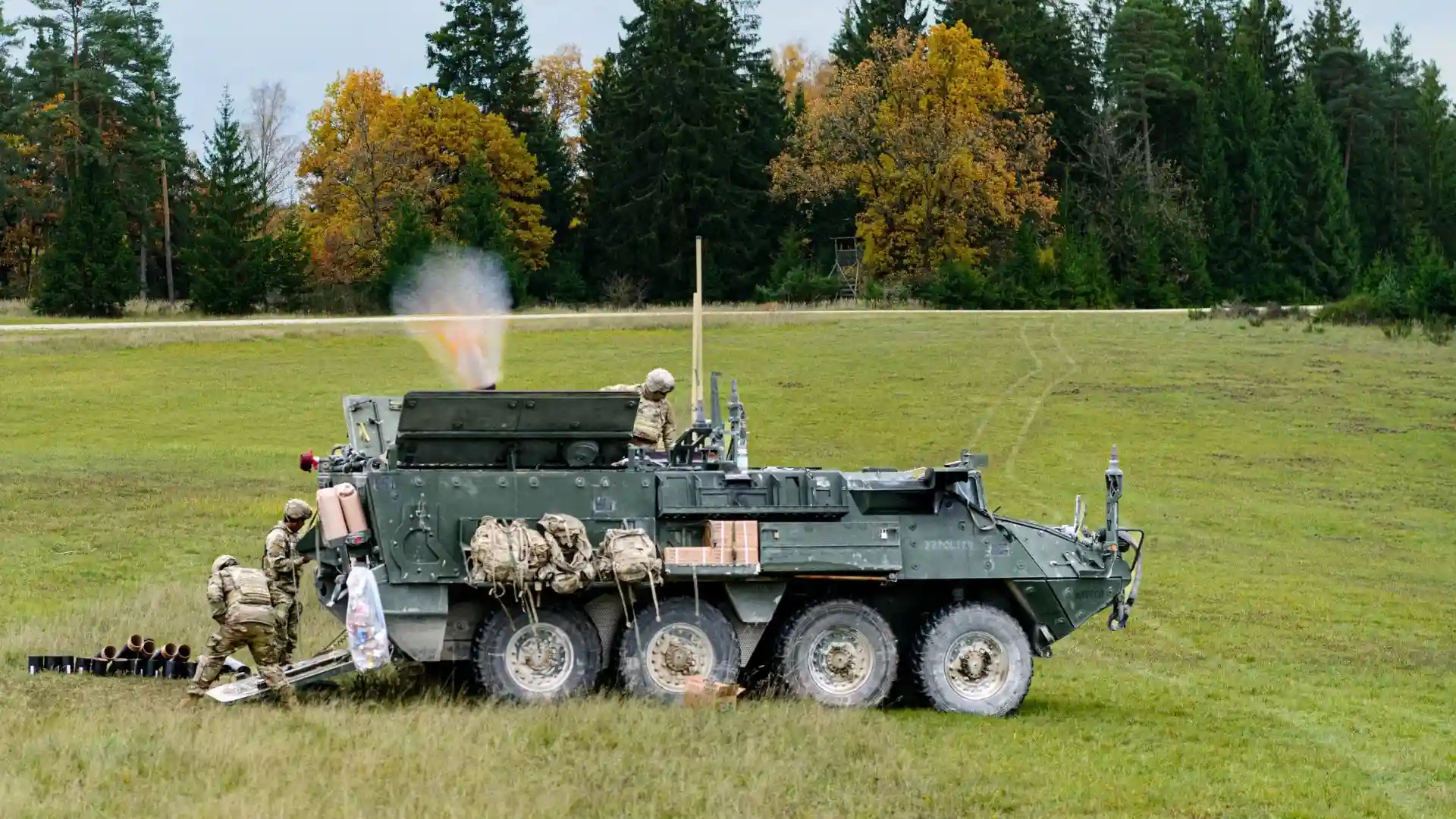
U.S. Army Soldiers of the 2d Cavalry Regiment fired 120mm mortar rounds from an M1129 Stryker Mortar Carrier during a platoon live-fire exercise at Grafenwoehr-Vilseck Training Area, Germany, on November 3, 2026. The Soldiers, assigned to Headquarters and Headquarters Troop, 2nd Squadron, appear in U.S. Army imagery released on November 25, 2026. The vehicle’s recoiling 120mm mortar is credited with up to 16 rounds per minute and a range of 7,240 meters with standard high-explosive ammunition.
The 2d Cavalry Regiment (2CR), based at Rose Barracks in Vilseck, is the Army’s only permanently stationed Stryker formation in Europe and provides V Corps, America’s forward-deployed corps, with combat-credible forces capable of rapid deployment across the European theater in support of NATO. The mortar shoot caps a busy year for the regiment: Saber Strike 2026 live-fire events in Poland in May and, in August, the first live-fire on European soil of the 30mm-armed Stryker Double V-Hull Infantry Carrier Vehicle by 3rd Squadron.
M1129 Stryker Mortar Carrier: 120mm Recoiling Mortar and Fire Control
The M1129, designated Mortar Carrier Vehicle B (MCV-B), is the indirect-fire variant of the General Dynamics Land Systems Stryker family, an 8×8 wheeled design descended from the LAV III and the MOWAG Piranha III. Publicly available specifications indicate a five-person crew, a road speed of about 100 km/h, and a hull length of 6.95 meters. Its defining feature is the mounted firing position: unlike the earlier MCV-A, which could only employ its mortar dismounted, the MCV-B fires from inside the hull through a large rear roof hatch.
The primary weapon is the 120mm Recoiling Mortar System-Light (RMS6-L), a turntable-mounted derivative of the Cardom system developed by Soltam Systems, now part of Elbit Systems. The recoil mechanism absorbs firing loads that a medium-weight wheeled chassis could not otherwise sustain, and the turntable lets the crew shift the tube across a wide arc without repositioning the vehicle. Open-source data credits the system with a maximum rate of fire of 16 rounds per minute for the first minute and a sustained rate of 4 rounds per minute. Army figures for its 120mm mortar family give a maximum range of 7,240 meters with standard high-explosive ammunition such as the M934A1, while other open sources cite up to about 8 km depending on the round.
Fire direction runs through the M95/M96 Mortar Fire Control System-Mounted (MFCS-M), which pairs a fire control computer with an inertial navigation and pointing system. The practical effect is time: digital laying compresses the interval between halting and firing, and between the last round and displacement, which is the window in which a mortar section is most exposed to counter-battery fire.
Squadron Mortar Platoons in 2d Cavalry Regiment’s Fires Architecture
The unit identified in the imagery matters. In Stryker infantry battalions, and in 2CR’s equivalent squadrons, the battalion-level mortar platoon sits in the headquarters element and fields four mortar carriers, alongside smaller company-level sections. That gives the squadron commander an organic indirect-fire asset that does not depend on brigade artillery. Publicly available data indicates that battalion-level M1129s also carry a dismountable M252 81mm mortar, with stowage for roughly 48 rounds of 120mm and 35 rounds of 81mm ammunition per vehicle. Company-level carriers instead pair the 120mm tube with a dismountable M224 60mm mortar.
Within the regiment, the 120mm platoons fill the gap between direct-fire weapons and the M777 howitzers of the field artillery squadron, delivering responsive fires out to several kilometers under the squadron’s direct control. A platoon live-fire of this type rehearses the full fire mission cycle: receipt of a call for fire, computation, laying, firing, and displacement to a new position.
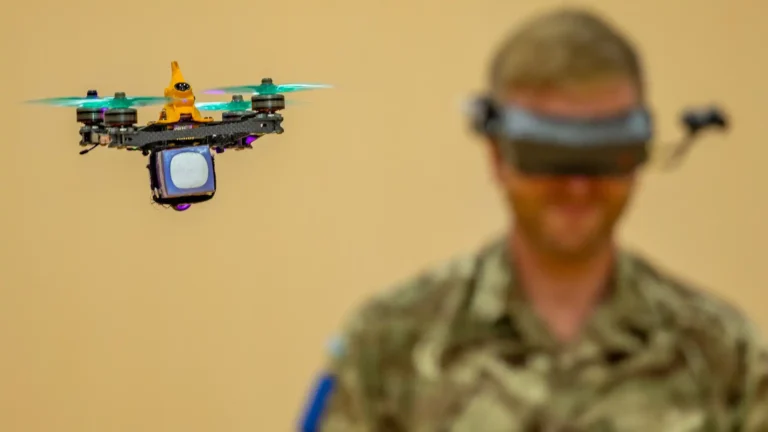
The exercise also comes as 2CR expands its use of unmanned systems for reconnaissance under V Corps’ Eastern Flank Deterrence Initiative, after Army-wide restructuring led the regiment to divest its legacy unmanned aircraft and a cavalry squadron. Pairing small drones with organic mortars shortens the sensor-to-shooter loop at the lowest tactical echelon. The Army has not said whether drone-based observation was integrated into the November 3 shoot, nor has it disclosed the number of vehicles involved, rounds expended, or ammunition types used.
Analysis: Platoon live-fire with the M1129 is routine, but its relevance on NATO’s eastern flank is rising. The war in Ukraine has shown that mortars remain heavily used at the tactical edge, and that any firing position that lingers is quickly found by drones and counter-battery radar. The M1129’s open-roof firing design leaves the crew exposed to top-attack threats such as first-person-view drones, a vulnerability the Army acknowledged when it previously solicited industry for a turreted 120mm Future Indirect Fire Turret intended to replace the M1129 and its tracked counterparts. Until a protected successor reaches units, crew proficiency in rapid emplacement and displacement remains the principal survivability measure for 2CR’s mortar platoons.
The regiment’s fleet is in transition, with the 30mm-armed Double V-Hull Stryker now in service with 3rd Squadron and the M1252 serving as the double V-hull configuration of the mortar carrier. The Army has not announced a timeline for replacing 2CR’s M1129s. The next indicators will be the regiment’s 2027 exercise schedule in Germany and Poland and any procurement decision on a turreted mortar for Stryker formations.