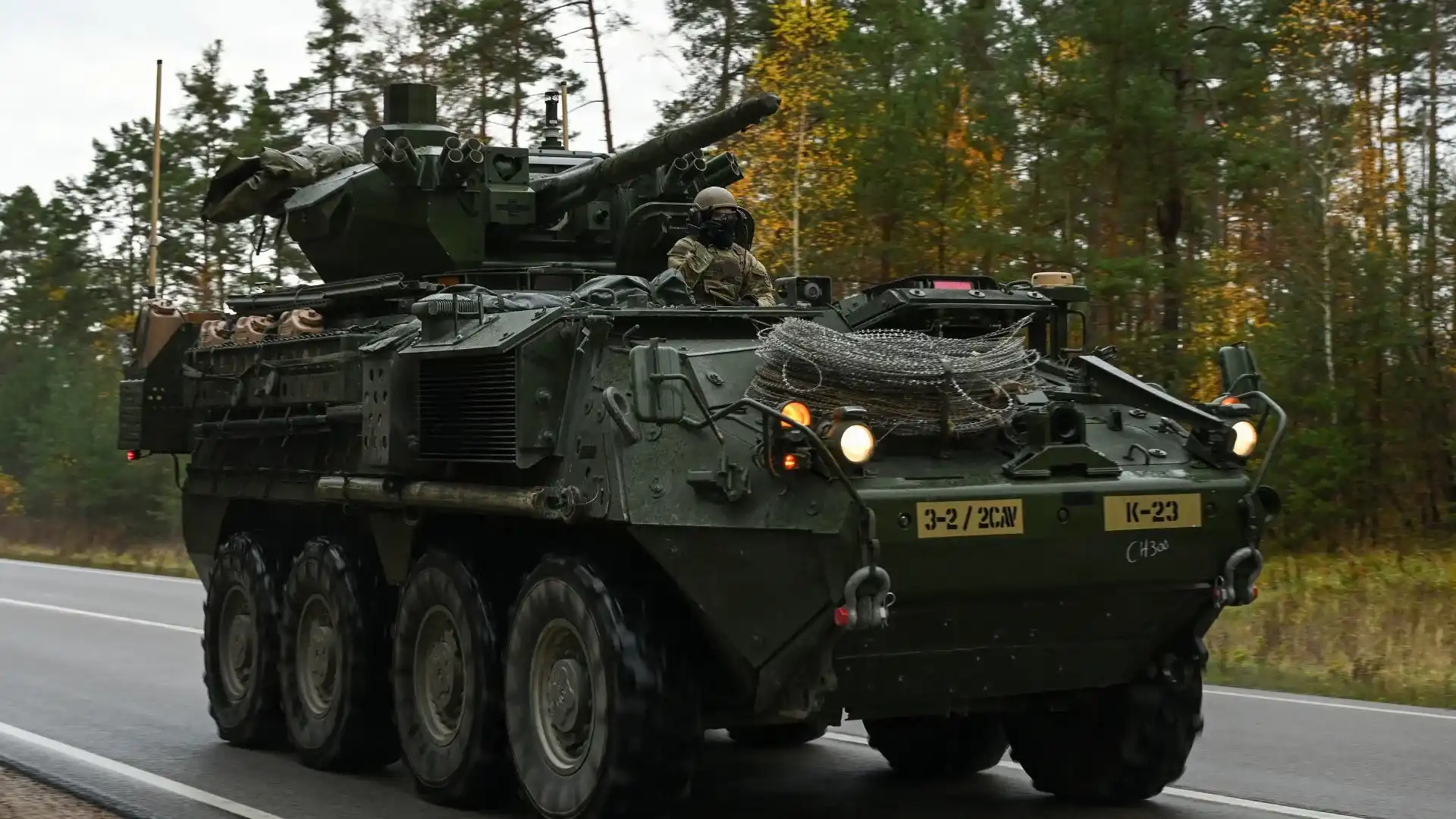
The US Army awarded General Dynamics Land Systems a $332.5 million Stryker sustainment contract on November 18, 2026, to field, train on, and maintain the Stryker family of vehicles over the next five years. The indefinite-delivery/indefinite-quantity (IDIQ) contract covers total package fielding, deprocessing, new equipment training, and field-level maintenance support, with an estimated completion date of November 17, 2031. Army Contracting Command, Detroit Arsenal, Michigan, is the contracting activity under contract number W912CH-27-D-A111, and the Sterling Heights, Michigan-based company won the award against two competing bids, according to the Department of War contract announcement.
The award arrives as the Army reshapes its medium-weight force under the Army Transformation Initiative launched in May 2025, an effort that is pulling Strykers out of some formations while pushing them into others. The Pennsylvania Army National Guard’s 56th Stryker Brigade Combat Team became a Mobile Brigade Combat Team on March 31, 2026, and the Washington Army National Guard’s 81st Stryker Brigade began turning in its vehicles in late 2025 in favor of Infantry Squad Vehicles. Meanwhile, the 4th Infantry Division’s former 3rd Armored Brigade Combat Team at Fort Carson, Colorado, received its first Strykers on September 2, 2026, as it converts from M1A2 Abrams tanks and Bradley Fighting Vehicles into a Stryker formation; a standard Stryker Brigade Combat Team operates more than 300 Strykers.
Stryker Sustainment Contract Scope and Pricing Structure
The contract combines three pricing structures: cost-no-fee, cost-plus-fixed-fee, and firm-fixed-price. The announcement does not specify how the $332.5 million ceiling divides among them or which tasks fall under each type. Work locations and funding will be determined with each order, so the figure represents a ceiling rather than obligated money; actual spending will depend on the task orders issued over the five-year period.
The four work streams map to distinct phases of a vehicle’s service life. Total package fielding delivers vehicles together with the spares, tools, publications, and support equipment a unit needs to reach operational capability. Deprocessing returns vehicles from shipment or storage configuration to an issuable condition. New equipment training qualifies crews and maintainers on new variants or configurations, while field-level maintenance covers repairs performed at unit level, typically supported by contractor field service representatives working alongside brigade maintainers.
Three bids is a wider field than recent Stryker support competitions attracted. The predecessor sustainment vehicle, awarded in August 2020 under contract W56HZV-20-D-0075 and valued at $428.2 million, drew two bids; it also covered contingency maintenance support and carried Foreign Military Sales (FMS) orders, including mission support and training for Ukraine. A separate $54.3 million IDIQ awarded on August 24, 2026, under W912CH-26-D-0077, covers field-level maintenance and fielding where interactive electronic technical manuals and logistics products are not yet fully integrated, and it drew a single bid. The Army has not identified the competing bidders on the new award, and the announcement does not state whether it carries FMS ordering authority.
How Brigade Conversions Shape Stryker Fleet Support Through 2031
The Stryker is an eight-wheeled armored vehicle in Army service since 2002, fielded in infantry carrier, reconnaissance, command, mortar, medical evacuation, engineer, anti-tank, and fire support variants. The Army fleet is far from uniform: flat-bottom hulls, Double V-Hull vehicles, Double V-Hull A1 models, and the 30mm-armed Infantry Carrier Vehicle-Dragoon now fielded in Europe each bring different parts stocks, technical data, and training requirements.
Publicly available specifications indicate the Double V-Hull A1 pairs a blast-deflecting hull and blast-attenuating seats with a 450 hp Caterpillar C9 engine, a gross vehicle weight rating raised to roughly 60,000 lb, upgraded suspension and braking, wider tires, a height management system, and an improved in-vehicle network and electrical power architecture. Crews and mechanics moving between configurations need dedicated training, the new equipment training work this contract funds.
Procurement has not stopped despite the Army’s fiscal year 2026 budget proposal signaling an end to Stryker buys. On May 15, 2026, the service awarded General Dynamics Land Systems $229.6 million for 50 Double V-Hull A1 vehicles, with work running through June 30, 2028. The 3rd Brigade’s conversion is the sharpest demand driver: a unit that maintained two tracked families must now absorb an 8×8 fleet with different engines, drivetrains, suspension components, tires, recovery requirements, and spare parts, compressing fielding and training into months.
Analysis: The Army is treating the Stryker as a durable core of its active-component medium force even as the Transformation Initiative strips it from National Guard formations. Original equipment manufacturer field support remains embedded in the sustainment model, and the parallel August contract tied to incomplete electronic technical manuals and logistics products indicates the service’s organic maintenance tools have not yet caught up with fleet changes. Three bids suggests some competitive pressure on sustainment pricing, though the incumbent’s position as designer and producer remains a structural advantage.
The next indicators are the first task orders under W912CH-27-D-A111, which will show whether early spending concentrates on the 3rd Stryker Brigade’s fielding at Fort Carson, and the fiscal year 2027 budget’s treatment of Stryker procurement. Still unknown are the split across pricing types, the competing bidders, and whether FMS customers will order against the contract.