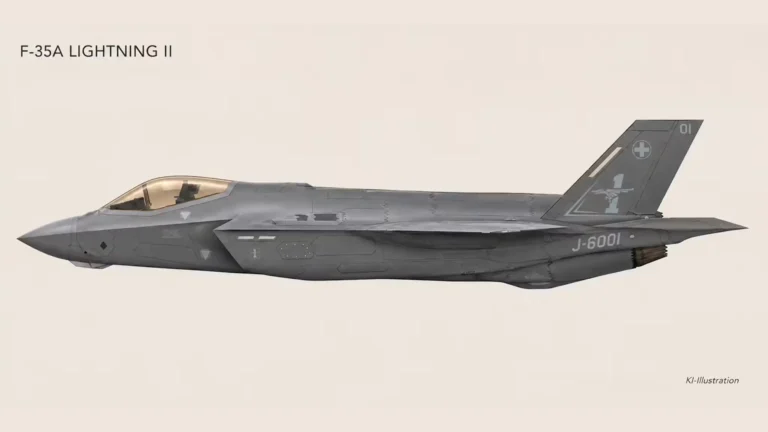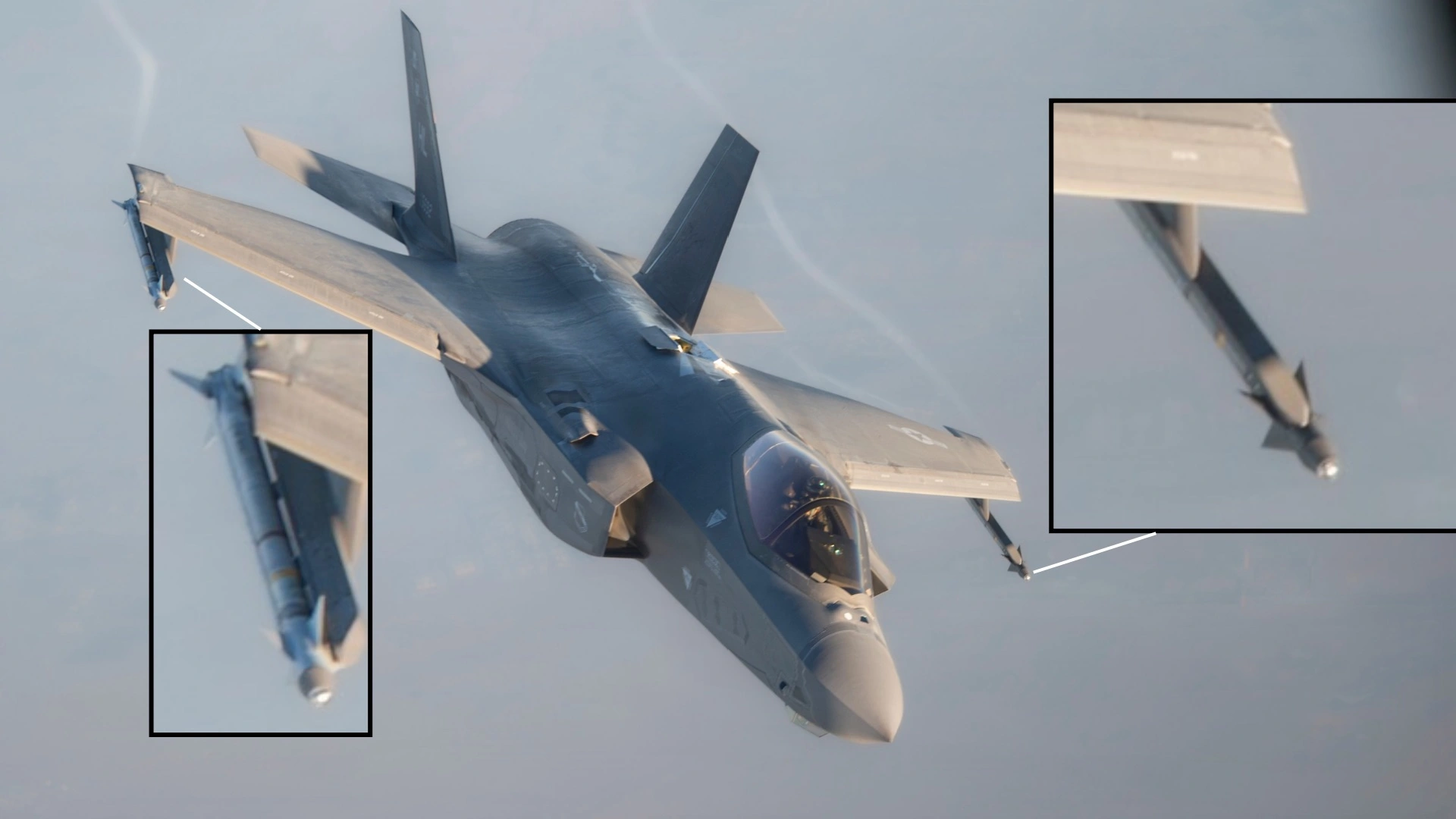
U.S. Air Force F-35A Lightning II fighters operating in the U.S. Central Command (CENTCOM) area of responsibility are carrying AIM-9X Sidewinder short-range air-to-air missiles finished in an almost uniform light gray or white scheme, a configuration not previously documented on the weapon. Official Air Force imagery shows the new scheme on F-35As since at least November 3, 2026, including a series released by Air Forces Central of jets refueling from a KC-135 tanker over the region on November 14.
Since the AIM-9X entered service in the early 2000s, operational rounds have used a dark gray nose section and fins on a light gray body. On the missiles now seen in CENTCOM, only the tip housing the seeker remains dark, while the body and fins share a single light tone. As of late November, the scheme had not been observed on other U.S. aircraft types in theater or on F-35As deployed elsewhere, and released video appears to blur certain markings on the missiles. The War Zone (TWZ), which reported the new scheme on November 27, has asked the F-35 Joint Program Office (JPO) and Raytheon, the AIM-9X prime contractor, for an explanation; neither has publicly explained the change.
AIM-9X Sidewinder Block II+ and the F-35 Signature Problem
The leading explanation is that the F-35As are carrying the Block II+ variant, designated AIM-9X-3. The U.S. Navy, lead service for the Sidewinder program, has stated that this version “incorporates specialized external materials to enhance aircraft platform survivability” and was developed to “satisfy the requirements of the Joint Strike Fighter platform.” The Navy’s own fact file states that Block II+ entered production in 2019 and has a reduced radar cross section. The first Block II+ orders date to December 2017.
Block II+ retains the capabilities of the AIM-9X-2 Block II, fielded in 2015: a two-way datalink enabling lock-on-after-launch engagements, an imaging infrared seeker, jet-vane thrust vectoring control, and high off-boresight targeting cued by helmet-mounted displays. Naval Air Systems Command lists a length of 3.02 meters, a 5-inch (127 mm) diameter, and a launch weight of 186 pounds (84 kg). Lock-on-after-launch allows a shot against a target outside the seeker’s initial field of view, using datalink updates from the launch aircraft.
The survivability logic is specific to the F-35. No variant of the Joint Strike Fighter can currently carry the AIM-9X internally; the missile rides on external wing stations, which degrades the aircraft’s radar signature. A missile with reduced radar reflectivity recovers part of that penalty. The F-35 link was visible earlier: in June 2026, the Air Force released a photo of an F-35A over the Middle East carrying a standard-painted AIM-9X stenciled “F-35 USE ONLY.”
SIP III, SIP IV and Compact Variant on the AIM-9X Roadmap
Other explanations remain open, as TWZ notes. The new finish could simply help ground crews separate F-35-only rounds from standard stock, with no signature effect from the paint itself. It could also mark a newer configuration. The System Improvement Program III (SIP III) defines the AIM-9X-4, which adds a new Application Specific Integrated Circuit (ASIC) processor. A Pentagon Modernized Selected Acquisition Report dated April 21, 2026, states that ASIC integration “has impacted missile reliability and halted testing,” with recovery of operational availability tied to fielding of the AIM-9X-4 configuration in September 2027.
The AIM-9X-5 is the companion SIP III model, and the Lot 25 contract modification awarded on June 2, 2025, listed 242 AIM-9X-5 rounds as Block II+ missiles for Foreign Military Sales customers, which suggests it is the reduced-signature counterpart of the -4. Work is also underway on the SIP IV configuration, designated AIM-9X-6, and on a Compact Variant (AIM-9X CV) that Navy budget documents describe as having a new “compact airframe optimized for internal carriage on advanced aircraft with improved kinematic performance.” A further possibility is an undesignated subvariant tuned against threats specific to the region, such as long-range one-way attack drones.
That mission is central to current CENTCOM air operations. Laser-guided 70mm Advanced Precision Kill Weapon System II (APKWS II) rockets have become the Air Force’s preferred low-cost counter-drone weapon on the F-15E and F-16, but the F-35 cannot currently employ them at all.
Analysis: If these are Block II+ rounds, the Air Force is not fielding new hardware so much as committing a specialized, F-35-specific inventory to an active theater after years in inventory. Iran and the Houthis in Yemen field air defenses that can threaten F-35s in certain conditions, and a theater that saw combat operations against Iran in April 2026 offers little margin for signature compromises. Every external store erodes the low-observable profile that justifies the F-35’s cost, and a reduced-signature Sidewinder narrows that gap without sacrificing short-range firepower. The same constraint exposes a capability gap: with no APKWS II integration, the F-35 spends a high-end interceptor on targets that other fighters engage with rockets.
Formal confirmation of the variant from the JPO or Raytheon remains the immediate unknown. The next programmatic markers are AIM-9X-4 fielding, targeted for September 2027, progress on the AIM-9X-6, and Compact Variant development for internal carriage. Whether the light scheme spreads to F-35As outside CENTCOM, or to Navy and Marine Corps F-35B and F-35C squadrons, will indicate whether this is a theater decision or a fleet-wide change.