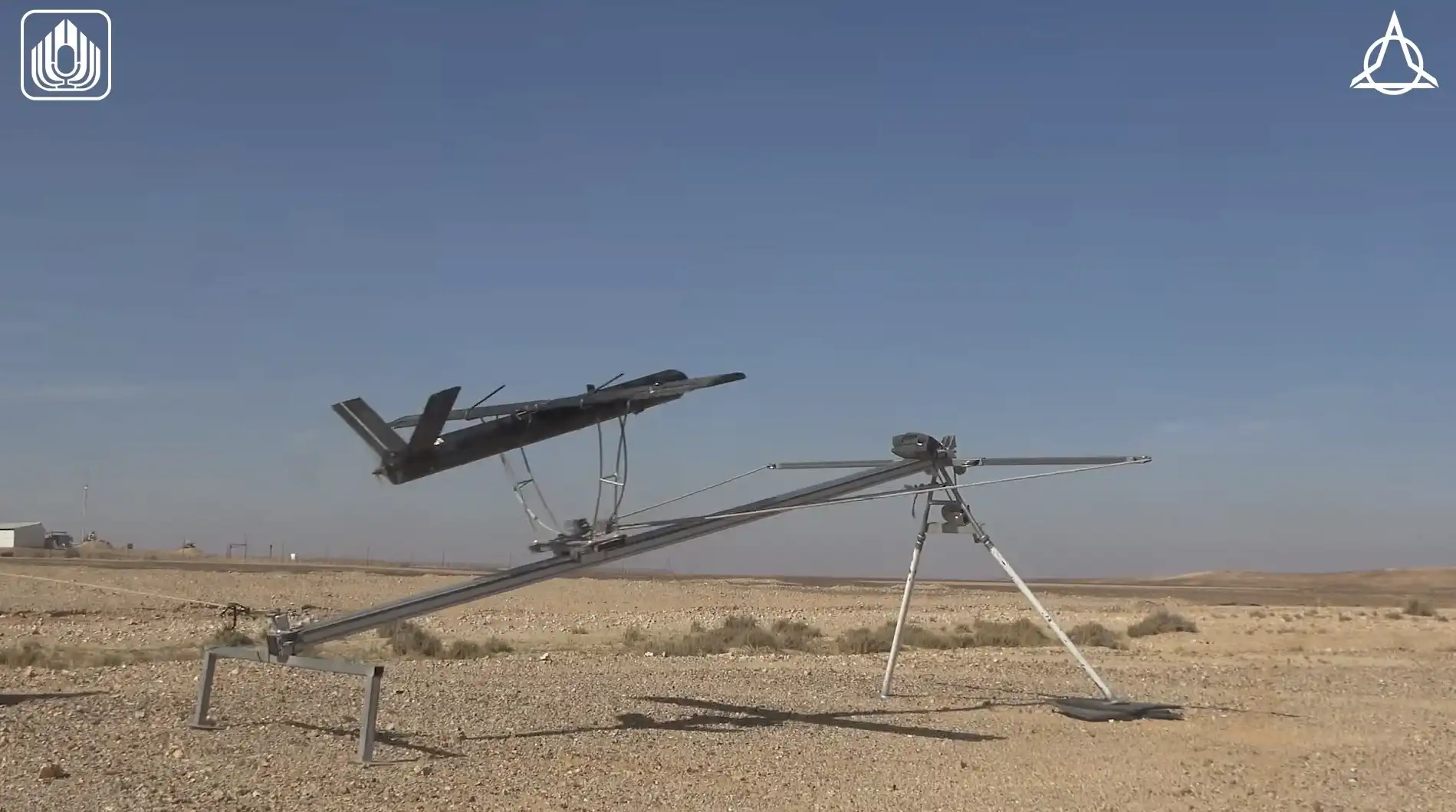
Israel’s Ministry of Defense and U.S. military and research organizations have evaluated approximately 20 counter-unmanned aerial vehicle (C-UAV) systems in Israel in the Black Sands trial, a joint campaign announced on November 26, 2026. The ministry said it was the first time the campaign was held on Israeli soil. It did not disclose the test dates, the ranges used, the systems involved, or their results.
The trial comes as small drones remain the fastest-adapting threat facing both militaries. Israeli forces have faced sustained attacks by explosive-laden and first-person-view (FPV) drones launched by Hezbollah from Lebanon, while U.S. forces in the Central Command (CENTCOM) area of responsibility have faced repeated one-way attack drone strikes, including the January 2024 attack on Tower 22 in Jordan that killed three U.S. soldiers. Black Sands is built to test interception solutions against that threat set with the operators who would field them directly involved.
How the Black Sands Trial Evaluated 20 Counter-UAV Systems
The Israel Ministry of Defense (IMOD) Directorate of Defense Research and Development (DDR&D), known by its Hebrew acronym MAFAT, co-led the campaign with U.S. organizations including the Capabilities Development and Innovation (CD&I) office, Special Operations Command Central (SOCCENT), CENTCOM, the Office of Naval Research (ONR), and Joint Interagency Task Force 401 (JIATF 401). The Israel Defense Forces (IDF) Ground Forces and the Israeli Air Force (IAF) took part, along with Israeli and American defense companies that the ministry did not name.
According to IMOD, the systems were tested against several UAV threat types in scenarios simulating the threats and operational challenges facing both countries. Each was assessed for its fit with the participating forces’ operational needs, with Israeli and American end users working together directly.
The ministry has released no performance data, no vendor list, and no breakdown by defeat mechanism. It is not possible to say how the field divided between radio-frequency jamming, kinetic interceptors, gun-based solutions, directed energy, or detection-only sensors, or which drone classes served as targets.
Black Sands is not a new framework. SOCCENT, CD&I, and DDR&D drafted the concept in February 2025 as part of CENTCOM’s broader Sands series of counter-unmanned systems events. The inaugural iteration, Black Sands 25.2, ran from October 20 to 31, 2025, at Marine Corps Base Camp Lejeune, North Carolina, where 12 jointly developed technologies were field-tested to detect and defeat unmanned systems. The Israeli iteration nearly doubles that number and adds Israeli operational units to the evaluation.
Special Operations and JIATF 401 Shape the U.S. Role
CD&I, formerly the Irregular Warfare Technical Support Directorate, identifies and develops capabilities for irregular warfare against state and non-state actors. It sits within the special operations secretariat that a November 2, 2026, memorandum from Secretary of War Pete Hegseth redesignated the Office of Strategic Services (OSS) for public use, a secondary title that still requires congressional action to become permanent. IMOD said CD&I and DDR&D have worked together for many years on advanced technologies, including drone interception and neutralization.
JIATF 401 carries different weight. Established in August 2025 under Army leadership, the task force is the Department of War’s lead organization for countering small unmanned aircraft systems, charged with synchronizing counter-drone efforts across the department and delivering capabilities at scale to defend the homeland and protect U.S. and allied forces. Its presence ties an allied test campaign to the body that writes counter-drone policy and standards for the department. ONR’s participation points to maritime and expeditionary applications, although the ministry gave no detail on naval scenarios.
Brig. Gen. (Res.) Dr. Daniel Gold, head of DDR&D, said hosting the campaign in Israel allows the partners “to connect the knowledge and operational experience accumulated in Israel with additional capabilities and technologies, and to jointly evaluate the solutions required by forces in the field.” Brig. Gen. Benny Aminov, head of the R&D Unit within DDR&D, described a threat “characterized by the accessibility of civilian technology, widespread availability, and a rapidly accelerating cycle of learning and adaptation.”
Analysis: Moving Black Sands from a U.S. base to Israel changes the character of the campaign. At Camp Lejeune, the event showcased co-developed prototypes; in Israel, it put roughly 20 systems in front of IAF and Ground Forces users with extensive recent combat experience against drones. For Washington, the value lies less in any single system than in access to that operational knowledge, a point Aminov made explicitly when he said the cooperation provides the United States “with access to unique technologies and invaluable operational experience.” With JIATF 401 involved, the trial also shortens the path from Israeli and American prototypes toward U.S. fielding decisions, provided the results hold up under formal test and evaluation.
IMOD has not said whether results will be published, which systems performed best, or when the next iteration will take place. The next indicators to watch are any JIATF 401 fielding or procurement announcements involving Black Sands participants, the schedule of the next CENTCOM Sands event, and whether Congress codifies the OSS structure that now houses CD&I.