HENSOLDT and ARGUS Interception GmbH announced on November 26, 2026, that they are expanding their counter-unmanned aircraft system (C-UAS) partnership to integrate ARGUS’s A1-Falke net interception drone into HENSOLDT’s Elysion C-UAS solution. The two German companies will jointly market the combined system to protect critical infrastructure, civilian facilities, and military sites in Germany and abroad.
The agreement lands six weeks after the Bundeswehr ordered A1-Falke systems on October 15, 2026, under a seven-year framework contract worth up to €1.1 billion, and follows a year in which drone sightings repeatedly disrupted German airports. It also extends HENSOLDT’s approach of pairing its sensors and command and control (C2) software with specialist interceptor makers: on January 26, 2026, the Taufkirchen-based company signed a memorandum of understanding with TYTAN Technologies to bring that firm’s interceptor drones into the same architecture. HENSOLDT reported 2025 revenue of approximately €2.46 billion and employs around 10,000 people.
How HENSOLDT Elysion Integrates the A1-Falke Net Interceptor
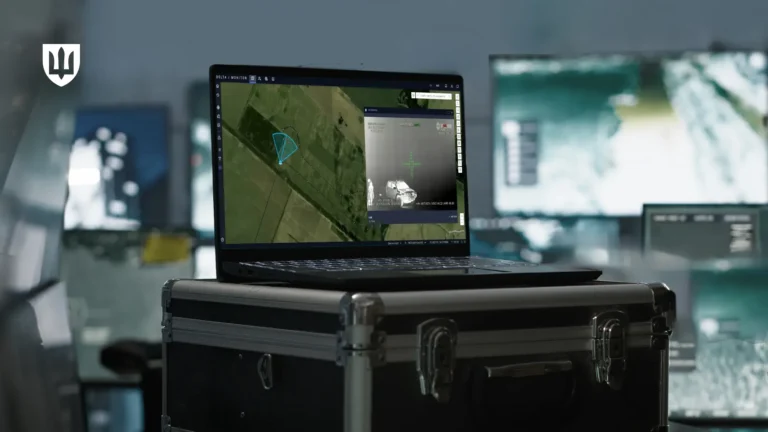
Elysion is HENSOLDT’s modular C-UAS platform, built around the Elysion Mission Core software. Mission Core fuses data from radar, electro-optical and infrared cameras, radio-frequency sensors, and acoustic detectors into a single situational picture, applies AI-supported classification and tracking, and presents response options to the operator. HENSOLDT states that this level of automation allows one operator to run the full engagement sequence. The company offers Elysion in stationary, mobile, and deployable configurations and says it is already in service in military and police scenarios. Known applications include the Bundeswehr’s ASUL counter-drone system, into which HENSOLDT has integrated kinetic countermeasures, and C-UAS vehicles commissioned by the German Federal Police in April 2026.
Integrating the A1-Falke adds a controlled, non-kinetic capture effector to that multi-sensor, multi-effector architecture. According to the companies, the result is a continuous chain of effects running from early detection and identification through situational awareness, C2, and decision support to the physical interception of an uncooperative drone. The stated purpose is to give operators an option in sensitive environments where kinetic effectors cannot be used, or can be used only to a limited extent.
Christian Jaeger, Vice President of the Land Business Unit at HENSOLDT, said the capability creates additional options for scenarios in which “controlled and proportionate defence measures are crucial.” Sven Steingräber, CSO and co-founder of ARGUS Interception, said effective C-UAS operations depend on the interplay of detection, situational awareness, decision support, and controlled intervention, not on individual systems alone.
A1-Falke Specifications: Speed, Endurance, and Net Capture Payload
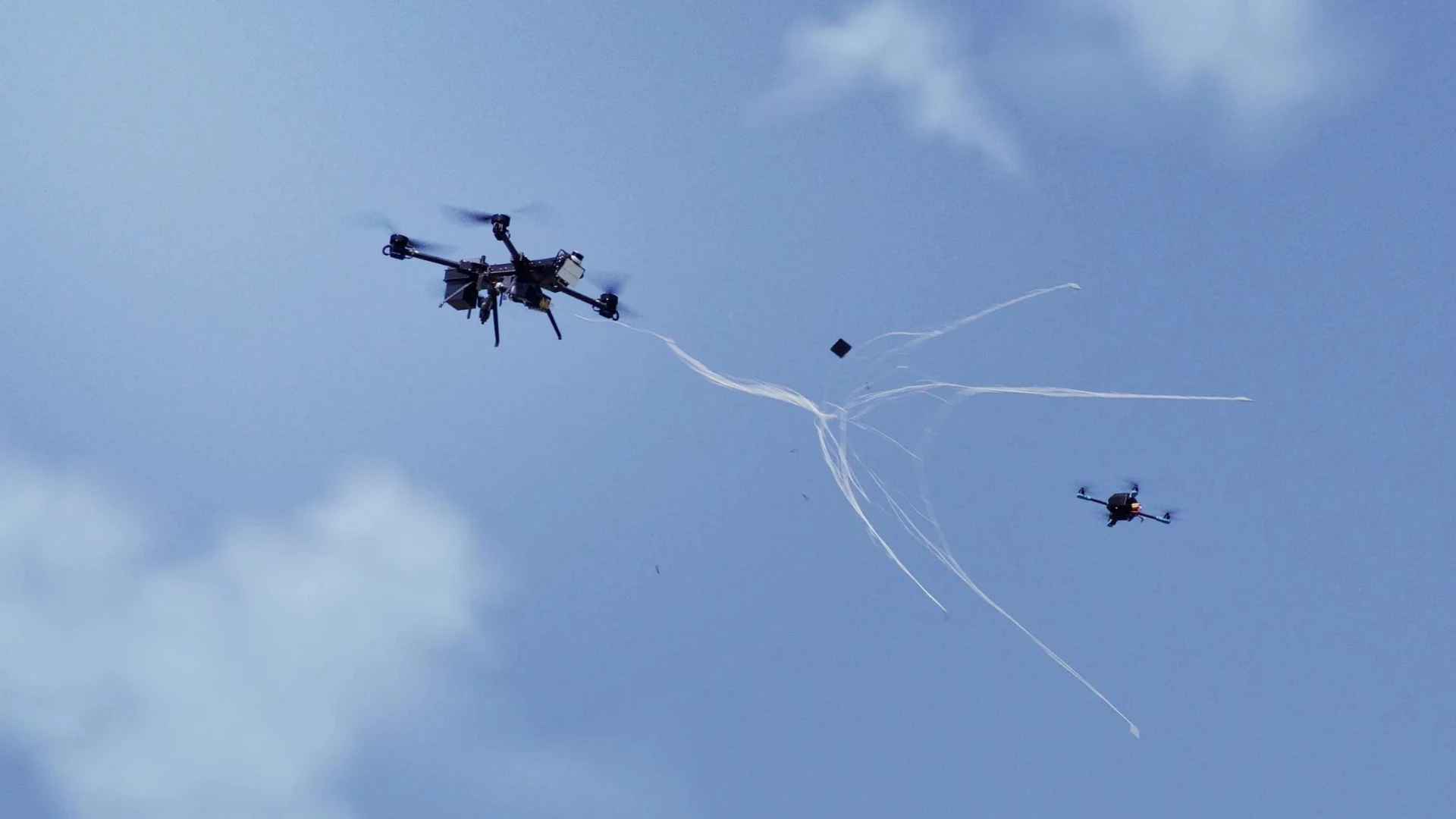
The A1-Falke is a quadcopter interceptor that captures its target with a fired net instead of destroying it. Publicly available specifications indicate a takeoff weight below 25 kilograms, a top speed of up to 100 km/h, and a flight endurance of about 30 minutes per battery charge. The aircraft carries up to three net payloads, in 4 x 4 meter or 7 x 7 meter sizes, which gives the operator repeat engagement attempts on a single sortie. That speed envelope lets the interceptor run down fast small multirotor drones, the class most often involved in incursions over airports and bases.
Target acquisition combines ground-based sensors with the interceptor’s onboard sensing; ARGUS has publicly demonstrated the drone with an onboard radar from US manufacturer Echodyne. Open-source reporting indicates the intercept begins only after an operator authorizes it, and the entangled target is then carried to a predetermined landing point. ARGUS says its patented net technology avoids secondary damage from falling debris and preserves the captured drone for forensic examination of its technical origin, configuration, and operational context. For police forces and infrastructure operators, that evidentiary value is something jammers and guns cannot deliver.
ARGUS pairs the interceptor with the Falke-NEST, an automated hot-standby shelter that keeps an A1-Falke launch-ready around the clock for short response times. Neither company disclosed the financial terms of the expanded partnership, the interface used to connect the A1-Falke to Mission Core, or the engagement range of the integrated system.
Analysis: The partnership aligns two capabilities the German government is already buying. HENSOLDT supplies the C2 backbone for Bundeswehr and Federal Police counter-drone systems, and ARGUS holds a framework contract worth up to €1.1 billion for the interceptor. Making the A1-Falke a native Elysion effector lowers integration risk for German customers and gives both firms a packaged, German-built offer for European markets where rules of engagement over civilian areas restrict gunfire and missiles. The limit is the threat class: a 100 km/h net carrier addresses small multirotors in peacetime airspace, not massed fixed-wing attack drones, so it complements kinetic interceptors and does not replace them.
HENSOLDT says initial joint demonstrations and customer projects are already in the pipeline, without naming dates or customers. The next indicators are the first public demonstration of an A1-Falke engagement controlled through Mission Core, the composition of Bundeswehr call-offs under the framework contract, with first deliveries reported for 2027, and whether a critical infrastructure operator or police force becomes the first announced customer for the combined system.