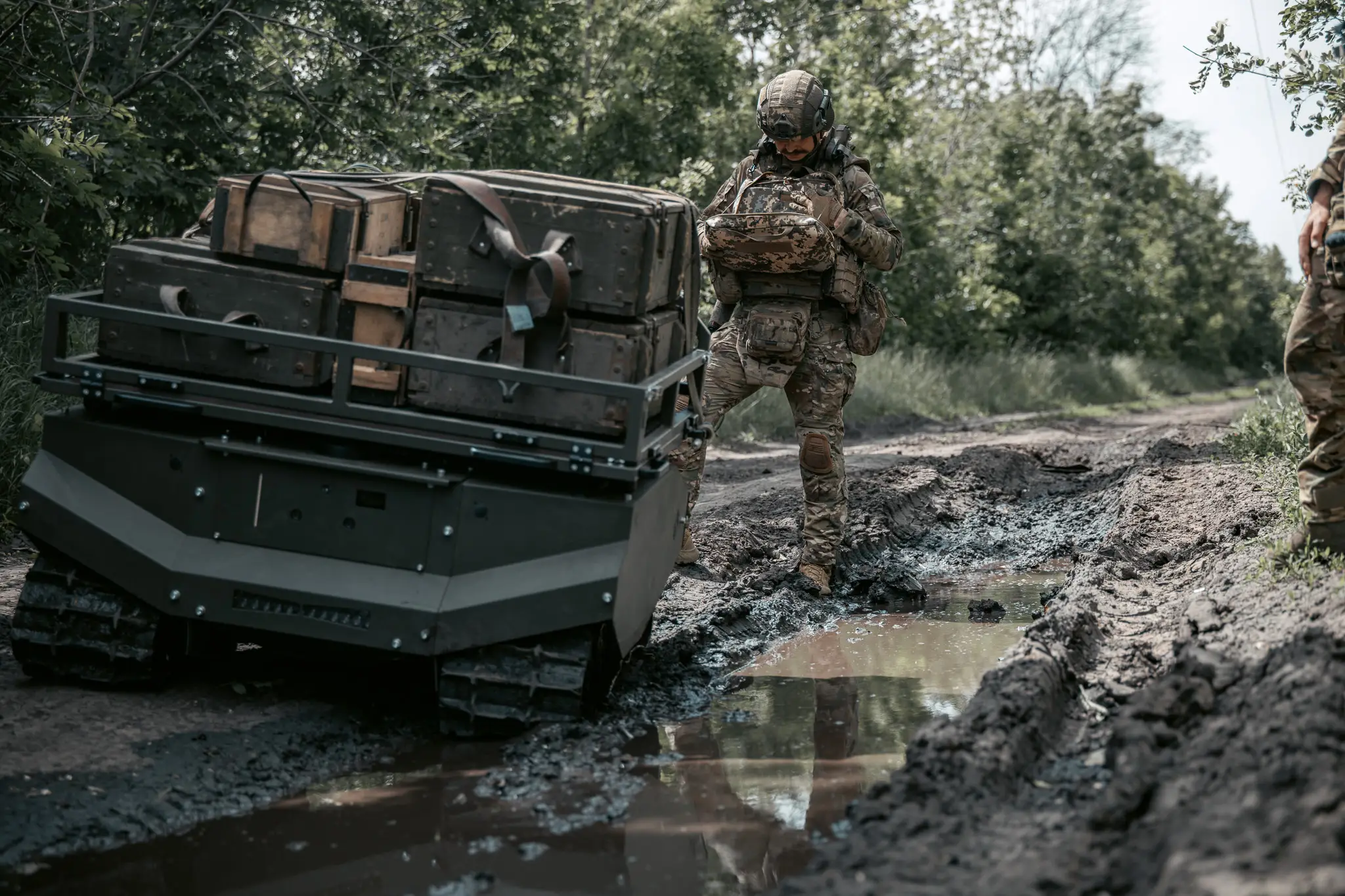
Germany’s ARX Robotics and Ukraine’s Roboneers have signed a strategic partnership for unmanned land warfare that commits both companies to integrating their unmanned ground vehicles (UGVs) and developing new systems jointly. The agreement was signed in Kyiv in the presence of German Chancellor Friedrich Merz and Ukrainian President Volodymyr Zelenskyy, ARX Robotics announced on October 4, 2026.
The deal deepens cooperation that already supplies UGVs to the Armed Forces of Ukraine and was formalized in June 2026, when the two firms formed ARX Industries, a joint venture for serial production of the Roboneers Rys Pro UGV in Ukraine and Germany. It lands as Kyiv estimates its 2026 requirement for unmanned ground systems at 50,000 units.
Ukraine UGV Partnership Expands From Rys Pro Production to Co-Development
The new agreement covers technical integration of both manufacturers’ systems and joint development work. Neither company has disclosed financial terms, volumes, the platforms in scope or a timeline for a first co-developed system.
The production layer is better documented. ARX Industries aims to build thousands of Rys Pro units in its first year, scaling to tens of thousands annually afterward. The joint venture covers manufacturing, maintenance and operational support under the Build with Ukraine initiative, with backing from both governments. Planned roles include casualty evacuation (CASEVAC), frontline resupply, mining and demining modules, and combat configurations.
The Rys Pro is a wheeled, remotely operated carrier. A May 2026 upgrade raised range to 40 km per charge, or 80 km using the four batteries supplied with each vehicle, while keeping a 300 kg payload. It added a digital datalink with mesh networking, LTE control, a short-range assault controller for infantry, a rear-view camera and a standard Starlink Mini terminal. A separate LTE/Wi-Fi antenna provides a 60 m fallback channel to recover the vehicle if a first-person-view (FPV) drone strike disables the satellite link.
For assault support, the Rys Pro accepts the Roboneers Saber remote weapon station (RWS), formerly ShaBlya. Variants mount 7.62 mm PKT or M240 machine guns, 12.7 mm M2 Browning, Canik M2 QCB or Ukrainian MG-50 QCB machine guns, and 40 mm MK19 or AGL-53 automatic grenade launchers. Roboneers says its systems have completed more than 15,000 frontline missions since 2014, a company figure without independent verification. The two firms have already equipped one Ukrainian regiment with 30 UGVs for concurrent logistics, CASEVAC and ammunition resupply tasks.
Gereon RCS, Mithra OS and the Deutz Ulm Production Ramp
ARX brings the Gereon Robotic Carrier System (RCS), a compact, tracked and modular UGV. Publicly available specifications indicate a payload of up to 500 kg, a 40 km range, up to 72 hours of operating time and a 15 km/h speed in its current configuration. The 2023 prototype weighed 450 kg, measured 141.5 by 131 by 73 cm and carried dual GPS receivers, a lidar sensor and a stereo camera. Germany funded 30 Gereon RCS units for Ukraine in late 2024, and ARX now claims the largest Western-built UGV fleet in the country.
The software layer carries more weight than the chassis. Mithra OS, the ARX artificial intelligence (AI) operating system, is built as an open-interface core linking crewed and uncrewed vehicles, with over-the-air updates and swarming among meshed assets. ARX also sells it as a retrofit that converts legacy vehicles into networked, optionally uncrewed platforms. The companies have not said whether Mithra OS will run on the Rys Pro, which is the technical crux of any integration.
The platforms complement rather than duplicate each other. A wheeled 300 kg carrier with an organic weapon option suits fast resupply and assault support; a tracked 500 kg carrier suits mud, snow and engineer tasks. Common control, if achieved, would let a unit dispatch mixed UGV packages from a single ground station and cut operator training and spares overhead.
Industrial capacity is the second variable. On September 29, 2026, ARX and engine maker Deutz delivered the first Gereon systems built at the Deutz plant in Ulm, 12 weeks after launching the production ramp-up. The batch belongs to a larger contract for Ukraine’s Defense Forces whose quantity has not been disclosed.
Analysis: The agreement moves ARX and Roboneers from a production arrangement toward shared design authority, which matters for who controls the battlefield feedback loop. Roboneers contributes combat iteration speed; ARX contributes German industrial partners, a software stack built for allied interoperability and access to Western customers, including Ajax wingman work with General Dynamics Land Systems-UK and Gereon trials with Poland’s 1st Sapper Regiment. ARX chief executive Marc Wietfeld presented the partnership as a channel for Ukrainian combat lessons into Western land systems development. The scale gap remains stark: thousands of Rys Pro units in year one against a 50,000-unit national requirement leaves most of Ukraine’s 2026 demand to other suppliers.
Milestones to watch include the first integrated or co-developed system, any Mithra OS port to the Rys Pro, ARX Industries’ first-year output and the Deutz Ulm ramp-up over the coming months. Funding, intellectual property arrangements and whether co-developed systems will be offered to the Bundeswehr or other NATO armies remain undisclosed.