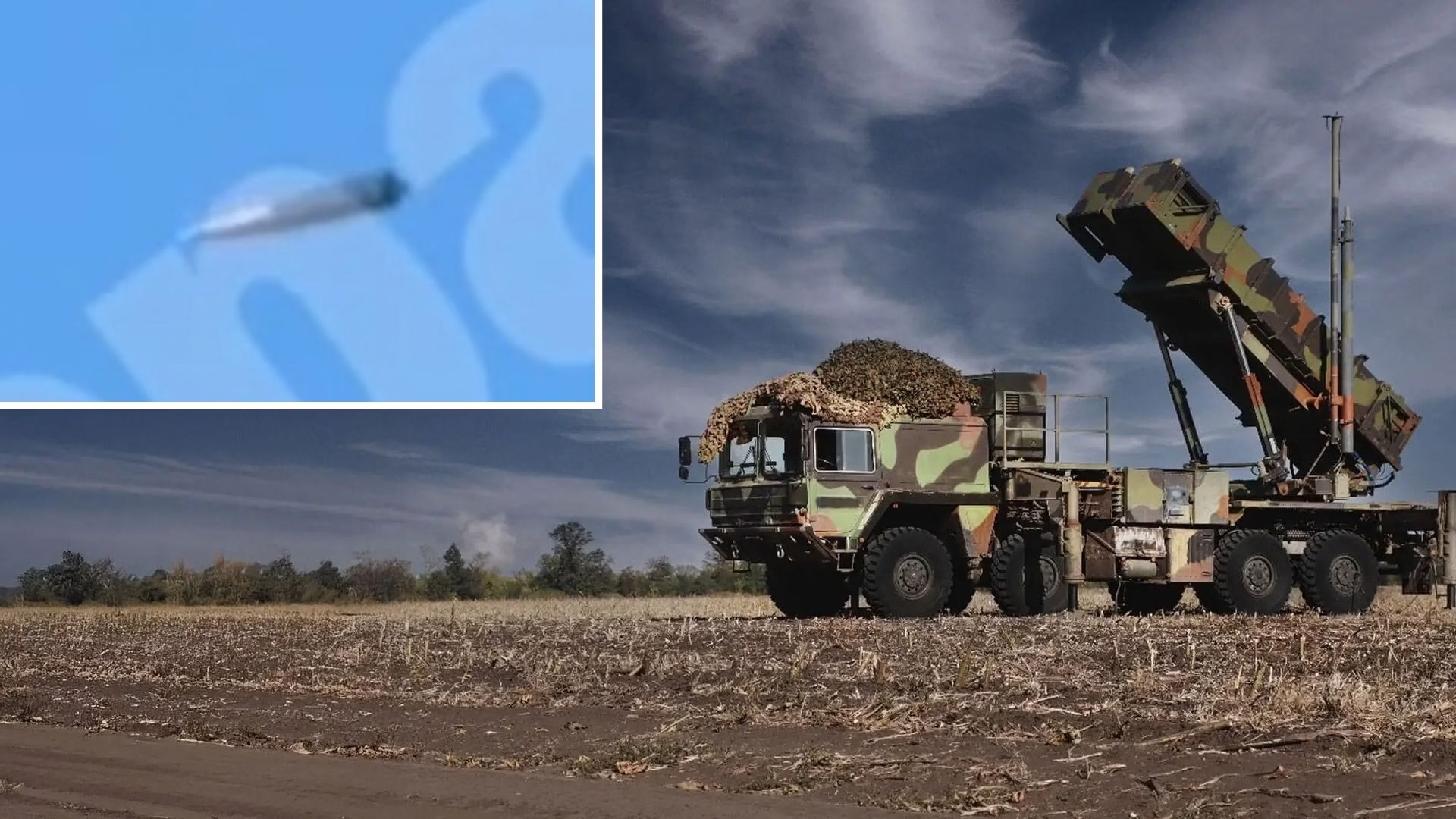
Ukraine’s Air Force said a US-supplied Patriot air defense system intercepted one of two Russian 3M22 Zircon missiles fired at Kyiv during a daytime ballistic attack on October 10, 2026. Air Force spokesman Yuriy Ihnat disclosed the preliminary figures on national television, adding that Russia launched roughly 100 jet-powered drones over the course of the day, most of them aimed at the capital.
The raid extends a pattern that has reshaped the air war over Kyiv this year. Russia used the Zircon only sporadically in 2024 and 2025, then began firing it regularly from January 2026; around 40 had been launched by late June, according to Ukrainian data. Every salvo draws on the same scarce resource: Patriot interceptors, the only weapon Ukrainian officials describe as able to reliably engage targets flying a ballistic profile. In recent months, the Air Force has stopped publishing ballistic launch and intercept counts, which makes Ihnat’s disclosure a rare data point.
How Patriot Intercepted One of Two Zircon Missiles Over Kyiv
Ihnat said the drone wave approached from the south, north, and east. Explosions sounded across the city in the early afternoon. Kyiv Mayor Vitali Klitschko reported debris falling in the courtyard of a residential building in the Obolonskyi district, where a restaurant was also hit and caught fire. Rescuers initially found four injured, one in serious condition; by evening, Klitschko put the toll at seven, three of them in serious condition. Earlier in the day, drone debris struck a 25-story residential building and an eight-story office building in the Solomianskyi district and fell on open ground in Podilskyi, while power outages temporarily halted the Kyiv Metro.
President Volodymyr Zelensky said some of the ballistic missiles were successfully intercepted, and tied the timing of the raid to what he described as permissive signals Moscow received the previous day over the sale of Russian oil products.
Within hours, a two-second video circulated on social media, attributed to a Kyiv-based Telegram channel, purporting to show the forward section of a Zircon spiraling to the ground after the Patriot engagement. DefenseWarroom could not independently verify the footage, its location, or the identification of the object. The Air Force has not released imagery, interceptor type, or engagement details. Ihnat said the second Zircon hit a target but did not say where. It has also not published a breakdown of other ballistic weapons used in the raid.
Speed, Range, and Propulsion: What Zircon Debris Reveals
The 3M22 Zircon (NATO reporting name SS-N-33) was developed by NPO Mashinostroyeniya as a ship-launched anti-ship weapon. Russia claims a top speed of about Mach 9 and a range of up to 1,000 km; Chief of the General Staff Valery Gerasimov has cited a lower Mach 8, covering 450 km in 4.5 minutes. The Russian Navy fields it from the 3S14 universal vertical launch system aboard Project 22350 Admiral Gorshkov-class frigates. Strikes on Ukraine have come from ground launchers, mainly in occupied Crimea, from where Ukrainian estimates put flight time to Kyiv at about three minutes. On July 2, 2026, the Air Force reported the first Zircon launches from Russia’s Kursk region.
Combat evidence has eroded the official narrative. Forensic examination of debris by the Kyiv Scientific Research Institute of Forensic Expertise points to a solid-propellant rocket motor, and analysts found no air intake, a combination inconsistent with the scramjet propulsion long attributed to the weapon. Analysts now largely assess Zircon as a quasi-ballistic missile, matching Ihnat’s description of an anti-ship missile that strikes like a ballistic one. Russia has not disclosed warhead mass, dimensions, or guidance modes, and those parameters remain unconfirmed in open sources. Russian procurement documentation reviewed by Ukrainian analysts puts unit cost at about $5.6 million.
Patriot Interceptor Shortage Shapes Kyiv’s Ballistic Missile Defense
The October 10 result fits a volatile record. Of 46 Zircons fired at Ukraine through late June, 40 of them this year, Air Force data indicates 41% were shot down. On June 15, 2026, air defenses downed five of six Zircons fired from Crimea, which Ihnat called one of the best results recorded against the weapon. Weeks later, the curve broke the other way: on July 2, 24 of 28 ballistic and Zircon missiles fired in a single raid got through, and in an early July raid the Air Force reported intercepting none of 23 Iskander-M ballistic missiles and six Zircon and Oniks missiles.
Ukrainian officials attribute the swings to interceptor supply rather than system performance. Patriot batteries defending Kyiv draw on a stock also stretched across Kharkiv, Dnipro, Odesa, and Zaporizhzhia, and Ihnat has warned that the persistent deficit may push Russia to prioritize ballistic missile production, even though those weapons take longer to build than cruise missiles. Ukraine first used Patriot to down a Kh-47M2 Kinzhal over Kyiv in May 2023; three years on, the question is less whether Patriot can engage these threats than whether enough PAC-3 and PAC-2 rounds reach the launchers. Kyiv has requested interceptors from nearly 40 partner countries, while Ukrainian military intelligence reported in August that Russia had already met its annual production plan for Zircon and Oniks.
Analysis: The intercept confirms again that a supplied Patriot battery can defeat Zircon, but it does not change a cost exchange that favors Moscow. Russia can pair a handful of Zircons with roughly 100 drones to force the defender to commit its scarcest interceptors against its fastest targets, with doctrine commonly assigning two interceptors per ballistic threat. Intercepts over a dense city still scatter debris, as the missile fragments that fell in an Obolonskyi courtyard show. For NATO planners, Kyiv remains the principal combat dataset on engaging Russia’s claimed hypersonic weapons, and it points to magazine depth and production rate, not sensor or missile performance, as the binding constraint on European ballistic missile defense.
The next indicators are whether the Air Force releases engagement details or debris findings from the October 10 raid, how quickly PAC-3 deliveries arrive before winter, and whether Russia sustains daytime Zircon salvos alongside its drone campaign against the energy grid. Where the second Zircon struck has not been disclosed.