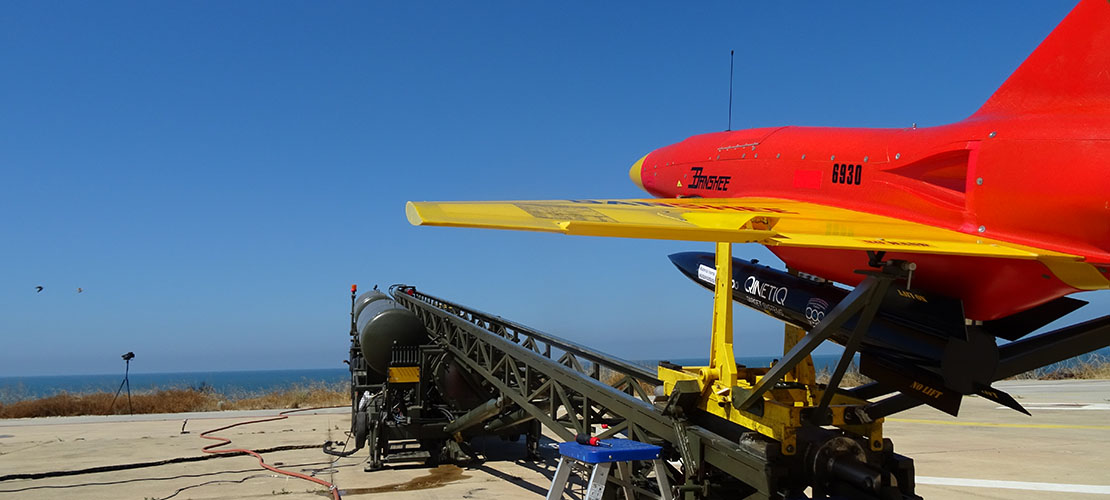
The UK Ministry of Defence (MOD) and QinetiQ launched Project Safari on October 10, 2026, a joint program that gives small and medium-sized enterprises (SMEs) a single point of access to Britain’s sovereign test and evaluation (T&E) ranges and streamlines approvals for trial activity. At MOD Hebrides, Minister for Defence Readiness and Industry Luke Pollard signed an agreement with QinetiQ for the first design stage of a multimillion-pound investment to prepare the range for hypersonic missile testing.
The initiative targets the gap between prototype and fielding. The MOD acknowledges that outdated, multi-layered approvals have kept SMEs and defense newcomers from testing hypersonic missiles, directed energy weapons and autonomous systems in realistic conditions. The 2025 Strategic Defence Review (SDR) committed the department to increasing SME spending by £2.5 billion a year by summer 2028, inside a Defence Investment Plan the government says carries £298 billion over four years.
Project Safari and the LTPA: A Single Front Door for SMEs
Project Safari runs through the Long Term Partnering Agreement (LTPA), signed in 2003 for 25 years, under which QinetiQ operates 16 MOD-owned ranges and test facilities across England, Scotland and Wales, from MOD Boscombe Down and MOD Aberporth to the British Underwater Test and Evaluation Centre. A five-year, £1.54 billion extension announced in May 2025 carried the agreement to 2033 and included a joint pledge to widen SME access. Safari is the first named mechanism to deliver it.
The program sets three lines of effort: a single front door through which SMEs request facilities and specialist expertise, reformed approval processes for trials, and range infrastructure modernized for a digital T&E environment. It also places regulators alongside government, industry and technology developers, a meaningful inclusion given that trial clearance depends on safety cases as much as on range availability.
The existing access model explains the friction. The MOD centrally funds LTPA capabilities for Front Line Commands, Defence Equipment and Support (DE&S), the Defence Science and Technology Laboratory (Dstl) and organizations working directly for the department, while other customers buy access commercially. Firms without a direct MOD contract sit outside that funded pathway. Pollard conceded that limited T&E access had held back smaller businesses and new entrants. QinetiQ Group Chief Executive Steve Wadey framed the problem as one of tempo, warning that “we’ve got to go faster to stay ahead.”
Neither party disclosed a value for Project Safari, an opening date for the single front door, or which LTPA sites will join first.
How MOD Hebrides Is Being Readied for Hypersonic Weapons Testing
Built by the Royal Air Force in 1957 and 1958 to fire the Corporal missile, MOD Hebrides spans South Uist, Benbecula and St Kilda. It comprises a Deep Range for complex weapons trials and in-service firings and an Inner Range for ground-based air defense campaigns. Range data published by QinetiQ indicates 115,000 square kilometers of sanitized airspace with unlimited altitude, extendable to 460,000 square kilometers for specific trials. QinetiQ and the MOD previously committed £60 million to modernize the site, including new radars.
The MOD has not disclosed the value of the design-stage agreement. Weapons flying above Mach 5 compress tracking timelines and enlarge range safety footprints, raising demands on radar coverage and telemetry. The work supports Team Hypersonics (UK), which runs the £1 billion Hypersonic Technologies and Capability Development Framework (HTCDF) with roughly 90 suppliers, including SMEs and academic institutions, against a widely reported 2030 target for a sovereign hypersonic capability.
Project Brakestop shows the range already serving SME-led weapons. Launched by the MOD’s Taskforce Kindred in November 2024, it called for a ground-launched weapon able to strike beyond 500 kilometers with a 225-kilogram warhead at a target unit cost of £400,000, excluding the warhead. MBDA UK’s Crossbow, MGI Engineering’s TigerShark and Rotron Aerospace’s SkyLance were all flight-tested at MOD Hebrides, and Phase 2 contracts worth around £15 million fund 15 improved effectors from each selected supplier. MGI, an Oxfordshire firm with more than 25 years in Formula 1, won its first defense contract through Brakestop; Pollard met the company during the visit.
The SME roundtable at the range included Greenjets and Cambridge Aerospace, both selected in July 2026 with Frankenburg Technologies under the Low-Cost Air Defence Effectors (LCADE) program to develop a British drone interceptor. Cambridge Aerospace’s tube-launched Skyhammer, rated at more than 30 kilometers and 700 kilometers per hour, went from a late-2024 company founding to an MOD supply contract in April 2026.
Analysis: Britain’s acceleration agenda has largely solved for design speed; the binding constraint is now proof. Brakestop moved its competitors to flight test quickly in part because a dedicated MOD team, working with QinetiQ, arranged range access on their behalf. Project Safari tries to extend that pathway to firms without a program sponsor, and its credibility will rest on measurable outputs: time from application to range slot, trial cost to an SME, and how many approval layers disappear. A hypersonic-capable Hebrides would also strengthen the UK as a test host for allies, who already fire there under a three-year arrangement QinetiQ signed with the NATO Support and Procurement Agency (NSPA) in June 2024.
Outstanding details include the Safari application process and launch date, the first LTPA sites in scope, and whether the Hebrides design stage becomes a build contract. Demand for range time will rise as Brakestop Phase 2 effectors and HTCDF demonstrators head toward live trials, while the NSPA arrangement runs to mid-2027.