Japan’s Ministry of Defense has signed a contract to acquire interceptor drones from Ukrainian manufacturer SkyFall, Defense Minister Shinjiro Koizumi said on October 9, 2026, adding that the ministry is working toward early delivery. Koizumi disclosed the deal at his post-Cabinet press conference in Tokyo but did not identify the model, quantity, contract value, delivery date, or receiving unit.
The announcement turns a political signal into a signed procurement. On October 1, former defense minister Itsunori Onodera, who coordinates the ruling Liberal Democratic Party’s work on revising Japan’s three core security documents, met President Volodymyr Zelensky in Kyiv and told reporters that Tokyo would buy SkyFall drones on a trial basis to assess their performance. Ukrainian officials used those meetings to brief the delegation on Russia’s expanding use of jet-powered attack drones. The contract arrives as the government prepares to revise its National Security Strategy, National Defense Strategy, and Defense Buildup Program before the end of 2026.
SkyFall Interceptor Drones Contract: What Tokyo Has Confirmed So Far
Koizumi’s statement was brief and procedural: the contract is concluded and the ministry is pursuing early delivery. Neither the ministry nor SkyFall has published the number of airframes, the price, the configuration, or whether the package includes ground control stations, training, or spares. The ministry also has not said which branch of the Japan Self-Defense Forces (JSDF) will receive the systems first, or where test and evaluation will take place.
Onodera’s reference to a trial purchase points to an evaluation lot rather than a fleet buy. Japanese media have reported that officials regard Ukrainian drones as highly capable because of continuous battlefield upgrades, and that the government is separately studying Ukrainian-made attack drones for the JSDF.
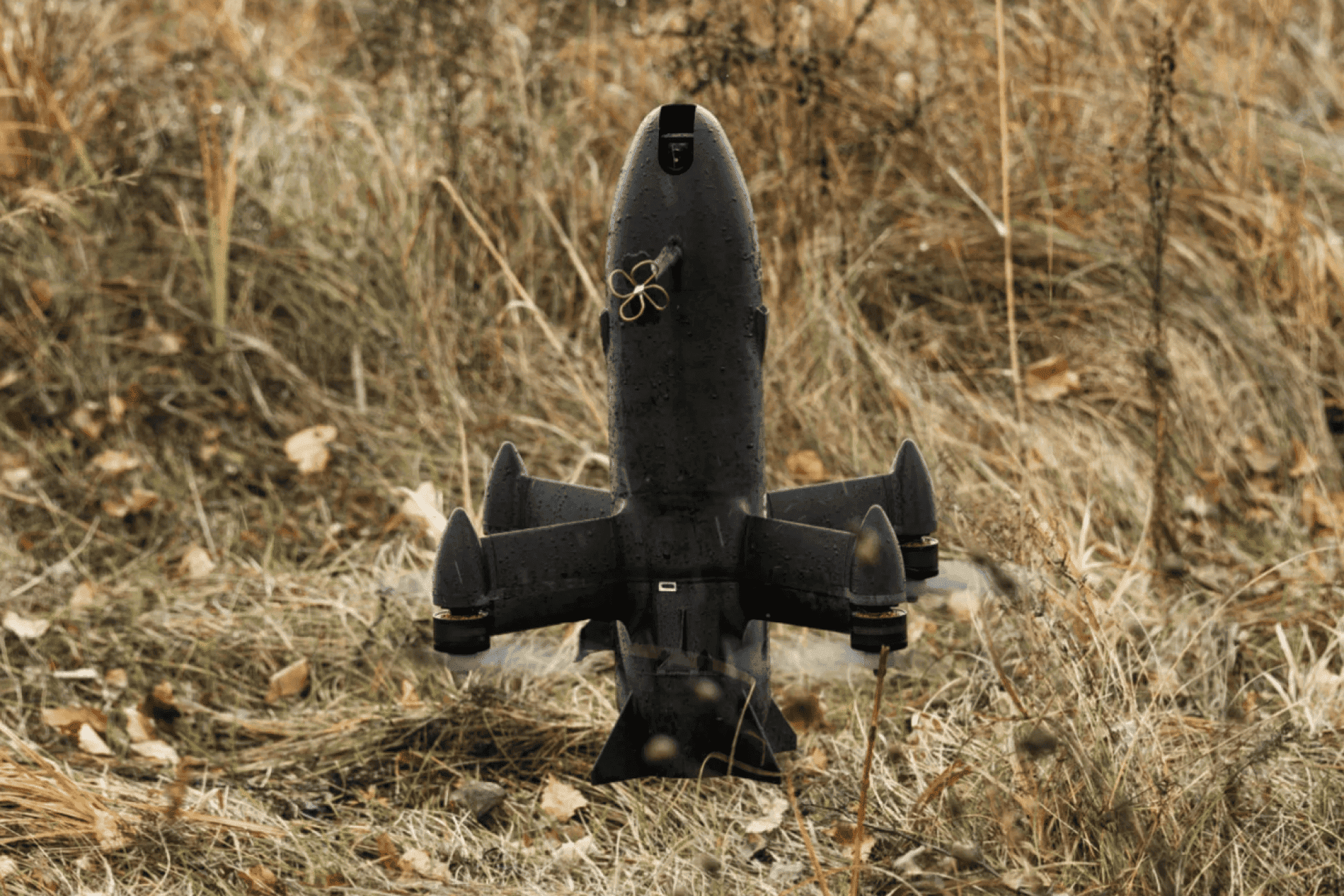
SkyFall’s portfolio spans the Vampire heavy bomber drone, Shrike first-person-view (FPV) strike drones, and the P1-SUN family of aerial interceptors. Because the company’s interceptor offering is built around the P1-SUN line, a P1-SUN variant is the likely candidate, although Tokyo has not confirmed the model.
Koizumi tied the purchase to an industrial lesson. He said Ukraine has accumulated more experience in new ways of warfare than any other country and cited what he called a “rapid feedback cycle,” in which drones with new capabilities appear every two to three weeks. Japan, he said, has much to learn from that model for both its defense industry and its production base.
P1-SUN Family: Speed, Range, and AI Terminal Guidance Compared
The baseline P1-SUN entered Ukrainian service in November 2025 to counter piston-engine Shahed-136 one-way attack drones, which Russia builds as the Geran-2. SkyFall’s published figures give it a top speed of 310 km/h, a range of about 23 km, a 5,000 m ceiling, more than 17 minutes of endurance, and a warhead of up to 800 g. The company says the type had destroyed more than 5,500 Shahed-type drones by July 2026 and has cited a unit price of roughly $1,000. Neither figure has been independently verified.
The P1-SUN Long, shown at Eurosatory in Paris in June 2026, stretches range to 33 km and ceiling to 9,000 m and adds an onboard artificial intelligence (AI) module for autonomous target detection.
The P1-SUN JetKiller, unveiled at the Farnborough International Airshow on July 20, 2026, responds to Russia’s turbojet-powered Geran-3, Geran-4, and Geran-5 variants. Propulsion changes raise top speed to 370 km/h, with a 30 km range, 9,000 m ceiling, 15 minutes of endurance, and a 500 g warhead. Configurations include analog or digital day and night cameras, or an AI terminal guidance module that SkyFall says detects and locks onto targets at up to 1 km. On September 30, 2026, the company released footage of a JetKiller, operated by a National Guard of Ukraine unit through SkyFall’s remote control network, destroying a Geran-5.
Speed remains the limiting factor. Geran-5 cruise speed is reported at 450 to 600 km/h, above the JetKiller’s maximum, so successful engagements depend on early radar cueing, head-on intercept geometry, and catching targets during slower flight phases. For Japan, interceptor performance will hinge on sensor integration as much as on the airframe.
How Ukrainian Interceptors Fit Japan’s SHIELD and Radar-Site Defense Plans
The SkyFall order sits inside a wider counter-drone effort. On May 27, 2026, the ministry issued a request for information on radar-site defense unmanned aerial vehicles (UAVs) to protect radar installations and nearby facilities against simultaneous attacks by long-range attack drones such as the Shahed-136. The requirement called for automatic guidance from ground equipment, minimal crewing, integration with other systems, prior use by foreign militaries, and a proven record of downing long-range attack drones, with fielding in fiscal 2027 or fiscal 2028 at the latest.
Radar-site defense UAVs form one layer of the Synchronized, Hybrid, Integrated and Enhanced Littoral Defense (SHIELD) concept, a coastal network of air, surface, and undersea unmanned systems funded at ¥100.1 billion in the fiscal 2026 budget. The ministry’s record ¥8.9 trillion fiscal 2027 request, released August 31, 2026, adds interceptor drones and seeks to begin development of a close-range air defense system combining interceptor missiles, autocannons, and lasers.
Tokyo is also hedging across suppliers. Japanese firm Terra Drone has fielded interceptor designs in Ukraine through local partners. SkyFall, for its part, agreed in June 2026 with Airbus Defence and Space to integrate the P1-SUN family with the Airbus Air C2 airspace management system, a precedent for linking the interceptor to a non-Ukrainian command network.
Analysis: The direction of the transfer is the core story. At the same briefing, after a reporter cited Kyiv’s interest in Japanese license-produced Patriot missiles, Koizumi said the government is not currently considering transferring weapons to Ukraine under the Self-Defense Forces Act. Military technology is now moving from Kyiv to Tokyo, not the reverse. Japan’s missile-heavy air defense faces a cost-exchange problem against mass-produced attack drones: every PAC-3 or Standard Missile round spent on a cheap target comes from a finite, slow-to-replenish inventory. A trial lot of combat-iterated interceptors, reported at around $1,000 per unit in Ukrainian service, lets the JSDF test whether that cost curve survives contact with Japan’s radar architecture, electromagnetic environment, and maritime geography before committing to scale.
Delivery timing is the first marker. SkyFall planned to begin serial JetKiller production in August 2026 and claims capacity of up to 50,000 interceptors per month, which suggests supply volume is unlikely to be the bottleneck; logistics, integration testing, and operator training are more likely constraints. The variant, lot size, evaluation site, and any licensed production or technology transfer remain undisclosed. The year-end revision of the three security documents will show whether this trial lot becomes a sustained acquisition line.