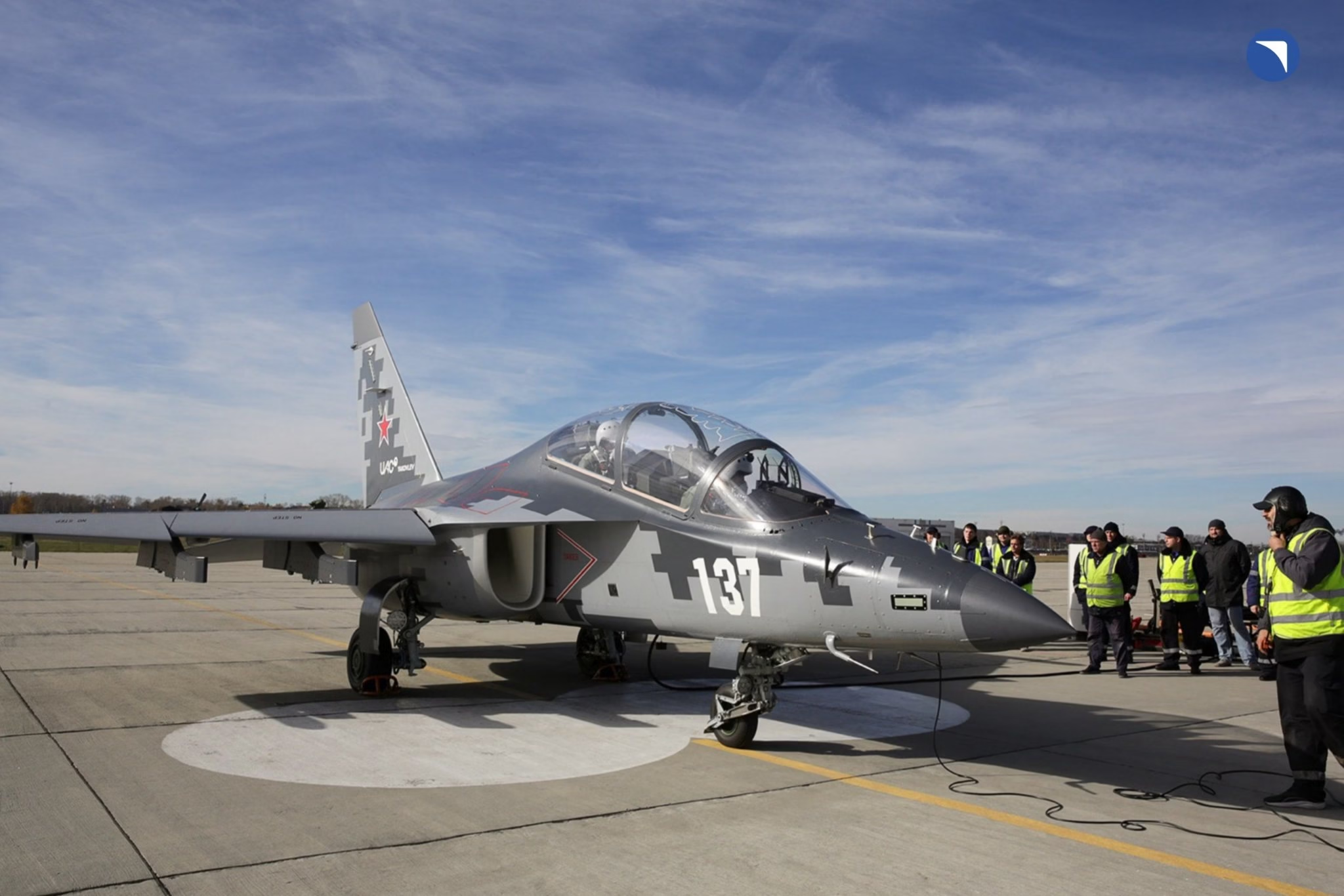
Russia’s third Yak-130M prototype has completed its first flight at the Irkutsk Aviation Plant in Siberia, United Aircraft Corporation (UAC) said on October 9, 2026, bringing the only test airframe built to production specifications into the program. Yakovlev test pilots Oleg Mutovin, a Hero of Russia, and Alexander Guskov flew the sortie. UAC said all onboard systems worked normally and the planned mission was completed, but did not specify when the flight took place.
The flight puts all three planned Yak-130M test aircraft in the air less than four months after the first prototype flew on June 25, 2026. Yakovlev, part of UAC under state conglomerate Rostec, is converting the Yak-130 advanced jet trainer, in Russian service since 2010, into a radar-equipped light combat aircraft for export customers and the counter-drone mission. Vladimir Dokuchayev, first deputy chief designer of the Yak-130 program, said first deliveries are scheduled for 2028.
Third Yak-130M Prototype Joins Trials in Production Configuration
Dokuchayev said the third aircraft differs from its two predecessors because it carries the technical specifications of a production model, and that adding it to trials “will enable us to complete the test program on schedule.” UAC has not said which systems or structural changes separate it from the first two airframes, or how many test sorties the program has flown.
Yakovlev first showed the Yak-130M as a mock-up at the Army-2024 forum near Moscow in August 2024, announcing three test aircraft and presenting the upgrade as a way to strengthen the type’s export appeal. Rostec announced on October 9, 2025, that the first prototype had been handed over for ground and flight testing; the second airframe was completed the same month, and the type made its international debut at the Dubai Airshow in November 2025.
The first prototype’s maiden sortie lasted about 50 minutes, reaching 2,000 meters and 600 km/h with Guskov and test pilot Andrey Voropaev at the controls. The second prototype flew in late July 2026, about a week after President Vladimir Putin inspected the program in Irkutsk on July 24 and singled out its potential against strike drones and uncrewed surface vessels. A production-representative third airframe lets mission-system and weapons trials run on the configuration customers will receive, cutting the risk of late retrofits.
Radar, Targeting Pod and Defensive Aids: Inside the Yak-130M Mission Suite
UAC says more than 50 percent of the aircraft’s equipment has been upgraded, with changes concentrated in sensors, communications and self-protection rather than the airframe. The baseline Yak-130 carries no radar and simulates radar modes for training. The Yak-130M adds the BRLS-130R nose radar, which Russian industry sources describe as an active electronically scanned array (AESA) developed by Radar MMS. Detection range, antenna size and track capacity have not been published, so AESA performance remains a manufacturer claim until demonstrated.
Targeting relies on the SOLT-130K pod, which combines a television camera, thermal imager, laser rangefinder and laser designator in one housing. Open-source reporting identifies it as a derivative of the SOLT-25 system built by the Krasnogorsk Plant for the Su-25SM3 attack aircraft. Earlier armed Yak-130 configurations depended on Platan or Sapsan-type pods to guide laser munitions.
Self-protection comes from the President-S130 defensive aids suite, carried in two external pods and combining missile approach warning, a radar warning receiver, an active jammer and countermeasure dispensers. The KSS-130 communications suite adds data exchange with other aircraft and ground command posts. Together, these systems give the Yak-130M a day and night, all-weather ability to detect and engage small, slow air targets such as large unmanned aerial vehicles (UAVs), a task that otherwise falls to heavier fighters, helicopters and ground-based air defenses.
Yak-130M Weapons, Payload and Propulsion Versus the M-346FA
Publicly available UAC figures give the Yak-130M a maximum takeoff weight of 10,290 kg and a maximum combat load of 2,500 kg, excluding pylons, across nine hardpoints. That is 500 kg below the 3,000 kg commonly quoted for the baseline Yak-130; UAC has not explained the difference. Published performance includes a maximum clean speed of 960 km/h and a service ceiling of 12,500 meters.
Yakovlev lists the RVV-MD short-range infrared-guided air-to-air missile, the KAB-250LG-E laser-guided bomb and the K08BE guided bomb among planned weapons, and Rostec has said the jet will carry satellite- and laser-guided air-to-surface munitions. Integration of an R-77 family beyond-visual-range missile, which would exploit the radar more fully, has been discussed in open-source reporting but not confirmed by UAC.
Propulsion is unchanged so far. The first prototype flew on two AI-222-25 turbofans rated at about 2,500 kgf (24.5 kN) each, the baseline powerplant. Industry reporting in 2025 linked the program to the SM-100, an AI-222-25 derivative credited with roughly 20 percent more thrust and double the service life, but UAC has not confirmed which engine will equip production aircraft, a key question for hot-climate export operators.
The closest Western counterpart is the Leonardo M-346FA, which shares the Yak-130’s origins in a joint Yakovlev and Aermacchi program that split in 2000 and pairs a similar subsonic twin-engine layout with the Grifo-M346 multimode radar.
Analysis: The Yak-130M is Moscow’s bet on affordable combat mass for the drone era: a radar-equipped subsonic jet able to hunt large drones and uncrewed surface vessels at lower operating cost than heavy fighters, while still training crews for fourth- and fifth-generation types. Irkutsk Aviation Plant director Andrei Soynov said on July 24, 2026, that a contract for 18 aircraft with Vietnam was being signed, which would make Hanoi the launch customer before trials end. For Western planners, the program signals that Russia intends to keep a light combat export line open to Su-30 operators, despite the sanctions risk such purchases carry under the US Countering America’s Adversaries Through Sanctions Act (CAATSA).
Next come weapons release and radar trials across the three aircraft, then completion of the test program ahead of 2028. The production engine standard, the first series customer and the value and delivery schedule of the Vietnamese order all remain undisclosed.