The US State Department has approved a possible Foreign Military Sale (FMS) to Egypt of up to 2,020 Javelin FGM-148F anti-tank guided missiles and up to 200 Javelin Lightweight Command Launch Units (LWCLUs) for an estimated $832 million. The congressional notification, issued on October 2, 2026, by the department’s Bureau of Political-Military Affairs under Transmittal No. 25-67, names Lockheed Martin of Orlando, Florida, and RTX Corporation of Arlington, Virginia, as principal contractors.
The case extends a steady run of US munitions approvals for Cairo, a major non-NATO ally since 1989. Washington cleared more than 5,000 TOW 2A radio frequency missiles for $691 million in May 2022, 720 Stinger missiles for $740 million in September 2024, 2,183 AGM-114R Hellfire missiles in December 2024, and a $4.67 billion National Advanced Surface-to-Air Missile System (NASAMS) package in July 2025. The Javelin request shifts to dismounted ground combat as Egypt faces instability along its borders with Libya and Sudan, where civil war erupted in April 2023, and in North Sinai.
Inside the Egypt Javelin Package: FGM-148F Missiles and LWCLU Launchers
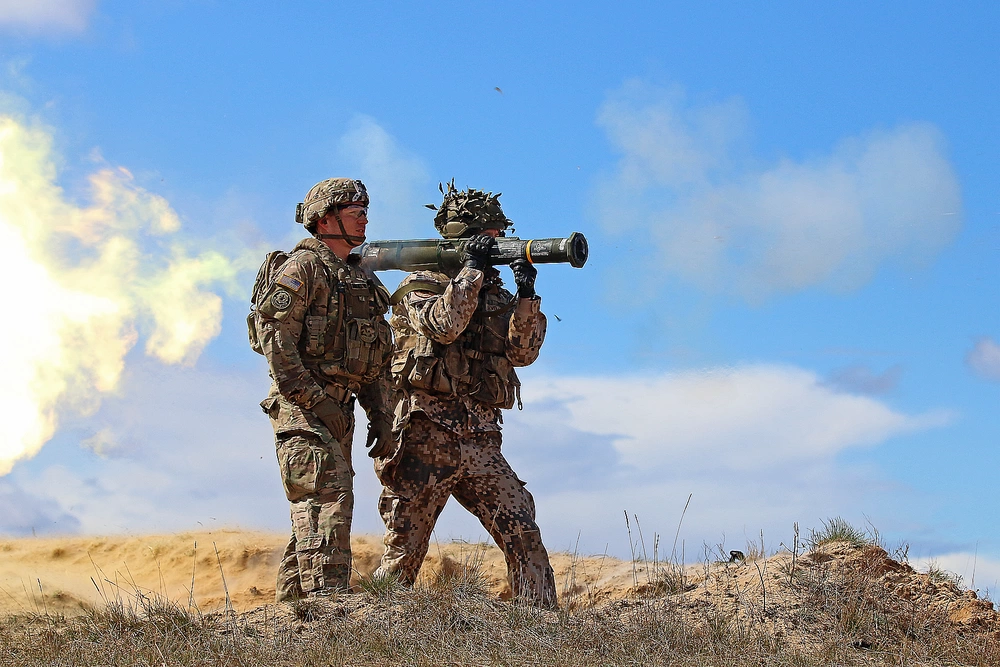
The FGM-148F is the Spiral 2 production standard of the Javelin, the fire-and-forget medium anti-armor weapon built by the Javelin Joint Venture (JJV) between Lockheed Martin and Raytheon, now an RTX business. Its multi-purpose warhead (MPWH) wraps a steel fragmentation sleeve around the tandem shaped charge of earlier rounds, extending lethality from main battle tanks to light armor, structures, and dismounted troops. Publicly available specifications indicate an 8.4 kg warhead and a composite mid-body that allows drop-in use with existing launch tubes. The 20 fly-to-buy missiles in Egypt’s request are production rounds test-fired to validate lot acceptance.
An imaging infrared seeker locks on before launch, freeing the gunner to displace immediately, and a soft-launch motor limits backblast for firing from covered positions. Open-source data place the flight ceiling at 150 meters in top-attack mode, which strikes thinner roof armor, and 60 meters in direct-attack mode against fortifications.
The LWCLU carries the larger capability gain. According to the JJV, the sight is 30 percent smaller and 25 percent lighter than the legacy Command Launch Unit and more than doubles target detection and recognition range through upgraded day and high-definition thermal cameras. The legacy unit is qualified to 2,500 meters; the LWCLU has demonstrated engagements at 4,000 meters, on par with Rafael’s Spike LR. The sight is compatible with all current and legacy Javelin rounds. In 2021, Raytheon fired a FIM-92 Stinger from an LWCLU to defeat an uncrewed aerial vehicle at Eglin Air Force Base, Florida, a potential commonality path for an Egyptian Army that already operates Stinger on Avenger vehicles.
Javelin and TOW 2A: Building Egypt’s Two-Tier Anti-Armor Architecture
Egypt’s anti-armor force has long rested on the BGM-71 TOW family. Open-source tallies credit the Egyptian Army with roughly 12,000 TOW 2A missiles delivered between 1998 and 2012, before the 2022 replenishment case for counterterrorism and border security. Order-of-battle estimates also list older Soviet-era 9K11 Malyutka and Franco-German MILAN systems. Egypt does not appear among publicly identified Javelin operators in the region, a group that includes Jordan, Oman, Qatar, and the United Arab Emirates.
TOW 2A is a semi-automatic command to line of sight (SACLOS) weapon with a range of about 3,750 meters, requiring the gunner to hold the sight on target until impact, typically from a vehicle or tripod. Javelin inverts that logic: a two-soldier team fires and relocates before the missile arrives, and open sources put the missile in its launch tube at 15.9 kg. The pairing gives Egyptian commanders vehicle-mounted overwatch with TOW and a mobile, fire-and-forget layer at platoon level.
The quantities point to a deliberate stockpiling choice. At up to 2,020 missiles for 200 launchers, Egypt is requesting roughly 10 rounds per LWCLU. Morocco’s March 2024 approval covered 612 missiles and 200 LWCLUs for $260 million, about three per launcher. The published summary does not break out training devices or sustainment items, so a per-missile cost cannot be isolated from the $832 million total. The State Department assesses that the sale will not alter the regional military balance, requires no additional US personnel in Egypt, involves no known offset agreement, and will not affect US defense readiness.
Analysis: The Egypt case is as much an industrial-base test as a capability upgrade. The JJV has been ramping output under a $7.2 billion US Army contract covering fiscal years 2023 to 2026, targeting 3,960 missiles per year by late 2026. Egypt’s ceiling equals roughly half of that annual target and enters a queue already crowded by US Army replenishment after transfers to Ukraine and by European and North African orders. Approval is the easy step; delivery tempo will depend on whether the expanded line sustains its rate into the next contract cycle.
Congress now has a 30-day formal review period under the Arms Export Control Act. The notification does not mean a sale has been concluded: Cairo must still sign a Letter of Offer and Acceptance, and final quantities may fall below the stated ceilings. Neither the funding source, Foreign Military Financing or national funds, nor a delivery schedule has been disclosed. Those variables, together with JJV production slots, will determine when Egyptian infantry units field their first LWCLUs.