Hensoldt has signed a memorandum of understanding (MoU) with the Ministry of Defence of Ukraine covering further large-scale deliveries of air defense radars, continued development of radar capabilities, and a study of options to deploy and jointly operate the company’s TRL-4D LR long-range radar. Chief Executive Oliver Dörre signed the document in Kyiv on the sidelines of German Chancellor Friedrich Merz’s visit, and Hensoldt announced the agreement on October 5, 2026.
The signing comes as Russia escalates missile and drone strikes on Ukrainian energy and transport infrastructure ahead of winter. Merz arrived in Kyiv by train on October 4, accompanied by Economy Minister Katherina Reiche and around 10 executives from German defense and energy firms, as a Russian strike hit a key bridge in the capital. German officials tied the visit to €1 billion in military aid and €350 million to repair damaged power plants, alongside a push for closer defense-industrial cooperation.
Ukraine Air Defense Radars: What the Hensoldt MoU Covers
The MoU expands what both parties describe as an existing strategic partnership. It rests on three elements: additional radar deliveries that Hensoldt characterizes as large-scale, joint work on further radar capability development, and an assessment of how TRL-4D LR systems could be deployed and operated jointly. Hensoldt presents the agreement as an extension of cooperation already agreed in ballistic missile defense (BMD), without naming the specific program or partner.
The company’s most visible BMD commitment to date is its June 16, 2026 strategic partnership with Ukrainian manufacturer Fire Point, signed at Eurosatory in Paris. Fire Point holds design authority for the FREYJA BMD system and develops its FP-7 interceptors, launchers and command and control (C2) node, while Hensoldt produces, tests and delivers the radar and supports integration. The FP-7.X anti-ballistic missile measures 7.25 m in length with a 0.53 m fuselage diameter. Fire Point’s chief designer has said the radar will feed the C2 center that guides interceptors into the engagement zone, and the company aims to bring the cost of a ballistic intercept below $1 million by 2027.
Key parameters remain undisclosed. The announcement gives no radar quantities, contract value, delivery schedule or funding source, and an MoU is a statement of intent: deliveries will require follow-on contracts. Dörre framed the urgency in operational terms. “The coming winter will be another major test for Ukraine, particularly for its civilian infrastructure,” he said. “The Ukrainian air defence forces urgently need our high-performance radars to help protect infrastructure such as bridges.”
TRML-4D and TRL-4D LR: Two Radar Classes, Two Missions
The TRML-4D is the sensor Ukrainian crews already know. A C-band (NATO G-band) mobile radar built on gallium nitride (GaN) active electronically scanned array (AESA) technology with digital multiple beamforming, it tracks about 1,500 targets out to an instrumented range of 250 km with 360-degree rotating coverage. Publicly available specifications indicate track ranges beyond 120 km against fighter aircraft and beyond 60 km against supersonic missiles, with detection down to a 0.01 m² radar cross-section, comparable to small drones. It is the main sensor of Diehl Defence’s IRIS-T SLM medium-range surface-to-air system, in Ukrainian service since October 2022. A May 2024 order added six units for more than €100 million, and a July 2025 package worth over €340 million combined TRML-4D and SPEXER 2000 3D MkIII short-range radars.
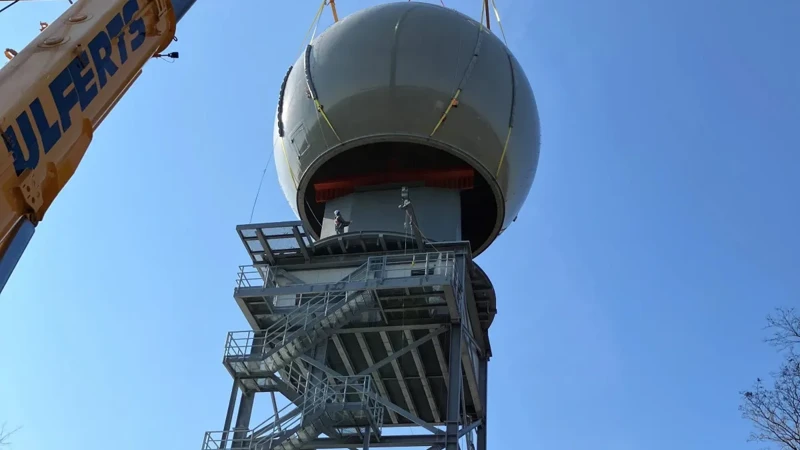
The TRL-4D LR belongs to a different class. It is a fixed-site S-band AESA surveillance radar with tactical BMD capability, developed with ELTA Systems, a subsidiary of Israel Aerospace Industries. Germany ordered four in July 2021 under the Hughes Air Defence Radar successor program (HADR NF) to replace its legacy air surveillance radars by 2030. The first was installed in 2026 at Brockzetel in northern Germany; its primary antenna weighs about 13 tonnes and sits inside a radome more than 13 meters in diameter. A near-identical naval variant, the TRS-4D LR, is replacing the SMART-L on the German Navy’s three F124 Sachsen-class frigates. Hensoldt has not published range figures for the LR family.
The two radars are complementary. The TRML-4D cues medium-range engagements against aircraft, cruise missiles and drones; a TRL-4D LR would extend early warning and ballistic trajectory tracking deeper along Russian attack axes, the cueing any BMD layer depends on.
Analysis: The MoU points to a shift from equipping individual IRIS-T SLM batteries toward a layered national sensor architecture, in which long-range S-band surveillance cues medium-range fire units and, eventually, an indigenous BMD layer. The constraint is survivability. Mobile TRML-4D units protect themselves by relocating; a fixed-site radar with a 13-tonne antenna cannot, and would draw Russian ballistic and cruise missile strikes as soon as it emits. That likely explains why the parties committed to studying deployment and joint operation rather than ordering systems outright. For Hensoldt, Ukraine remains the combat reference behind European demand, with more than 150 radars under European Sky Shield Initiative (ESSI) contracts as of February 2026.
The next markers are firm contracts specifying quantities, schedules and financing, and any decision on where and how a TRL-4D LR would be sited. FREYJA integration tests pairing the radar with FP-7 interceptors will show whether the BMD track moves beyond demonstration. Hensoldt is expanding production capacity and its workforce; how it allocates output between Ukraine, ESSI customers and the Bundeswehr through the winter will determine how quickly the MoU turns into radars in the field.