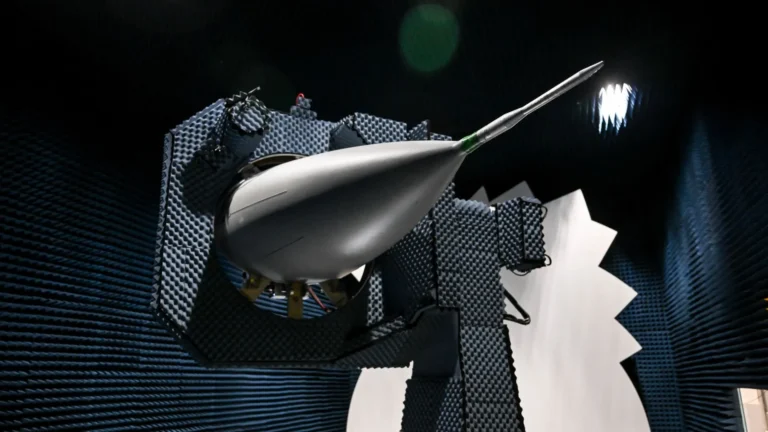
MBDA has secured approval of the Preliminary Design Review (PDR) for its Remote Carrier Compact (RC) demonstrator, a compact collaborative combat drone developed under the Franco-German-Spanish Next Generation Weapon System (NGWS). The company disclosed the milestone on October 6, 2026, stating that France, Germany, and Spain signed off on the review this summer and that it opens the way to the design, production, and 2029 first flight of the demonstrator.
The approval closes MBDA’s share of NGWS Phase 1B, the technology maturation phase launched in December 2022 with contracts valued at approximately €3.2 billion and structured to end with preliminary design reviews.
It also arrives after the program lost its centerpiece. In June 2026, on the eve of the ILA Berlin air show, Berlin and Paris abandoned joint development of the New Generation Fighter (NGF), the manned sixth-generation aircraft around which the Future Combat Air System (FCAS), known in France as SCAF, was built. Reporting since then indicates the combat cloud and remote carrier pillars could continue under a restructured framework, but no successor contract has been made public. MBDA acknowledges the initial NGWS framework is ending but says it remains committed to the Remote Carrier Compact’s operational future.
How MBDA Took the Remote Carrier Compact Through PDR
MBDA France and MBDA Germany led the work with SATNUS, the Spanish joint venture of GMV, Sener Aeroespacial, and Tecnobit-Grupo Oesía that coordinates Spain’s contribution to the remote carrier pillar. Under Phase 1B governance, Airbus Defence and Space serves as remote carrier prime contractor for Germany, with MBDA and SATNUS as main partners for France and Spain. Airbus concentrated on larger, recoverable loyal wingman platforms, while MBDA took design authority for the smaller effector-class carrier launched from combat aircraft.
To reach PDR, the team completed the demonstrator design, built several representative mock-ups, and produced a digital twin of the effector. Ground testing covered subsystem trials, integration and structural integrity mock-ups, and wind tunnel campaigns. Simulation work characterized the vehicle, validated the digital models and initial algorithms, and demonstrated performance across a range of mission scenarios, according to the company.
Through the first half of 2026, MBDA presented results at technical meetings in all three countries, gathering feedback from experienced French, German, and Spanish air force pilots. That input matters for a system whose value depends on how a crew tasks and trusts an uncrewed teammate in contested airspace. SATNUS separately flight-tested a Next Generation Autonomy Computer (NGAC) on a modified target drone in November 2025; MBDA has not said whether that architecture feeds the Remote Carrier Compact.
Expendable Remote Carrier Lineage: Size, Endurance, and Mission Payloads
MBDA did not publish dimensions, weight, propulsion, or sensor details with the PDR announcement. The company describes the Remote Carrier Compact as agile, versatile, and cost-effective, with missions spanning escort, reconnaissance, and direct engagement of high-value targets.
The design appears to descend from the Expendable Remote Carrier (ERC) concept MBDA detailed at the Paris Air Show in June 2023, which carried the same 2029 first flight target. Figures released at the time put the ERC demonstrator at about 4 meters in length and roughly 400 kilograms, flying at subsonic speed with around one hour of endurance. Those numbers predate the PDR and may have changed.
MBDA said then that final airframe size would depend on the NGF’s internal weapons bay, and that a modular payload would accept warheads, intelligence-gathering sensors, electronic warfare packages, and communications relay equipment. Candidate missions included suppression of enemy air defenses, saturating integrated air defense systems, counter-air support, and land and maritime strike.
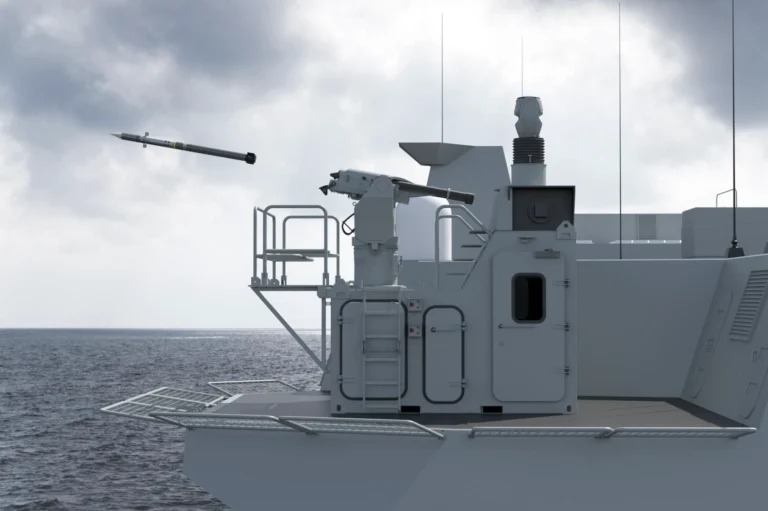
That mass class places the vehicle between a heavy cruise missile and a loitering munition. Publicly available specifications indicate the SCALP/Storm Shadow weighs about 1,300 kilograms, more than three times the ERC figure. An effector in the 400-kilogram range can be carried in numbers, released in coordinated groups, and lost without sacrificing a high-value airframe. Launch flexibility is the other variable: imagery released with the PDR depicts the Remote Carrier Compact leaving a fighter jet, a frigate, and an A400M transport. Propulsion type, seeker suite, guidance modes, and datalink standards remain undisclosed.
What the NGF Cancellation Means for Remote Carrier Integration
With the NGF gone, the realistic near-term hosts become the Rafale, including the F5 standard France is developing to operate alongside a combat drone, and the Eurofighter Typhoon flown by Germany and Spain, along with the transport aircraft and surface combatants shown in MBDA’s imagery. External carriage on those fighters removes the internal bay constraint but brings the signature and drag penalties the NGF-centered requirement was meant to avoid.
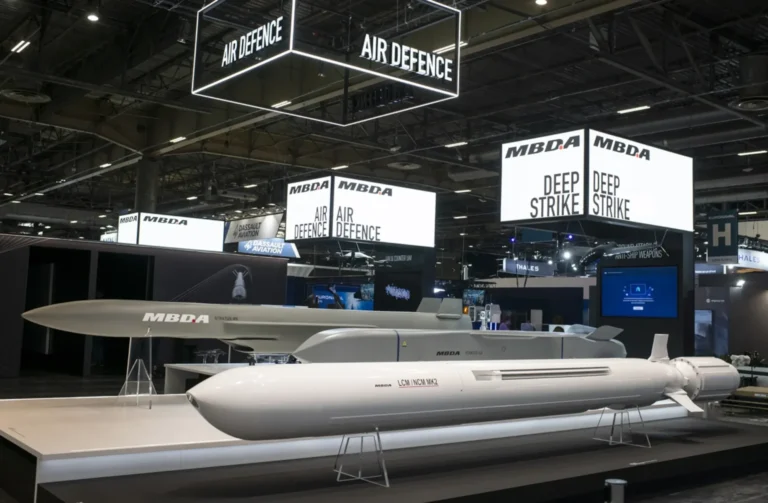
MBDA also runs national efforts in parallel. MBDA Deutschland unveiled its Remote Carrier Multidomain Multirole Effector (RCM²) at ILA Berlin in June 2024, a modular design intended for launch from combat and transport aircraft, frigates, and land vehicles. Parallel national products give the company industrial continuity if trinational funding stalls, but they also tempt governments to buy national solutions rather than a common European effector.
Analysis: The Remote Carrier Compact is the NGWS element least dependent on the fighter whose cancellation broke the program. It is a government-reviewed design for an attritable, multi-launch effector that can integrate on aircraft the three air forces already fly. That gives it one of the few credible paths from Phase 1B to service before 2040, and it answers NATO’s demand for affordable mass. The risk is programmatic rather than technical: without a funded follow-on phase, the 2029 first flight is a planning assumption, and the trinational work share that produced the PDR could fragment into national programs competing for the same industrial base.
The next decision point is whether France, Germany, and Spain fund a follow-on phase for the remote carrier and combat cloud pillars, and under what governance model. That contract would determine whether MBDA can reach a critical design review and build the demonstrator in time for a 2029 flight. Unit cost, production quantities, and the lead integration platform also remain undisclosed.