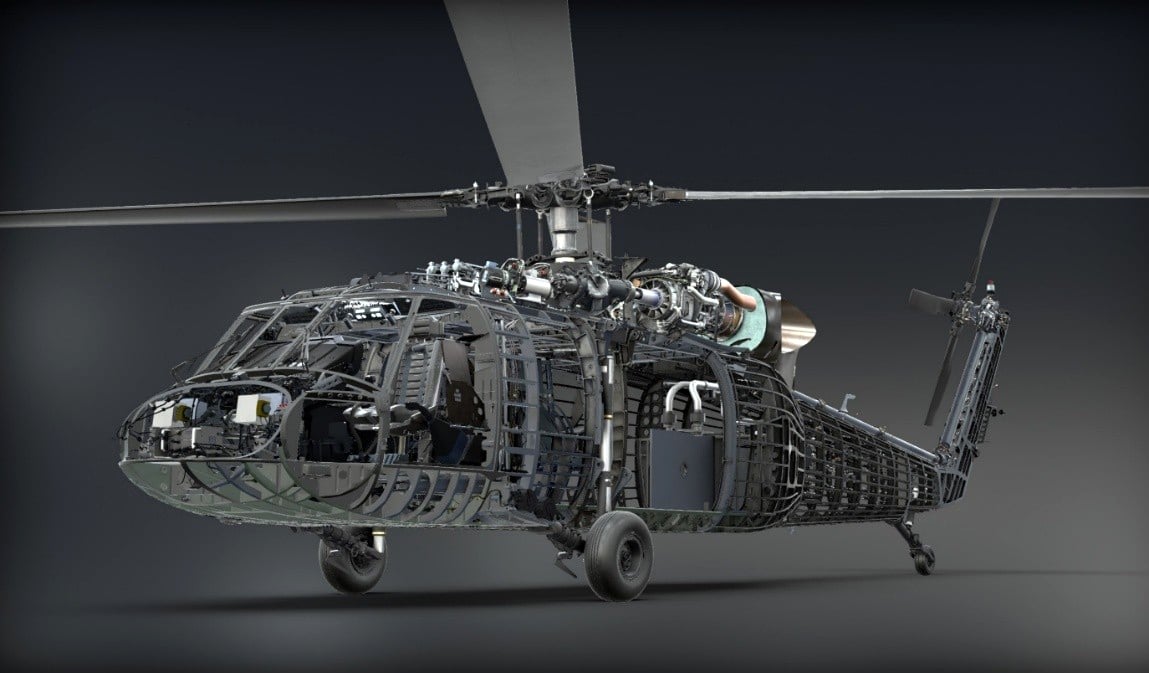
Lockheed Martin has signed a Direct Commercial Sale (DCS) contract with the Philippine Department of National Defense (DND) to deliver an S-70i Black Hawk Full Flight Simulator, a Virtual Maintenance Trainer and associated courseware to the Philippine Air Force (PAF), the company announced on October 8, 2026. The contract also covers sustainment and spares support through 2032. Neither party disclosed its value, the delivery schedule or the base that will host the devices.
The award follows the PAF’s acceptance at Villamor Air Base, on August 26, 2026, of the last seven of 32 S-70i helicopters ordered from PZL Mielec, Lockheed Martin’s Polish subsidiary, under a $624 million contract signed on February 22, 2022. Added to 16 aircraft from a 2019 order, minus one airframe lost in a night training accident in Tarlac province on June 23, 2021, the 205th Tactical Helicopter Wing now operates 47 S-70i helicopters, which Philippine authorities describe as the largest S-70i fleet in service. With procurement complete, the binding constraint has shifted from airframes to qualified crews and maintainers.
Inside the S-70i Black Hawk Simulator and Maintenance Trainer
Lockheed Martin describes the Full Flight Simulator as a digital twin of the aircraft that reproduces the visual and motion cues of flying an S-70i. The company has not published the configuration of the PAF device. Publicly available specifications for its S-70 Full Flight Simulator line indicate an FAA Level D class device with a six-degree-of-freedom motion platform, a 220-by-60-degree collimated visual display driven by 4K projectors, and more than 200 programmable aircraft malfunctions. Listed training tasks include initial qualification, instrument flight rules, night vision goggle (NVG) operations, emergency procedures, crew resource management and mission rehearsal.
Level D is the highest qualification tier for full flight simulators under U.S. Federal Aviation Administration (FAA) standards. A device at that fidelity lets an air force move emergency procedures, instrument and NVG proficiency off the aircraft, preserving flight hours on helicopters the PAF also needs for disaster response.
The Virtual Maintenance Trainer models every airframe subsystem, from hydraulics to avionics, with physics-based simulation. According to Lockheed Martin, it runs on commercial off-the-shelf computers and tablets and supports guided, free-play and graded modes for fault isolation, line replaceable unit (LRU) removal and installation, and functional testing, with more than 200 ready-made task trainers.
The company also maintains a digital thread to the Black Hawk’s operational flight program (OFP), which it says allows simulation updates in days rather than years. For an operator flying 47 airframes of one type, keeping the simulator concurrent with fielded avionics determines whether training transfers cleanly to the cockpit.
Training a 47-Helicopter S-70i Fleet Inside the Philippines
PAF Black Hawk simulator training has so far taken place offshore. Pilots began courses in late 2021 at the CAE-operated Brunei Multi-Purpose Training Centre under a multi-year arrangement with the Royal Brunei Air Force. Per Lockheed Martin, PAF pilots will continue training at the U.S.-based Sikorsky Training Academy while the in-country capability is established.
The S-70i is the international, commercially exported derivative of the U.S. Army’s UH-60M, built at PZL Mielec. Publicly available manufacturer data list two General Electric T700-GE-701D turboshafts producing a combined 3,356 shaft horsepower of maximum continuous power, a maximum takeoff weight of 22,000 lb (9,979 kg), or 23,500 lb (10,659 kg) with an external load, a 9,000 lb (4,082 kg) sling capacity, a 145-knot maximum cruise speed and a 268-nautical-mile range on internal fuel without reserve. In utility configuration, it carries two pilots, two cabin crew and up to 12 troops.
Those figures frame the PAF mission set: troop transport, search and rescue, humanitarian assistance, firefighting and medical evacuation across an archipelago of more than 7,000 islands. The 205th Tactical Helicopter Wing’s commander has said the larger fleet lets the PAF station an element in each region, with some aircraft slated for Palawan, the westernmost major island facing the South China Sea. Dispersed basing raises the number of crews, instructors and maintainers required per aircraft, the gap synthetic training is meant to close.
Lockheed Martin Lands First S-70i Black Hawk Training Device Order
The contract is the first order for Lockheed Martin’s own S-70i training devices, which the company markets on its status as the helicopter’s design authority and original equipment manufacturer (OEM). S-70i simulators in service to date have come from third-party suppliers, including the CAE-built full-mission simulator in Brunei. The award extends a training portfolio that already supports the CH-53K, F-35, F-16 and C-130J.
Tim James, Lockheed Martin’s vice president of Air and Commercial Solutions, called the award “a long-term investment in the PAF’s mission readiness.” William Blair, regional chief executive for Asia and India, tied the systems to the PAF’s fleet growth and modernization goals.
Negotiated directly with the manufacturer rather than through the U.S. government’s Foreign Military Sales (FMS) process, the DCS contract gives Manila direct control over scope and support terms. The 2032 sustainment tail adds a six-year Lockheed Martin support relationship alongside the logistics support PZL Mielec provides under the 2022 airframe contract.
Analysis: The PAF grew its Black Hawk fleet from 15 to 47 aircraft in about 26 months, a pace that a pipeline built on offshore simulator slots and live flight hours cannot absorb for long. An in-country full flight simulator paired with a portable maintenance trainer converts that acquisition into sustainable sortie generation, which matters more for Manila’s dispersed basing and disaster-response posture than additional airframes would. For Lockheed Martin, the deal creates a reference customer for an OEM-owned training offer aimed at an S-70i export base that includes Brunei, Chile, Colombia, Poland, Saudi Arabia and Thailand.
The next milestones are the choice of a host base, device delivery and the date in-country training reaches full capability. PAF officials have indicated that more Black Hawks could follow under the next phase of the modernization program; a follow-on buy would test whether a single full flight simulator can carry the training load, or whether additional flight training devices join the package.