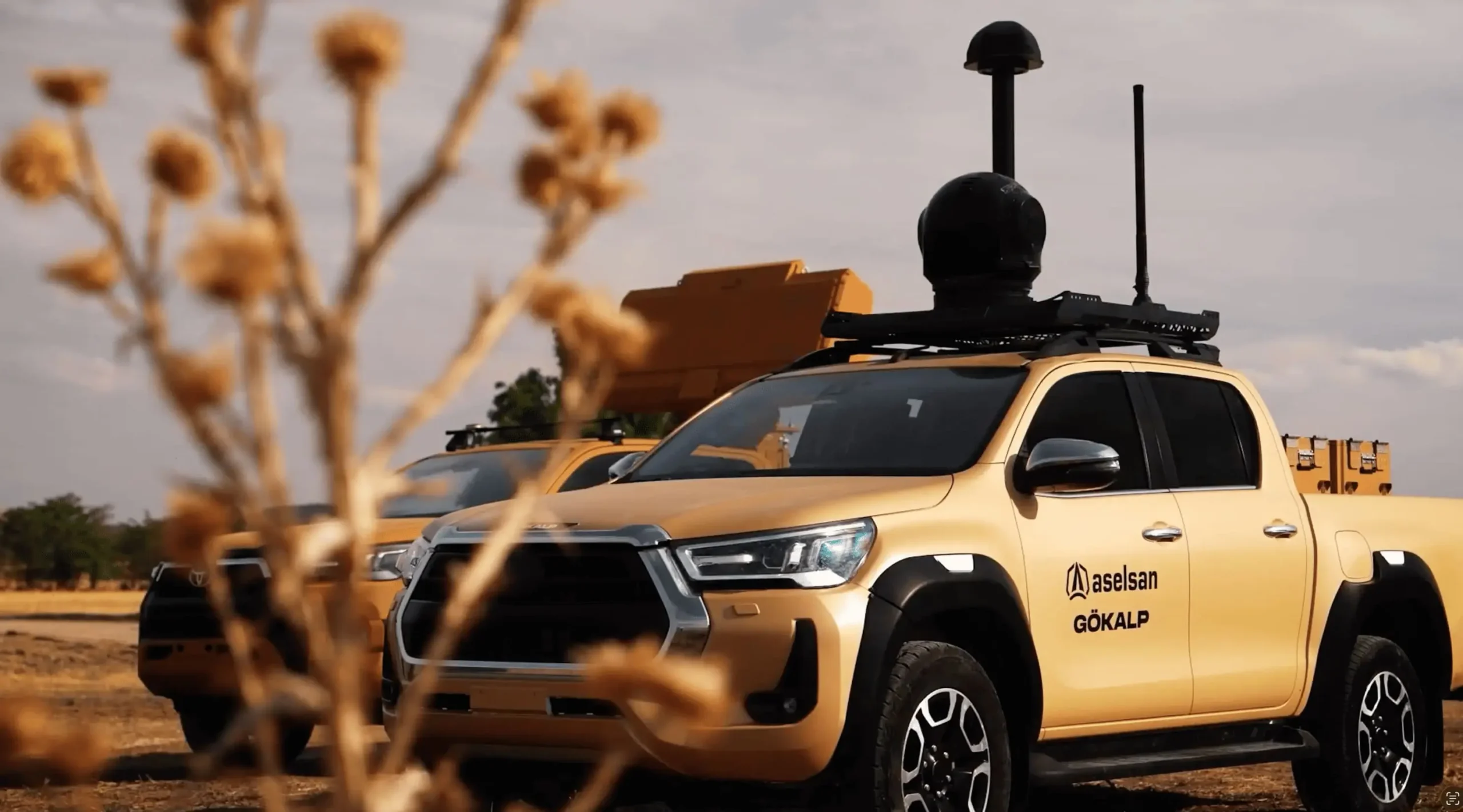
ASELSAN’s GÖKALP E1 interceptor drone destroyed a target drone in mid-air during a live demonstration at the company’s Oğulbey Technology Base in Ankara, the company said on October 10. An AURA radar detected the target and passed real-time track data through the DRONEDEF command-and-control software to the interceptor, which destroyed the drone by direct impact. ASELSAN did not disclose the date of the engagement.
The test follows GÖKALP’s public unveiling at SAHA Expo 2026 in Istanbul in May, where chief executive Ahmet Akyol said ASELSAN’s drone-defense products were moving into production. It also comes days after ASELSAN announced on October 5, 2026, that it had signed €2.46 billion ($2.75 billion) in contracts with Türkiye’s Presidency of Defense Industries (SSB) for hybrid air defense systems. ASELSAN has not said whether GÖKALP falls under that package and released no quantities or delivery schedule.
ASELSAN GÖKALP Interceptor Variants, Sensors, and Launch Configurations
The demonstration exercised the full kill chain. The AURA radar handled detection and tracking, DRONEDEF assigned the threat, and GÖKALP E1 completed the intercept autonomously in a hit-to-kill profile. ASELSAN has not specified which AURA variant supported the test.
GÖKALP fields two interceptor types, launched vertically from multi-cell canisters that can be configured to customer requirements. According to figures presented at SAHA Expo 2026, the E1 weighs 2 kg, has a maximum range of 1 km, and carries no warhead, relying on kinetic energy alone against Class 1 UAVs, including first-person-view (FPV) attack drones. The E2 roughly doubles the E1’s mass and speed, engages targets out to 7 km, and carries a warhead of around 1 kg while retaining a kinetic mode. Both interceptors are electrically powered, and the E1 carries a day/night camera.
ASELSAN product data lists system effective range above 1,000 m against Class 1 drones and above 7,000 m against Class 2 and Class 3 targets, with 360-degree coverage, datalink mid-course guidance, identification friend or foe (IFF), and AI-based detection and classification. The company names low-speed, long-endurance one-way attack drones as the primary target set.
Two configurations exist. The vehicle version, shown at SAHA on commercial pickups, carries an ASELFLIR 410 electro-optical gimbal, a datalink mast, and launch boxes on the flatbed, while a companion pickup carried a Kalkan 200-G X-band search radar rated to detect small UAVs at 40 km. The trailer version mounts four AESA faces of the AURA 150 radar, credited with an 8 to 10 km range, plus an optronic head and a larger effector load. ASELSAN markets the vehicle-integrated design as a mobile, cost-effective shield but has not published unit or per-shot costs. The architecture also accepts third-party interceptors.
Where GÖKALP Fits in DRONEDEF and the Steel Dome Architecture
DRONEDEF is the counter-UAS layer of Steel Dome, Türkiye’s multi-layer air defense network, which ties systems such as KORKUT, HİSAR, and SİPER together through the HAKİM command-and-control system. Within DRONEDEF, GÖKALP operates alongside the İHTAR detection and soft-kill system, the GÖKBERK laser, the EJDERHA high-power electromagnetic system, the KORKUT 100/25 SB and ŞAHİN gun systems, and the MİĞFER close-in counter-FPV turret.
That layering defines GÖKALP’s niche. MİĞFER’s anti-drone shotgun rounds are effective to roughly 100 m, the 10 kW GÖKBERK 10 engages between 150 m and 2,000 m, and the EJDERHA AD 210 is credited with a 1 km effect range. The E2 pushes hard-kill coverage to 7 km, bridging the gap between short-range effectors and Steel Dome’s missile tiers without expending a surface-to-air missile on a drone.
ASELSAN’s June 6, 2026 DRONEDEF demonstration at its Gölbek test center, attended by delegations from 19 countries, used İHTAR with an AURA 200-G radar, EJDERHA, and GÖKBERK, but did not feature an interceptor-drone kill. Publicly available specifications describe the AURA 200-G as an AESA radar with an instrumented range above 25 km and continuous 360-degree coverage in its four-antenna configuration.
Analysis: GÖKALP is ASELSAN’s answer to the cost-exchange problem exposed in Ukraine: low-cost drones cannot be engaged economically with missiles, while guns, lasers, and microwave systems protect only the inner perimeter. Interceptor drones fill that middle band. What distinguishes Türkiye’s approach is integration, with GÖKALP cued by national radars and tasked through a common C2 layer rather than operated as a stand-alone kit. ASELSAN’s openness to third-party interceptors, together with its June 2026 letter of intent with Latvian interceptor-drone maker VIC TEC, points to an export model in which DRONEDEF serves as the sensor and C2 backbone and NATO customers supply their own effectors.
Key unknowns remain. ASELSAN has not published unit costs, magazine depth per vehicle, performance data against faster jet-powered threats, or a launch customer, and the warhead-equipped E2 has not yet been shown in a live engagement. The next indicators to watch are SSB contract disclosures specifying DRONEDEF components and any move from the Latvian letter of intent toward a firm order.