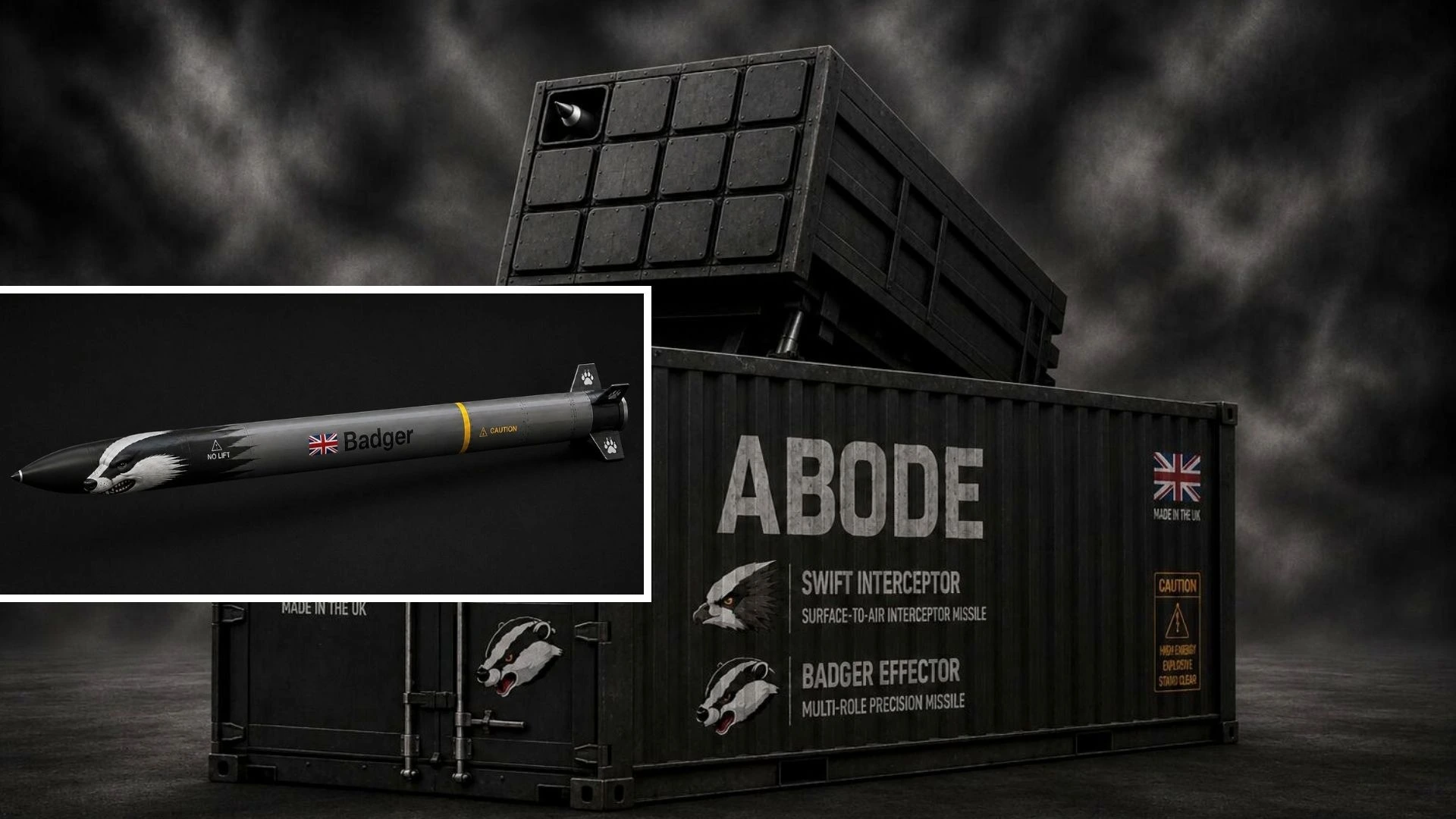
British startup Cody Aerospace & Defence unveiled the Badger Mk1 Tactical Strike Missile and the Abode Mk1 Containerised Launch System at the Apex Europe defense show, held in London on October 7 and 8, 2026. The company pitches the pair as a ground-to-ground indirect fires package for NATO and allied armies, and announced Ordnance One, a factory intended to build both systems and to manufacture other firms’ weapons under license.
The launch coincides with a British push to rebuild munitions stocks. The Defence Investment Plan published in June 2026 allocates £11.1 billion to munitions and weapons for stockpile replenishment and commits to at least six new energetics factories by 2030. Founder Henry Price, who spent 15 years at prime contractors and tier-one suppliers before creating Cody in February 2026, frames the business around one problem: by his account, the United Kingdom holds seven to ten days of stocks for high-intensity warfare and needs about three years to replace them.
Badger Mk1 Strike Missile: Range, Warhead, and Off-the-Shelf Subsystems
Cody credits Badger Mk1 with a range of 70 to 100 miles, roughly 110 to 160 km, and a warhead of up to 100 kg. The company has not released length, diameter, launch weight, propulsion type, guidance modes, or unit price, and the missile remains in the design phase. Publicly available specifications for the Guided Multiple Launch Rocket System (GMLRS) offer a benchmark: the baseline round reaches roughly 70 km with a 200-lb class unitary warhead, while Extended-Range GMLRS targets about 150 km. On paper, Badger would sit in the same envelope, giving European users a second source for a capability most of them buy through a single US supply chain.
The design approach trades novelty for schedule. Cody plans to buy seekers, rocket motors, and guidance units off the shelf from established suppliers to reach a high technology readiness level quickly. It is raising pre-seed capital to bring Badger to development maturity, including testing, within 18 months to two years. No customer, test date, or flight demonstration has been announced.
Price identifies obsolescence, not design, as the main time sink. Cody intends to fire Badger with mixed old and new components to qualify substitutions quickly while holding design authority in-house. “I want engineers to be delivering capability, not managing obsolescence,” he said. The company says its software and fire control will be open source, and Price called for a standardized NATO effector, citing Ukraine’s experience with three rocket systems from three countries whose similar-sized munitions are not interchangeable.
How Abode Mk1 and Ordnance One Aim to Shorten Replenishment Cycles
Abode Mk1 converts a standard ISO shipping container into a launcher that integrates Badger with radar and an integrated fire control system, sold as a complete capability rather than a round the customer must integrate. Company renderings show an elevating multi-cell launcher on the container roof and markings for a second effector, the Swift surface-to-air interceptor. Price said Cody aims to add an interceptor to the same launcher a couple of years after Badger, giving one platform both strike and intercept roles. He also floated airdropping Abode and moving it on uncrewed vehicles to support shoot-and-scoot tactics without exposing crews.
Ordnance One underpins the industrial pitch. Cody says the plant will build its own designs and produce other companies’ and countries’ equipment under license, but it has not disclosed a location, cost, or capacity. Price targets a replenishment cycle under one year once production begins, against roughly three years for US off-the-shelf purchases. He said that timeline can stretch to four or five years because Defense Priorities and Allocations System (DPAS) ratings generally favor US customers. Cody is lining up British suppliers for energetics and rocket motors, although Price acknowledged that rare earths and composites depend on supply chains Europe does not control, and that suppliers estimate a fully British supply chain would cost three to four times more.
Analysis: Cody’s proposition rests less on the missile than on the production model. Price estimates that NATO members field roughly 20 to 80 rocket launchers each, with about a third available for the front line at any time. In that environment, magazine depth and restock speed matter as much as range. A mid-range strike missile assembled from qualified commercial subsystems, in a factory that can also license-build allied munitions, targets exactly the gap the Defence Investment Plan funds. The risk is equally clear: Cody is eight months old, at pre-seed stage, and has flown nothing, while established primes compete for the same budget.
The next markers are a funding round, a site for Ordnance One, and a first firing. Until a Ministry of Defence contract or test data emerges, Badger and Abode remain industrial proposals rather than programs of record.