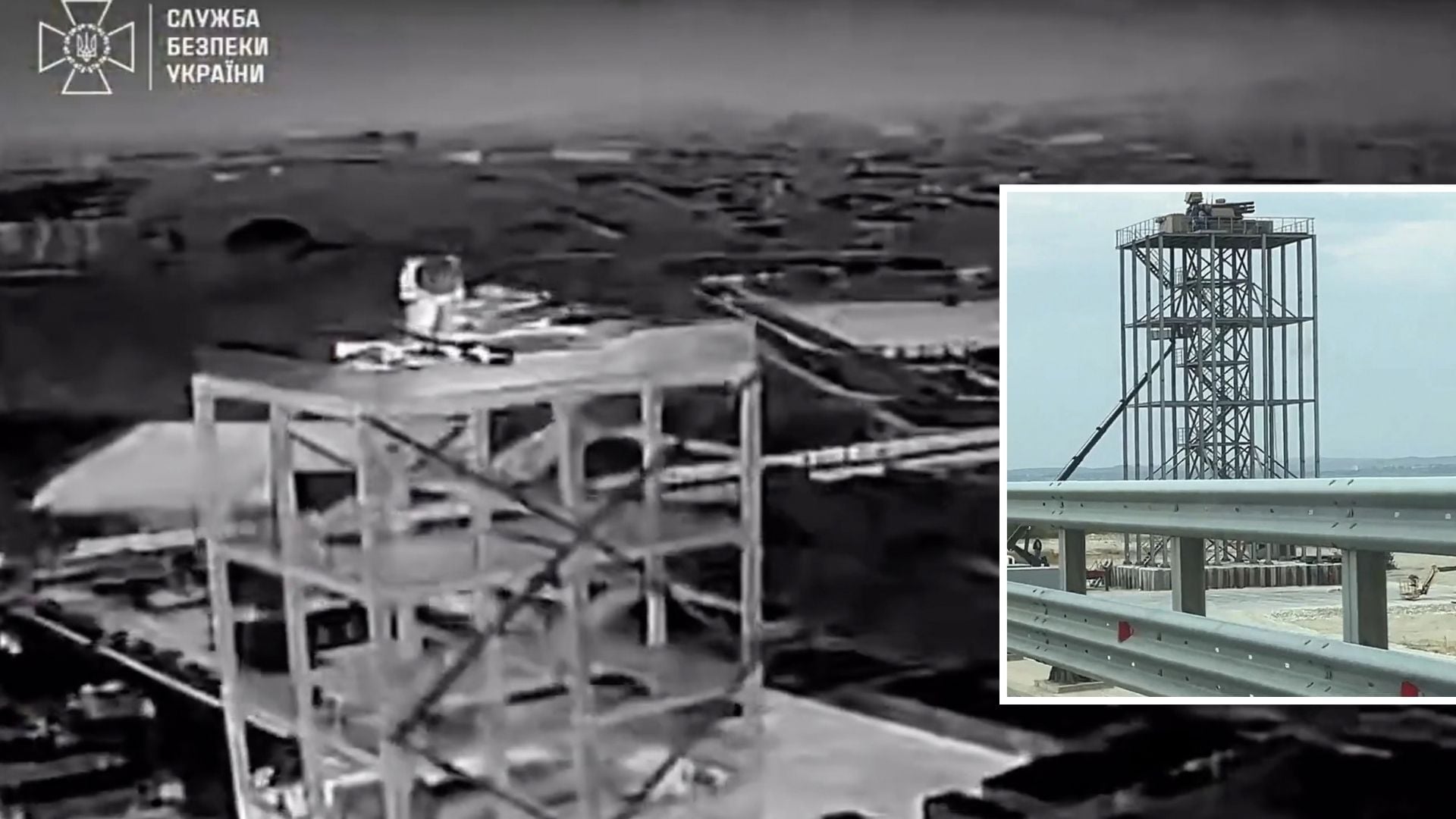
Ukraine’s Security Service (SBU) has released footage showing one of its drones destroying a Russian Pantsir short-range air defense system mounted on an elevated tower, the type of fixed platform Russia has built by the dozen against long-range Ukrainian drones. The SBU’s Alpha Special Operations Center carried out the strike. The service has not disclosed where or when it took place, which drone it used, or whether the tower survived.
The structures are widely nicknamed Flakturms, after the concrete anti-aircraft towers Nazi Germany raised in Berlin, Hamburg and Vienna. Pantsir systems first appeared on metal towers around Moscow in 2023. Satellite-imagery analysts counted 79 Pantsir towers within 50 kilometers of Moscow in July 2026, along with about 30 ground ramps and three or four Pantsir-SMD systems on city rooftops, roughly 125 prepared short-range positions in total. Another 29 towers surround Vladimir Putin’s Valdai residence and nearby military sites, and new platforms have appeared beside refineries in Ryazan, Kstovo and Yaroslavl.
Pantsir Tower Geometry: What Russia Gains by Lifting Its Radars
The Pantsir-S1, designated SA-22 Greyhound by NATO and developed by the KBP Instrument Design Bureau in Tula, pairs 12 radio-command-guided 57E6 missiles with two 2A38M 30 mm cannons on a single combat module. Publicly available specifications give the 57E6 an engagement envelope of 1.2 to 20 kilometers in range and 15 meters to 15 kilometers in altitude, while the guns cover the inner layer out to about 4 kilometers. A search radar with a reach of roughly 36 kilometers cues a phased-array tracking radar and an electro-optical channel. The Pantsir-S1M adds the 57E6M-E missile, which extends range to 30 kilometers and ceiling to 18 kilometers at speeds near 1,700 meters per second.
None of that reach matters against a target the radar cannot see. One-way attack drones fly low and use terrain, tree lines and buildings to mask their approach. Against a drone cruising at 50 meters, standard radar-horizon geometry places the line-of-sight limit at about 38 kilometers for an antenna 5 meters above flat ground and about 55 kilometers for one 40 meters up. The practical gain is larger in the forested and built-up terrain around Moscow, where canopy and structures, not Earth curvature, block low-altitude coverage at far shorter distances.
Russia has adapted the system to the platform. Russian footage aired in August 2026 showed a Pantsir-S1M installed on a 35-meter tower in Moscow without its truck chassis, with a two-person crew working at the top. That installation carried four 57E6 missiles, the cannons and eight TKB-1055 anti-drone missiles. On August 19, 2026, state corporation Rostec announced delivery of another batch of mobile Pantsir-S and stationary Pantsir-SMD systems to the Russian Ministry of Defense.
Fixed Platforms, Known Coordinates: How Drones Exploit Static Air Defense
The tower solves a sensor problem by creating a survivability problem. A truck-mounted Pantsir can fire and relocate; a demounted module on a 35-meter mast cannot move at all. Open-source mappers have published coordinates for most positions around Moscow, which lets Ukrainian planners study routes, approach angles and likely sectors of fire before launch. The SBU footage does not show how the drone approached, but the target was where the planners expected it, the core vulnerability of any fixed site.
The Fire Point FP-2, a fixed-wing medium-range strike drone with first-person-view terminal guidance, carries warheads between 60 and 105 kilograms, and Alpha has publicly credited 105-kilogram FP-2 variants with strikes in the Russian rear. On October 3, 2026, footage circulated by a Ukrainian monitoring channel showed FP-2s destroying a Pantsir-S2 that had been blocking drone routes deeper into Russia. Ukraine’s General Staff reported another Pantsir-S2 hit near Seltso in Bryansk Oblast on September 27 and 28, and confirmed a Pantsir-S1 destroyed near Kletnya, also in Bryansk Oblast, on August 27.
The engagement envelope also has an inner edge. The 57E6 cannot engage targets closer than 1.2 kilometers, which leaves the cannons as the last layer. The gunless Pantsir-SMD-E drops that layer entirely and relies on the TKB-1055, which engages from 500 meters to 7 kilometers. Radio-command guidance ties every missile in flight to the module’s own fire-control radar, which limits how many targets one module can engage at once and favors attackers that arrive in coordinated groups. A drone that survives into the final few hundred meters faces a shrinking set of answers.
Pantsir Attrition Versus Rostec Output and the SMD-E Response
The tower strike feeds a campaign measured in percentages. On October 31, 2025, then-SBU chief Vasyl Malyuk said Ukrainian forces had destroyed 48 percent of Russia’s Pantsir systems since the start of that year, calling the Pantsir the Russian system that performs best against Ukrainian long-range drones. He put Russian output at about 30 systems a year, below the loss rate. Ukrainian estimates place a single Pantsir-S1 at roughly $15 million and a Pantsir-S2 at up to $20 million; none of these figures can be independently verified.
Russia’s industrial response is the Pantsir-SMD family. Unveiled at the Army-2024 exhibition and offered for export as the SMD-E at IDEX 2025 in Abu Dhabi, the modular combat module dispenses with cannons and carries up to 12 57E6-E missiles, up to 48 TKB-1055 missiles, or a mix at a ratio of four small missiles per large one. The TKB-1055 entered serial production in June 2025, and Rostec claims a single SMD-E can destroy dozens of drones. In May 2026, a Mi-26 heavy-lift helicopter placed an SMD-E on the roof of Moscow’s 42-story Nordstar Tower. The module’s compact footprint makes it a natural candidate to replace older systems on existing towers.
Deeper magazines raise the cost of saturating a single site, but they do not hide it. The July 2026 counts describe prepared positions, not occupied ones, and how many towers carry a live system remains unknown. If Russian output still sits near Ukraine’s 2025 estimate, the tower network may already exceed the systems available to fill it.
Analysis: Russia is turning a mobile short-range air defense system into a fixed belt of point defenses, rebuilding a static architecture that echoes the Soviet-era rings around Moscow; some new sites sit beside abandoned S-25 Berkut positions. The trade buys radar geometry at the price of mobility and turns every position into a pre-surveyed target. As NATO members expand counter-drone protection around bases and energy infrastructure, the lesson is that sensor height must come with hardening, decoys, relocatable modules and overlapping coverage, so that no single tower becomes the point of failure. A point defense that cannot defend itself becomes the first target in the strike plan.
Key unknowns remain: the site and date of the strike, the Pantsir variant involved, and whether the tower can be rearmed. Geolocation of the footage would show whether Ukraine reached the Moscow belt or a tower closer to the front. The indicators to watch are Rostec’s Pantsir-SMD deliveries, the pace at which SMD-E modules move onto towers, and whether Russia adds passive protection or dedicated counter-drone cover around the platforms themselves.