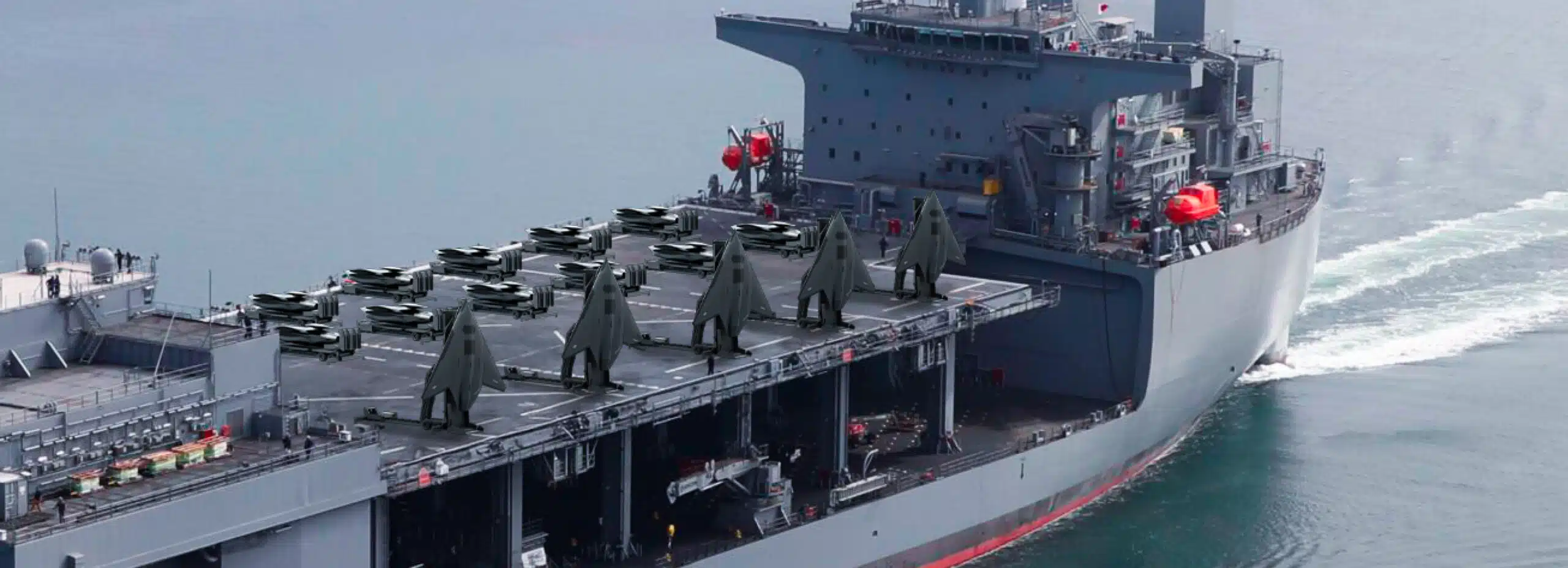
The U.S. Navy has executed a $150 million modification to its Other Transaction (OT) agreement with Shield AI to advance X-BAT, the company’s AI-piloted, vertical takeoff and landing (VTOL) fighter, Shield AI announced on October 8, 2026. The San Diego-based firm will match the award with $150 million of its own capital, bringing announced public and private commitments to the program to $400 million.
The award lands two months after the Department of the Navy’s Portfolio Acquisition Executive (Aviation) Rapid Capability Cell, working with the Defense Innovation Unit (DIU), committed $50 million to X-BAT under the Runway Independent Maritime Expeditionary Strike (RIMES) effort, a sum Shield AI also matched. RIMES seeks long-range strike aircraft that Combatant Commanders can launch and recover from ships, islands and austere sites, a requirement driven by the vulnerability of fixed runways to long-range precision fires in the Western Pacific.
How the Shield AI X-BAT Funding Stack Reached $400 Million
The new money does not come from a Navy aviation account. The Navy executed the modification with funds from the Office of the Under Secretary of War for Acquisition and Sustainment, drawn from its Defense Exportability Features (DEF) program. DEF pays for the engineering work needed to design export-ready configurations early in a program’s life: anti-tamper protection, safeguards for critical program information and differential capability sets for foreign customers. Federal law allows the department to share those costs with the contractor.
Both modifications sit on the same OT agreement, the prototyping vehicle that lets the services bypass traditional Federal Acquisition Regulation contracting. The resulting split is even: $200 million in government funding against $200 million in Shield AI capital. That structure gives the Navy and DIU a stake in an unflown, fighter-class aircraft while Shield AI, reportedly valued at $12.7 billion, absorbs much of the development risk.
Shield AI says roughly 500 engineers across the company and key suppliers, including GE Aerospace, are building flight-test aircraft. The team has completed engine light-off, integrated the thrust-vectoring nozzle and validated weapons bay aerodynamics in low- and high-speed wind-tunnel testing. Armor Harris, Shield AI’s senior vice president of aircraft, said the team is “testing early and often” while maturing the airframe, mission systems, ship suitability and production in parallel.
Range, Payload, and Propulsion: Inside the X-BAT Tail-Sitter Design
X-BAT is a tail-sitter. It rises vertically from a towed launch-and-recovery trailer, transitions to wing-borne flight, then lands tail-first on the same rail. Publicly available specifications indicate an airframe about 26 feet long with a 39-foot wingspan, a service ceiling above 50,000 feet and a range exceeding 2,000 nautical miles. Shield AI cites an objective combat radius of 1,000 nautical miles. Top speed has not been disclosed.
Propulsion explains the ambition. X-BAT uses the GE Aerospace F110-GE-129, the afterburning turbofan of the F-15 and F-16 families, rated in the 29,000-pound-thrust class according to publicly available engine data. It is paired with the Axisymmetric Vectoring Exhaust Nozzle (AVEN), first flown on an experimental F-16 in the 1990s. That thrust margin makes vertical lift-off possible and places X-BAT in a different weight class from the Air Force’s Collaborative Combat Aircraft (CCA) Increment 1 designs, the General Atomics YFQ-42A and Anduril YFQ-44A, which are runway-dependent and powered by business-jet-class turbofans.
Shield AI says internal weapons bays comparable in size to the F-35’s will carry stores up to the 2,000-pound class, and that the aircraft will support power-intensive electronic warfare and intelligence, surveillance and reconnaissance (ISR) payloads. A redesign shown in April 2026 replaced the original cranked-kite planform with a sharper arrowhead and added a dorsal auxiliary inlet for vertical flight. Hivemind, the company’s autonomy software, flies the aircraft without reliance on GPS or continuous communications. J.J. “Yank” Cummings, Shield AI’s head of Navy mission solutions and a former commanding officer of USS Gerald R. Ford (CVN 78), said X-BAT is designed to add combat power from carriers, amphibious assault ships and Expeditionary Sea Bases “without compromising existing operations.”
Exportability Funding, the Greek MoU, and X-Forge 3 Production
On October 8, Shield AI also signed a memorandum of understanding (MoU) in Athens with GEK TERNA, Greece’s largest critical infrastructure investor, to jointly pursue X-BAT parts production, aircraft integration and long-term sustainment in Greece. The companies envision a local program office, a Greek supplier base and a regional training and maintenance hub serving Cyprus, the Balkans and Southeastern Europe. Workshare remains subject to definitive agreements still under negotiation, and Athens has made no procurement commitment.
Greece already operates Shield AI’s V-BAT, and the Hellenic Army expanded that fleet in June 2026 for maritime surveillance over the Aegean. A runway-independent strike aircraft fits a country defending hundreds of islands with few, exposed airstrips. At home, Shield AI selected Des Moines, Washington, on September 30, 2026, for X-Forge 3, a 420,000-square-foot production facility due for completion in spring 2027. Production is planned to begin in 2029, with flight testing and sustainment based in Kansas.
Analysis: Routing DEF money into X-BAT before first flight shows the Pentagon treating the aircraft as a prospective allied product, not solely a Navy experiment. Designing anti-tamper features and releasable capability sets into a prototype costs far less than retrofitting them after a production decision, and it shortens the path to Foreign Military Sales once a U.S. program of record exists. The technical risk remains substantial. No afterburning, tail-sitting jet has ever entered combat service, and shipboard exhaust management, payload-range penalties in vertical flight and a reported $27 million unit price target all remain unproven.
Shield AI plans tethered testing followed by free-flight VTOL trials, with first flight targeted before the end of 2026 and full mission capability projected for 2028. The next indicators are whether the Navy or DIU fund a follow-on RIMES phase or a shipboard trial, whether X-BAT appears in future budget requests, and whether Greece converts the GEK TERNA framework into a government commitment. The Navy has not disclosed planned quantities or a transition path to a program of record.